Shutting down a data center can feel like a chaotic, high-stakes project. But with a structured data center decommissioning process, you can turn what seems like a logistical nightmare into a secure, compliant, and even profitable transition for your business. It's the only way to get it done right.
Why a Structured Decommissioning Process Is Non-Negotiable
Trying to decommission a data center without a detailed plan is a risk no business can afford. Companies start these projects for all sorts of reasons—moving to the cloud, consolidating facilities after a merger, or just upgrading old tech. No matter the reason, the core challenge is the same: retiring old IT assets without putting sensitive data at risk.
Without a solid process, it's easy for assets holding customer or company data to get lost in the shuffle. A single misplaced server can lead to a massive data breach, and the cost to your finances and reputation will be far greater than any money you thought you saved by cutting corners.
The Core Drivers for Decommissioning
These commercial projects usually kick off for one of several key reasons, and each comes with its own set of challenges.
- Cloud Migration: As services move to providers like AWS, Azure, or Google Cloud, the on-premise hardware that once supported them becomes obsolete.
- Facility Consolidation: Mergers and acquisitions often lead to closing entire data centers to streamline operations and real estate.
- Technology Refresh Cycles: When servers, storage arrays, and network gear reach their end-of-life, you need a systematic way to remove and replace them.
- Cost Reduction: Downsizing a physical data center footprint can create huge savings on power, cooling, and maintenance for your enterprise.
This whole process can be broken down into three main phases: planning, destruction, and recovery.
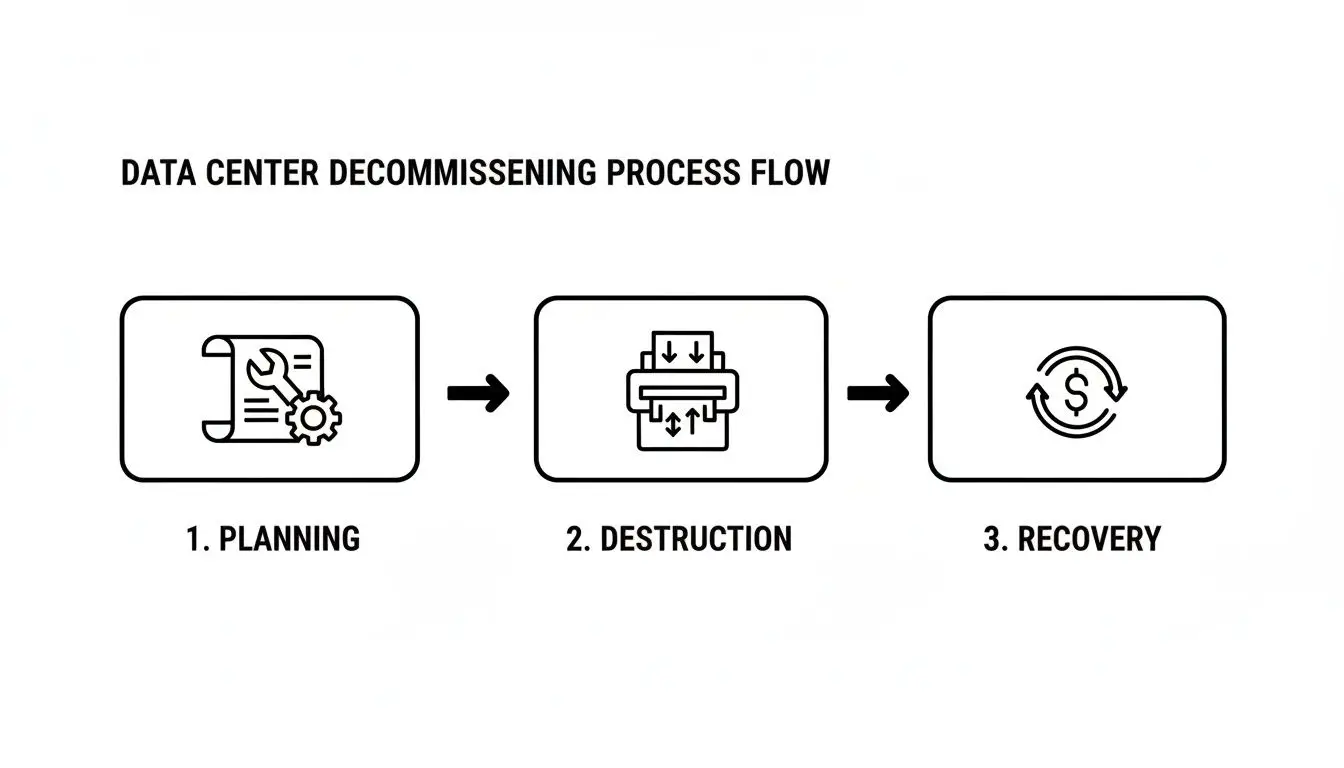
As you can see, success really comes down to nailing each of these stages, from the initial strategy all the way to the final asset disposition.
To help you get started, here is a quick overview of what each phase entails.
| Phase | Primary Goal | Key Activities |
|---|---|---|
| Phase 1: Planning & Strategy | Create a detailed project roadmap | Asset inventory, dependency mapping, risk assessment, selecting an ITAD partner |
| Phase 2: Execution & Destruction | Securely decommission assets and destroy data | On-site de-racking, secure logistics, data wiping or physical shredding, documentation |
| Phase 3: Recovery & Reporting | Recover value and finalize compliance reporting | Asset resale/buyback, responsible e-waste recycling, issuing Certificates of Destruction |
Each phase builds on the last, ensuring a seamless and secure project from start to finish.
Mitigating Risk and Ensuring Compliance
A formal process is your best defense against steep fines and legal trouble. Regulations like the FTC Disposal Rule and HIPAA have strict rules for data sanitization and e-waste disposal. You simply can't afford to get it wrong.
A professional IT Asset Disposition (ITAD) partner is your guide through this complex regulatory world. They bring the certified processes and documentation needed to prove compliance and, just as importantly, transfer liability away from your company.
This approach gives you a clear chain of custody for every single asset. From the moment a server is unplugged to its final recycling or resale, its entire journey is tracked and verified. This detailed record-keeping is critical during audits and proves you’ve done your due diligence. Using a thorough vendor due diligence checklist is a great way to make sure you pick a partner who can meet these standards.
Ultimately, a well-run decommissioning project is more than just managing risk. It’s a chance to recover real value from your old equipment through IT buyback programs, turning a cost center into a revenue generator. This guide will give you the roadmap to get there.
Crafting Your Decommissioning Blueprint and Asset Inventory
The success of any data center decommissioning rides on the quality of your initial planning and inventory. This is the foundation where you hammer out the project's scope, timeline, and who's accountable for what. A misstep here can cause a domino effect of problems, from blown budgets to serious security holes.
Think of it as the blueprint for a complex build. You wouldn't break ground without detailed plans, and the same logic applies here. This blueprint defines what a successful outcome looks like and dictates how every single asset is handled from the moment it's unplugged to its final destination.
Putting together a solid decommissioning blueprint and an exact asset inventory are the first, most critical steps. It’s a lot like using a comprehensive moving out checklist for a big move—it ensures nothing important gets missed. The aim is to eliminate any and all ambiguity.
Defining Your Project Scope and Timeline
First things first, you need to clearly define the project's boundaries. Are you clearing out an entire data hall, just a few rows of racks, or a small server closet? The scope has a direct impact on the budget, the resources you'll need, and the timeline.
A realistic timeline is absolutely essential. You have to factor in potential delays, like coordinating between different departments or waiting on security approvals. A rushed job is a breeding ground for mistakes and overlooked assets.
- Small Projects (e.g., 5-10 racks): These can typically be wrapped up in a few days to a week.
- Medium Projects (e.g., a data hall): These might take several weeks, based on how dense the racks are and the data destruction requirements.
- Large Projects (e.g., an entire data center facility): A project this size can easily span several months, demanding serious project management and a phased approach.
Bringing in your ITAD partner from day one is a game-changer. An experienced provider like Beyond Surplus can help you set an achievable timeline based on hundreds of similar projects, making sure you account for every little dependency along the way.
The Critical Role of Asset Inventory and Tagging
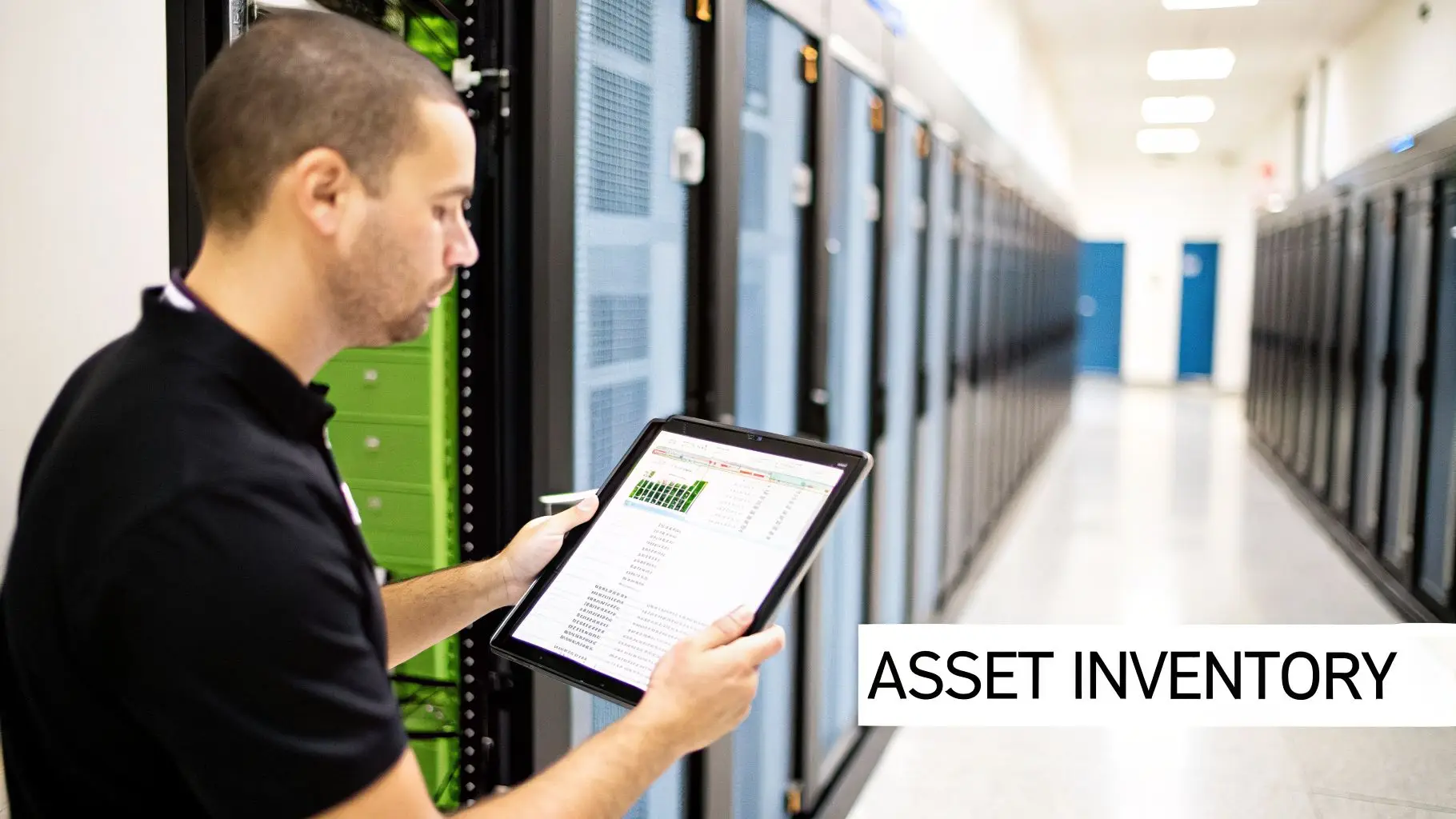
Your asset inventory is the bedrock of a secure chain of custody. It's a meticulous, non-negotiable process where you identify, catalog, and tag every single piece of equipment on its way out. This isn’t just about the big-ticket items like servers and storage arrays; it includes everything from network switches and firewalls down to the racks and cables.
A detailed asset inventory is your single source of truth. It's the master list that ensures every asset, especially those containing sensitive data, is tracked from the moment it’s unplugged until its final destruction or resale. Without it, you are flying blind.
The process involves systematically capturing a few key details for each and every item.
Essential Inventory Data Points:
- Unique Asset Tag: Your own internal tracking number.
- Serial Number: The manufacturer's unique identifier.
- Make and Model: Be specific, like "Dell PowerEdge R740".
- Physical Location: The exact rack and U-position where it lived.
- Data-Bearing Status: A simple but critical "Yes" or "No" to flag which assets need data destruction.
This detailed documentation is your safeguard. When an auditor eventually asks for proof of destruction for a specific hard drive, you can point directly to its entry in the inventory, which gets reconciled against the final Certificate of Data Destruction. This granular tracking is a core piece of effective IT asset lifecycle management and is fundamental to mitigating risk. Using inventory management software or even a well-organized spreadsheet can make this vital phase much more manageable.
Getting Data Destruction Right: Your Last Line of Defense
Once your asset inventory is locked down, we move to the most critical, high-stakes part of the entire decommission: data destruction. This is where a single mistake can unravel everything. An improperly wiped drive is a ticking time bomb for a data breach, and in today's world, that can easily put a company out of business.
Secure data destruction is not optional. It’s a core requirement to protect your customers, your proprietary information, and your reputation. This is exactly why the Data Center IT Asset Disposition market is booming, from $12.0 billion in 2024 to a projected $27.38 billion by 2032. The driving force? The absolute need for certified data sanitization to meet regulations like GDPR, HIPAA, and the FTC Disposal Rule.
Considering that data breaches from improperly disposed assets will cost companies an average of $4.88 million in 2025, bringing in a professional partner is a no-brainer. You can find more analysis on these market trends on Data Insights Market.
On-Site vs. Off-Site Destruction: What's the Best Fit?
The right approach to data destruction really depends on your company's security needs, compliance mandates, and how much risk you're willing to accept. It boils down to a few key options, each with its own pros and cons.
- On-Site Data Wiping: Technicians bring specialized software to your facility to overwrite every bit of data on your hard drives and SSDs. The big advantage here is that the hardware is preserved, which means you can resell it and recover maximum value.
- Off-Site Data Wiping: Your assets are securely transported to a certified ITAD facility, where the wiping process takes place. This is a great way to clear floor space quickly, but it puts a huge emphasis on maintaining a perfect chain of custody during transport.
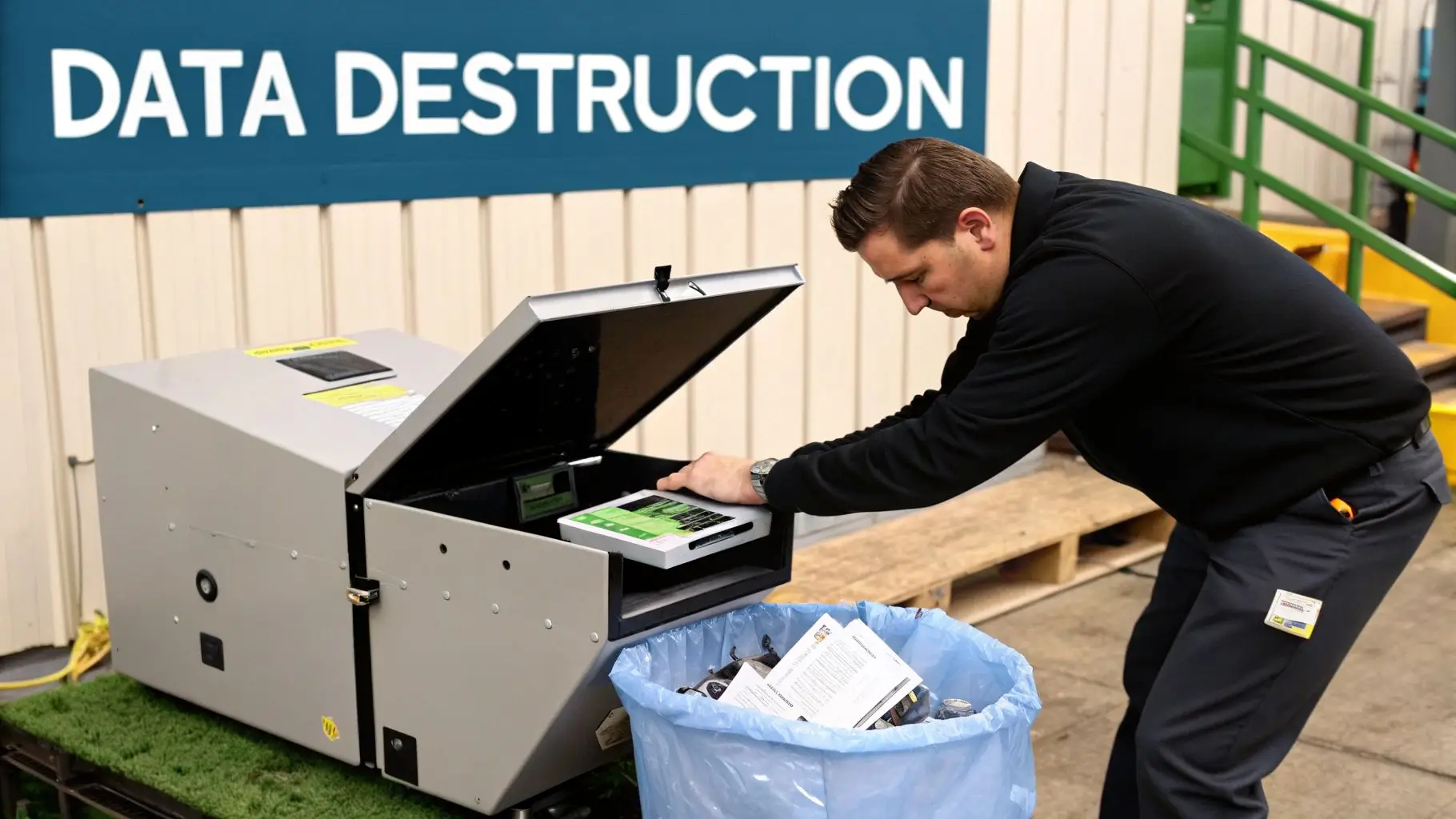
- On-Site Physical Destruction (Shredding): This is the ultimate in data security. A mobile shredding truck comes right to your location, and you can watch your drives and other media get turned into tiny, unrecoverable fragments. For government, healthcare, or financial data, this is often the only acceptable method.
Sticking to the NIST 800-88 Standard
When it comes to data sanitization, the industry playbook is NIST Special Publication 800-88. It's the framework everyone trusts to ensure data is truly gone for good.
NIST 800-88 outlines three distinct methods for sanitization:
- Clear: This uses basic software to overwrite data. It’s okay for low-risk information, but a determined person with the right tools could still potentially recover something.
- Purge: A much more robust method. This involves things like cryptographic erasure or multiple, complex overwrites that make data recovery practically impossible. This should be the minimum standard for most business data.
- Destroy: The final word in data destruction. This means physically destroying the media by shredding, incinerating, or even melting it. Once destroyed, there's nothing left to recover.
Any ITAD partner worth their salt, including Beyond Surplus, builds their entire process around these rigorous standards. For a deeper dive, check out our guide on NIST SP 800-88. Following these guidelines isn't just about best practices—it’s how you prove you did your due diligence if an auditor ever comes knocking.
The All-Important Certificate of Data Destruction
No matter which method you choose, the job isn't finished until you have a Certificate of Data Destruction in hand. This document is far more than just a receipt; it’s a critical legal record.
Here’s why it’s so important:
- It Transfers Liability: The certificate is your proof that legal responsibility for the data has officially been transferred from your company to your ITAD vendor.
- It Creates an Audit Trail: It meticulously lists the serial numbers of every single drive that was sanitized or destroyed, tying directly back to your project inventory.
- It Guarantees Compliance: For auditors, this certificate is undeniable proof that you followed all necessary regulations like HIPAA or the FTC Disposal Rule.
For any organization handling sensitive information, this certificate is your shield. It proves you took every required step to protect that data, effectively closing the loop on the most risk-heavy part of your data center decommissioning project.
Managing Logistics for De-Installation and Secure Transport
Once your data is gone for good, the project shifts from wiping drives to wrenching servers. This is where the heavy lifting begins, and the logistical side is just as critical as the data security steps you just completed. Messing up the physical removal can lead to damaged equipment, on-site accidents, or a broken chain of custody.
The work of de-installing hardware is a specialized skill. It's far more than just yanking plugs. It requires a disciplined process for safely disconnecting power distribution units (PDUs), untangling complex network cabling, and carefully extracting every server, switch, and storage array. Each move has to be planned and executed perfectly.
The Fine Art of De-Racking and Safe Disconnection
Getting gear out of the data center is a delicate dance. Servers are heavy and awkward, and pulling them from crowded racks without scratching them or hitting adjacent equipment is a real challenge. This is especially true for any assets you hope to resell, where even cosmetic damage can tank their value.
A professional crew will follow a strict, practiced routine.
- Power Down and Disconnect: All power and network cables are safely removed. Often, these are bundled separately for bulk recycling.
- Systematic De-Racking: Technicians un-mount assets in a specific order, usually starting from the top to keep the rack stable and safe.
- On-Site Staging: Equipment is then moved to a dedicated area for packing. Here, it’s checked one last time against the master inventory list.
This is where an experienced, dedicated on-site team really proves its worth. They know the ins and outs of data center environments—from raised floors to overhead cable trays—and can run the operation smoothly from start to finish.
Packing for Value and Secure Transport
How your assets are packed is just as important as how they’re removed. Tossing servers onto a pallet is a surefire way to lose thousands in resale revenue. You need proper packing to protect the equipment during its journey and preserve its value.
A secure, unbroken chain of custody doesn't end at your loading dock. It has to extend all the way to your ITAD partner's processing facility. Any gap in that chain is a risk.
This is a huge reason to work with an ITAD vendor that manages its own logistics. When a company like Beyond Surplus uses its own fleet or deeply vetted transport partners, you get a single chain of command. The same people who know the value of your assets are the ones responsible for getting them there safely.
This unified approach gives you several critical advantages:
- Unbroken Chain of Custody: No third-party handoffs where assets could get lost or mishandled.
- Specialized Handling: Drivers and movers are trained specifically to handle sensitive and high-value IT gear.
- Secure, Tracked Vehicles: Shipments are tracked with GPS in real-time, and trucks are sealed to prevent any tampering.
- Constant Reconciliation: Every tagged asset is scanned as it's loaded onto the truck and scanned again upon arrival, ensuring nothing goes missing.
Coordinating the pickup, managing on-site safety for the crew, and ensuring every single tagged piece of equipment makes it onto the truck takes a solid plan. This careful handling of the physical exit strategy minimizes disruption and plugs any security holes, paving the way for a successful project completion.
Maximizing Value Recovery and Sustainable E-Waste Recycling
Once the heavy lifting of de-installation and transport is done, your data center decommissioning project moves into its final—and most crucial—phase. This is where those retired IT assets stop being a logistical problem and start becoming a source of revenue and proof of your company's commitment to sustainability. The focus here isn't just about getting rid of old gear; it's about smart disposition.
The conversation naturally shifts from mitigating risk to creating value and acting responsibly. Every server, switch, and storage array that leaves your facility has one of two possible fates: resale on the secondary market or certified, eco-friendly recycling. A good ITAD partner handles both, making sure you get the most money back while sticking to the highest environmental standards.
Turning Retired Hardware into Revenue with IT Buyback
Too many IT managers write off old equipment as a sunk cost or, even worse, a pile of e-waste waiting for a hauler. The reality is that a good chunk of that decommissioned hardware still has significant value. The IT buyback process is how you tap into that hidden revenue, turning a budget liability into a welcome credit.
An ITAD partner like Beyond Surplus will systematically go through your assets to figure out their Fair Market Value (FMV). This isn't just guesswork; it's a detailed process.
- Testing and Auditing: Technicians get hands-on, testing every key component—CPUs, RAM, storage drives, and GPUs—to make sure they work as they should.
- Cosmetic Grading: The physical condition of the equipment is carefully checked. Scratches and dents can affect resale value, so this step is important.
- Market Analysis: The partner uses real-time market data to see what your assets are actually worth based on current supply and demand.
Not all hardware is the same when it comes to value. You’ll typically see the highest returns from newer servers (3-5 years old), enterprise networking gear from brands like Cisco or Arista, and high-capacity storage arrays. A transparent partner will give you a detailed report showing the value of each item, any processing costs, and the final amount you'll get back.
The Imperative of Certified E-Waste Recycling
For assets that are too old, broken, or proprietary to be sold, recycling is the only option. But this is where you have to be careful. Handing over your e-waste to the cheapest scrap hauler is a recipe for disaster. It can lead to environmental fines and serious brand damage if that equipment ends up in a landfill overseas.
This is precisely why choosing a partner with R2v3 or e-Stewards certifications is non-negotiable. These certifications are the gold standard for a reason.
A certified recycler provides a secure chain of custody and guarantees that all hazardous materials—like lead, mercury, and cadmium—are handled and disposed of according to strict environmental laws. It's the only way to know for sure your e-waste isn't becoming part of a global problem.
This push for sustainability is changing everything. The data center decommissioning market, valued at $5 billion in 2025, is expected to jump at a 12% CAGR to more than $15 billion by 2033. This growth is fueled by the urgent need for responsible e-waste management. With global e-waste projected to grow from 59 million tons in 2024 to 75 million by 2030, the pressure is on. Some forward-thinking providers are now using robotics and AI to automate dismantling, with some partners recovering up to 98% of materials like copper and gold for the circular economy. You can dive deeper into these trends in this detailed service report.
When you work with a certified recycler, you’re not just following the law; you're also boosting your company’s Environmental, Social, and Governance (ESG) credentials. You’ll receive a Certificate of Recycling that documents the responsible end-of-life journey of your assets, giving you an auditable record that proves your organization did the right thing. This final step closes the loop on your project, blending financial gain with environmental integrity.
Finalizing Your Project with Comprehensive Reporting and Audits
The physical work might be done, but a decommissioning project isn't truly finished until the paperwork is signed, sealed, and delivered. This final stage is all about creating a complete, auditable record of the entire process. This documentation is your ultimate proof of compliance and the final step in officially transferring liability.
Think of this closing phase as your most critical risk management tool. Without this paper trail, you have no verifiable way to prove you met all regulatory and environmental requirements if an auditor comes knocking.
Essential Documentation for Compliance
Your ITAD partner has a non-negotiable obligation to provide a final package of documents that closes the loop on every single asset. These are the records you'll need to archive and have ready for any future audits.
Here's what that package absolutely must include:
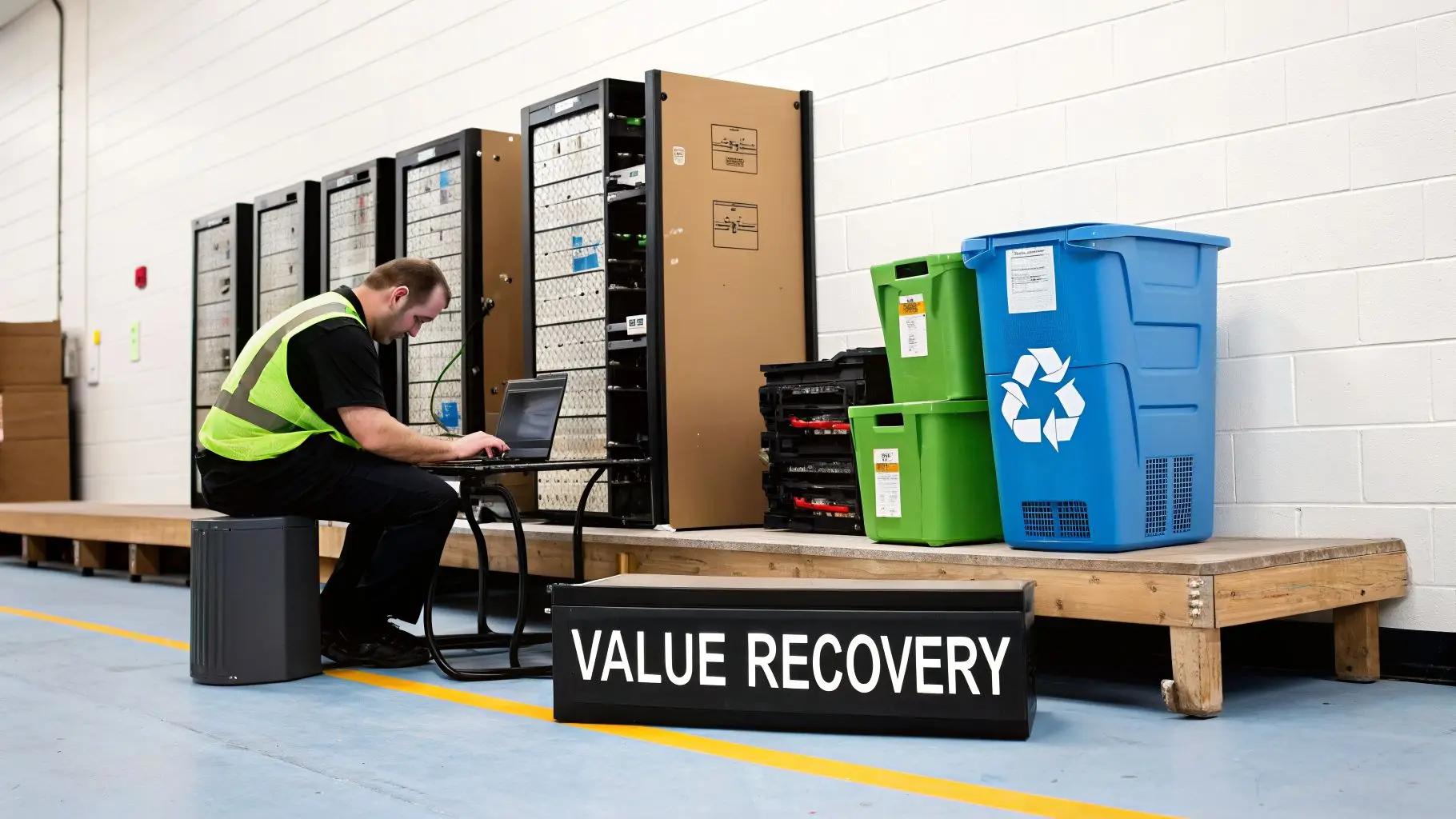
- Inventory Reconciliation Report: This detailed report is the master document. It matches every asset from your initial inventory list against its final disposition—whether it was resold, recycled, or physically destroyed.
- Certificates of Data Destruction: This is the legal proof that all your data-bearing devices were sanitized or destroyed according to standards like NIST 800-88. It should list every single hard drive by its serial number.
- Certificates of Recycling: This document proves that all non-reusable assets were processed by a certified recycler in an environmentally responsible and compliant manner.
Together, these records serve as your ironclad defense, proving due diligence was performed at every step of the project.
The global data center decommissioning market is seeing explosive growth, valued at around $12.12 billion in 2025 and projected to hit $19.94 billion by 2032. This surge is largely fueled by the rapid adoption of AI and cloud computing, which accelerates IT hardware obsolescence and makes a professional, documented strategy more critical than ever. In North America, strict regulations from bodies like the FTC and EPA have made these comprehensive reporting practices standard procedure. You can explore more on these trends in CBRE's research on global data centers.
Common Questions About Data Center Decommissioning
When it's time to decommission a data center, a lot of questions come up. IT managers, facility managers, and business owners are right to be concerned about security, cost, and timelines. Getting straightforward answers is the first step to planning a project that runs smoothly and securely.
Here are some of the most common questions we hear from clients planning a data center teardown.
How Long Will Our Decommissioning Take?
This is the classic "it depends" question, and for good reason. The timeline for a decommissioning project shifts dramatically based on the size and complexity of the job. There's really no one-size-fits-all schedule.
A small server closet with a few racks? We could be in and out in just a couple of days. But a massive enterprise data center with hundreds of servers, storage arrays, and network switches is a different beast entirely. That often requires a careful, phased approach that can span several weeks or even months.
A few key things will influence your project's timeline:
- The sheer number of assets: More servers, switches, and racks simply take longer to catalog, de-install, and process.
- Data destruction methods: On-site physical shredding, for instance, often takes more time to schedule and execute than software-based wiping.
- Logistical hurdles: We always account for things like building access hours, elevator availability, and how far assets need to travel to the loading dock. They all add up.
A good ITAD partner will map all this out with you during the planning stage to build a realistic schedule. This ensures there are no surprises once the project kicks off.
What's the Most Important Thing to Look for in a Partner?
While things like cost and speed are definitely on the list, the single most important factor when you're choosing a decommissioning partner is their security and compliance certifications.
You have to partner with someone who can prove they know what they're doing when it comes to secure data destruction and environmentally sound recycling. Look for top-tier certifications like R2v3 or e-Stewards. These aren't just fancy logos; they are your guarantee that the vendor follows strict, audited standards for data security and environmental responsibility.
When you're vetting a potential vendor, don't be shy. Ask to see sample documentation. A trustworthy partner will have no problem showing you examples of their Certificates of Data Destruction, Certificates of Recycling, and detailed inventory reports. This transparency is your proof that their process is professional, auditable, and completely transfers liability away from your organization while guaranteeing compliance with rules like the FTC Disposal Rule.
Can We Actually Make Money from Our Old Equipment?
Absolutely. It’s a common misconception that old data center gear is just junk. In reality, recovering financial value from retired IT assets is a major benefit of a professionally managed decommissioning.
Hardware that isn't ancient often holds significant resale value. We typically see strong returns on:
- Servers and networking gear from the last 3-5 years.
- High-capacity enterprise storage arrays and their components.
- Modern GPUs, FPGAs, and other specialized processors.
Your ITAD partner will test and grade these assets to determine their fair market value. You should receive a transparent report showing exactly how much value was recovered, which can be a great way to offset project costs and put money back into your IT budget.
Contact Beyond Surplus for certified electronics recycling and secure IT asset disposal. For a partner with proven expertise in secure, compliant, and profitable projects across the United States, Learn more about our services.