What are data center decommissioning services? This is the expert-led process for securely and efficiently retiring a business's IT infrastructure. It's a comprehensive project that covers everything from inventorying assets and destroying data to physically removing equipment and ensuring it's recycled responsibly. Professional decommissioning transforms a potential operational headache into a managed, secure, and financially sound transition for your enterprise.
Deconstructing Data Center Decommissioning
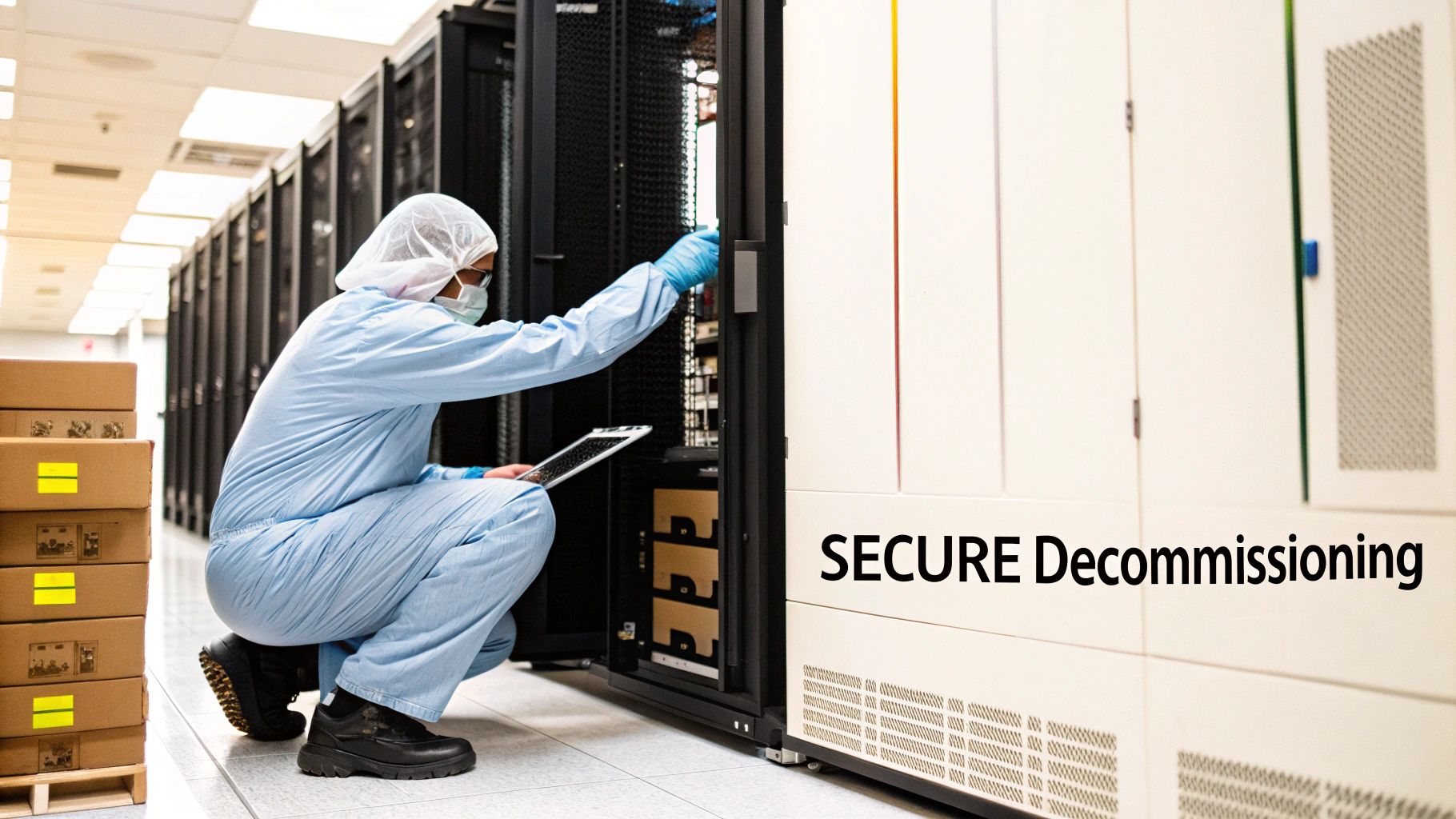
Decommissioning a corporate data center is a strategic, multi-stage project designed to methodically retire the critical IT infrastructure that powers a business. The process goes far beyond just unplugging servers; it is a vital part of the IT lifecycle that directly impacts your company's security, compliance, and bottom line. It's a critical service for any business navigating a cloud migration, technology refresh, or facility consolidation.
For any business undergoing this transition, professional data center decommissioning services are essential. A certified partner ensures that every single asset, from the smallest hard drive to the largest server rack, is accounted for, sanitized, and disposed of according to strict industry standards.
Core Components of Decommissioning
A proper decommissioning project is built on several key pillars that work in tandem to minimize risk and maximize any recoverable value. A professional partner executes these stages with precision, providing a clear, auditable trail from beginning to end.
- Strategic Planning and Asset Inventory: Before a single cable is unplugged, a meticulous plan is created. This starts with a detailed inventory of every server, switch, PDU, and cable, establishing a clear baseline for the entire project.
- Certified Data Destruction: This is the most critical security phase. All data-bearing devices undergo certified data erasure or physical destruction, ensuring no sensitive corporate information can ever be recovered.
- Physical De-installation and Removal: Trained technicians safely disconnect, de-rack, and remove all hardware from the facility. They handle all complex logistics without disrupting any remaining business operations.
- Environmentally Compliant Recycling: After all data is secured, any non-reusable assets are recycled according to strict environmental standards like R2v3, preventing hazardous e-waste from entering the waste stream.
To help visualize how these pieces fit together, here's a quick look at the typical project flow for commercial clients.
Key Phases of Data Center Decommissioning
| Phase | Objective | Key Activities |
|---|---|---|
| 1. Planning & Discovery | Establish project scope and create a detailed asset inventory. | Site walk-through, asset tagging, project timeline development. |
| 2. Data Destruction | Eliminate all corporate data securely to prevent breaches. | On-site/off-site data erasure, physical shredding, certification. |
| 3. De-Installation & Logistics | Safely remove all hardware from the commercial facility. | De-racking servers, disconnecting power/network, packing assets. |
| 4. Processing & Disposition | Sort, test, and process assets for reuse or recycling. | ITAD evaluation, sorting for remarketing, responsible e-waste recycling. |
| 5. Reporting & Certification | Provide complete documentation for compliance and auditing. | Chain-of-custody records, certificates of data destruction, recycling reports. |
Each stage is crucial for ensuring a secure and compliant outcome, transforming a complex corporate task into a manageable process.
A Rapidly Growing Market
The need for these specialized services is booming. The global data center decommissioning services market, currently valued at around $5 billion, is projected to explode to over $15 billion by 2033. That’s a powerful compound annual growth rate (CAGR) of 12%. This growth is driven by the rapid obsolescence of IT hardware as companies upgrade and increasingly tough data security regulations demanding proof of secure disposal.
Decommissioning is not an IT cost center; it's a risk management strategy. Properly executed, it protects a company's most valuable asset—its data—while ensuring compliance and supporting sustainability goals.
This structured approach is a core part of a bigger strategy known as IT Asset Disposition (ITAD). The goal of ITAD is to manage the end-of-life for technology in a way that is secure, sustainable, and financially smart. To get a better handle on this framework, you can explore our detailed guide on what IT Asset Disposition is and why it matters. By partnering with experts, businesses can turn a potential liability into a well-managed process that secures data, meets regulations, and recovers value.
Why Professional Decommissioning Is Non-Negotiable
Attempting to handle a data center decommissioning in-house is a massive risk for any business. Bringing in professional data center decommissioning services isn’t a luxury; it’s a foundational requirement for any company that values its data, reputation, and bottom line. The entire process rests on three pillars: ironclad security, strict regulatory compliance, and responsible sustainability. A failure in any one of these areas can lead to significant financial and reputational damage. A single improperly wiped drive can spiral into a multi-million dollar data breach, while ignoring environmental rules can lead to hefty fines and permanent damage to a corporate brand.
The High Cost of Inadequate Data Security
In a decommissioned data center, every single server, storage array, and networking switch is a potential landmine of sensitive corporate information. This includes customer data, intellectual property, employee records, and financial details. An internal approach often misses the sophisticated methods needed for permanent data erasure, leaving behind residual data that a determined actor can easily recover.
The true cost of a data breach isn't just the immediate financial penalty. It's the long-term erosion of customer trust, the damage to your brand's reputation, and the competitive disadvantage you face when your secrets fall into the wrong hands.
Professional decommissioning takes this risk off the table with certified and auditable processes. Simply formatting a drive or hitting "factory reset" is not enough for commercial-grade security. Experts use methods that meet the highest industry standards, ensuring that data is gone for good. To understand what's involved, businesses need to grasp the specifics of professional security and data destruction services, which are the bedrock of any secure decommissioning project.
Navigating the Complex Web of Compliance
Modern businesses operate under a dense fog of data protection and environmental regulations. Navigating these rules without a specialist is a direct path to non-compliance. Several key regulations directly dictate how business IT assets must be handled at end-of-life.
- FTC Disposal Rule: This federal rule requires businesses to take reasonable measures to protect consumer information during disposal. Failure to comply can result in serious legal action and financial penalties.
- HIPAA: For any organization that handles protected health information (PHI), HIPAA’s rules extend to the disposal of electronic media. An improperly decommissioned server from a healthcare provider could trigger a massive breach and equally massive fines.
- State-Specific Regulations: On top of federal laws, many states have their own unique data privacy and e-waste laws, adding another layer of complexity for businesses to manage.
A certified partner provides the critical documentation—like Certificates of Data Destruction and detailed audit trails—that serves as legal proof of due diligence. This paperwork isn't just a formality; it's a shield against future claims of negligence, effectively transferring that liability away from your organization.
Aligning Decommissioning with ESG Goals
Today, stakeholders, investors, and customers demand corporate responsibility. How a company retires its technology speaks volumes about its commitment to Environmental, Social, and Governance (ESG) principles. Disposing of old servers improperly is not only environmentally reckless but also a significant missed opportunity. Professional decommissioning turns a potential e-waste problem into a powerful story of responsible corporate stewardship. Partnering with an R2v3 certified vendor ensures every component is either remarketed for reuse or recycled in an environmentally sound way. This approach helps an organization:
- Reduce its carbon footprint by giving viable IT equipment a second life.
- Prevent hazardous materials from contaminating the environment.
- Strengthen its brand reputation by demonstrating a tangible commitment to sustainability.
Ultimately, professional decommissioning is an essential business function that protects corporate assets, ensures legal compliance, and reinforces the values your company stands for.
Your Phased Decommissioning Project Checklist
Decommissioning a data center without a solid, phased checklist can quickly lead to security breaches, expensive delays, and compliance headaches. A structured approach turns this massive undertaking into a series of clear, manageable steps. This playbook is built for IT and facility managers, providing an actionable framework that walks you through the entire project lifecycle. By breaking it down into distinct phases—strategic planning, on-site execution, and off-site logistics—you can maintain control, minimize risks, and guarantee a smooth transition from start to finish.
Phase 1: Strategic Planning and Asset Discovery
The success of a decommissioning project is determined long before a single server is unplugged. This initial phase is all about careful planning, stakeholder alignment, and creating an ironclad inventory of every asset involved.
- Define Project Scope and Objectives: First, clarify the business goal. Are you consolidating facilities, migrating to the cloud, or refreshing technology? Secure buy-in from all stakeholders—IT, finance, facilities, and executive leadership—to establish a unified vision and budget.
- Conduct a Comprehensive Asset Audit: Create a detailed inventory of all equipment slated for decommissioning, including servers, storage arrays, networking gear, PDUs, and cabling. Every item must be tagged with its serial number, model, and location logged in a central database.
- Develop a Detailed Project Timeline: Map out every project stage with realistic deadlines. This schedule should cover everything from initial data migration and hardware disconnection to final logistics and reporting, preventing scope creep and keeping the team aligned.
Phase 2: On-Site Execution and Data Sanitization
This is where the hands-on work begins. As your data center is carefully dismantled, precision, security, and safety are paramount. Every byte of sensitive corporate data must be completely and permanently destroyed. This process is designed to tackle the three biggest business risks: security, compliance, and sustainability.
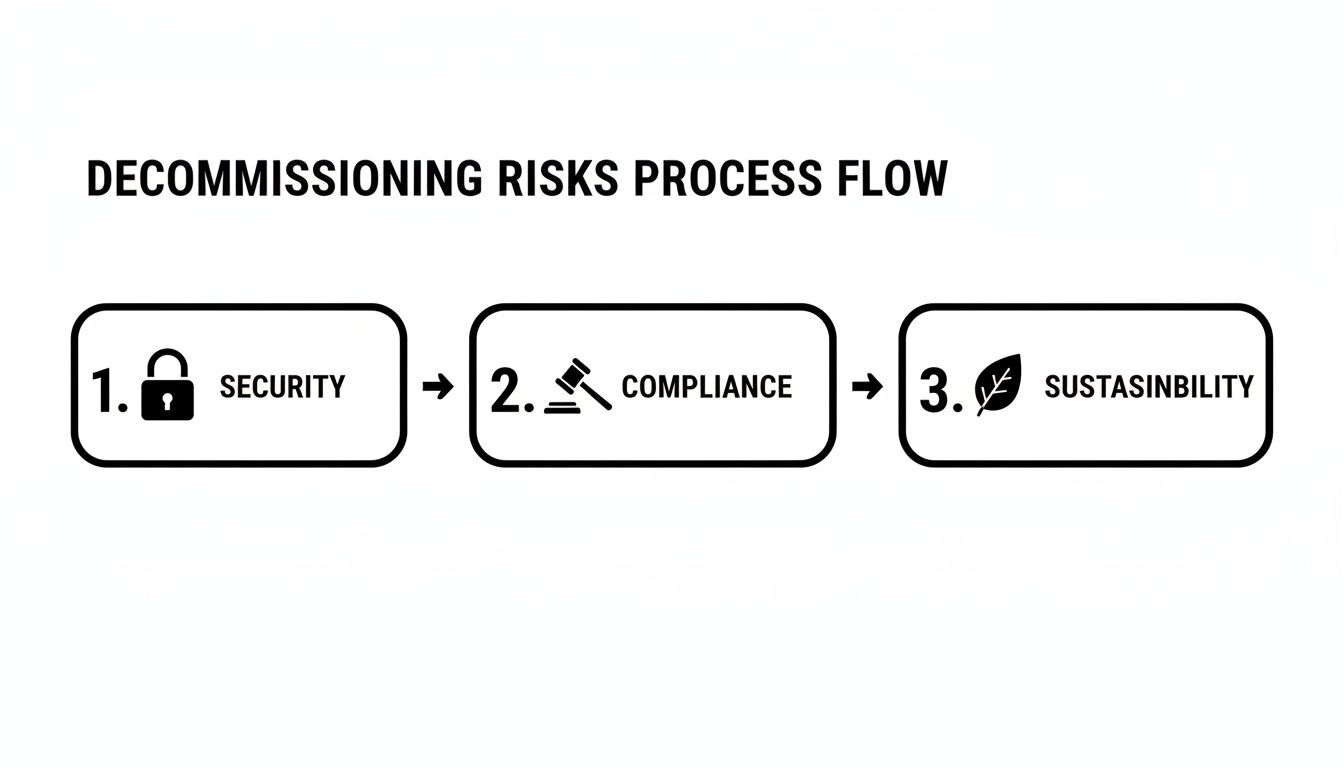
Each of these represents a critical area where professional oversight is the only thing standing between your business and potentially catastrophic financial and reputational damage.
Pro Tip: Never assume a factory reset or simple drive format is sufficient for business data. For true security, data destruction must be performed using certified methods that follow NIST 880-88 guidelines, providing an auditable Certificate of Data Destruction for every drive.
- Perform Certified Data Destruction: Execute data sanitization for all data-bearing devices, either on-site or off-site. Depending on security policy, this could mean multi-pass data wiping, degaussing, or physical shredding.
- Systematically Disconnect and De-Install Hardware: Following the project plan, trained technicians will safely power down and disconnect all equipment. This involves a careful process of de-racking servers, removing network components, and managing power and data cables.
- Package and Stage Assets for Transport: All decommissioned assets must be packed securely. Equipment should be palletized and shrink-wrapped to prevent damage during transit, ensuring every item from the initial inventory is accounted for before leaving the building.
Phase 3: Off-Site Logistics and Final Disposition
Once the hardware is out of your facility, the final and equally critical phase begins. This involves secure transportation, processing at a certified facility, and generating the final documentation needed for compliance, closing the loop on security and sustainability. This is not a niche service; it is a cornerstone of the modern IT landscape. The IT asset disposition market was valued at $10.93 billion and is expected to hit $23.66 billion by 2032, growing at a 10.2% CAGR. North America leads with a 41.35% market share, fueled by data center consolidations and a major push against e-waste. This process hinges on meticulous audits, recycling rates over 90%, and an unbroken, secure chain of custody.
- Secure Chain of Custody Transport: Use a logistics partner specializing in high-value electronics. This guarantees a secure, unbroken chain of custody from your door to the processing facility, complete with sealed, GPS-tracked vehicles.
- Asset Sorting, Testing, and Value Recovery: At the ITAD facility, assets are received and reconciled against the original inventory list. Technicians test equipment to identify components that can be remarketed, helping offset project costs through IT asset buyback programs.
- Responsible Recycling and Final Reporting: Anything with no resale value is responsibly recycled according to R2v3 standards. You will receive a comprehensive reporting package, including Certificates of Data Destruction, recycling certificates, and a detailed reconciliation of all assets. This paperwork is your proof of a secure, compliant, and sustainable project.
For a deeper dive into a related process, take a look at our complete data center migration checklist.
Turning Retired Assets Into Revenue
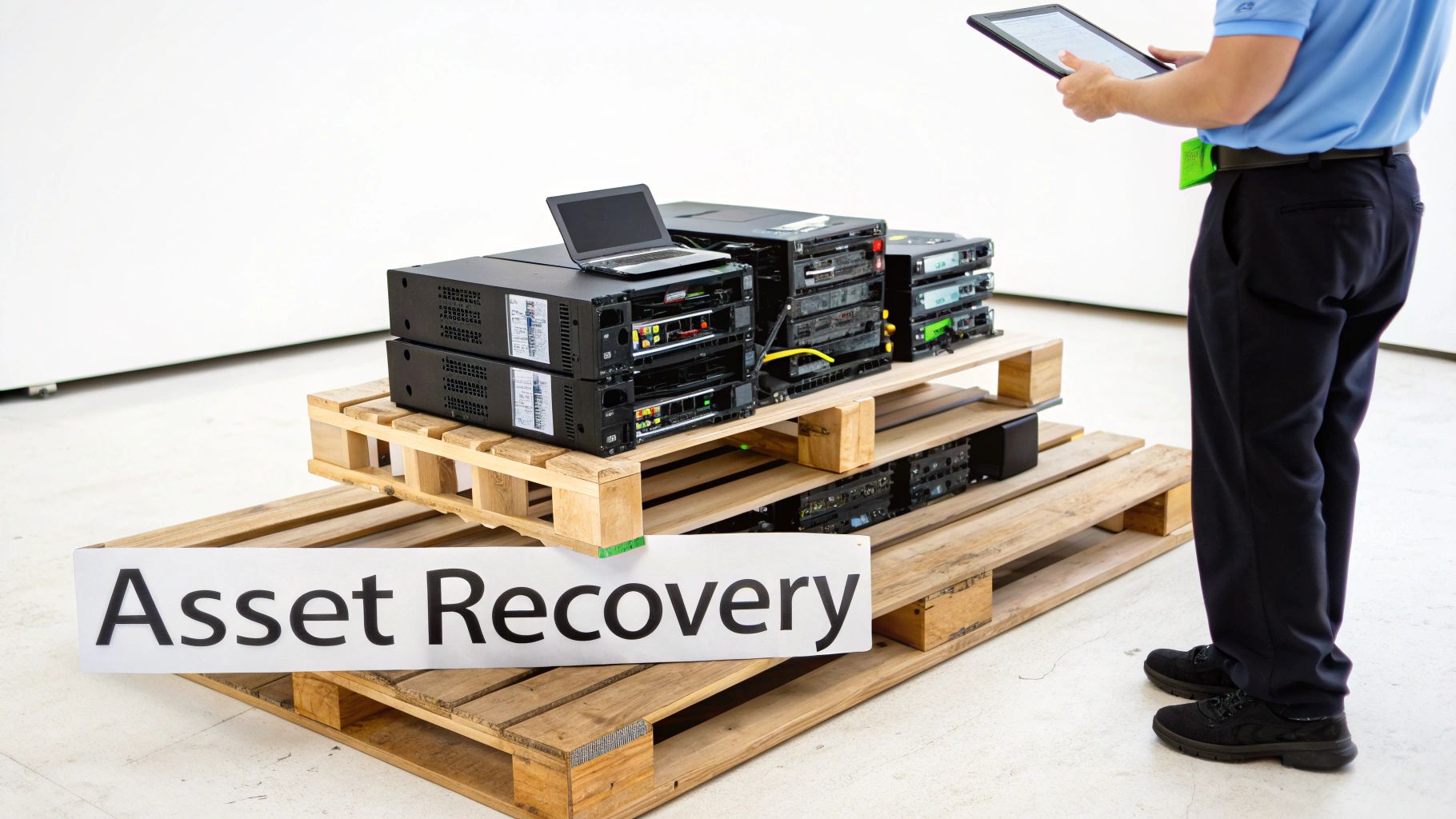
Many businesses view a data center decommissioning project as a significant cost. However, with the right strategy, your decommissioning project can not only pay for itself but actually generate a positive return. You can turn old, retired corporate hardware into a new revenue stream. The secret is integrating IT Asset Disposition (ITAD) directly into your decommissioning plan from day one. This is not about just disposing of old gear; it's about systematically extracting all remaining value from your servers, networking equipment, and storage arrays. It all comes down to identifying hidden value through an expert audit and real-world market knowledge.
Unlocking the Value in Your Retired IT Hardware
Every piece of equipment in your data center—even hardware considered obsolete for your specific business needs—likely holds significant value on the secondary market. A specialized ITAD partner knows exactly how to assess, test, and grade each asset to pinpoint its fair market value (FMV). This detailed audit is the bedrock of any successful value recovery program. Through this meticulous process, equipment is sorted and prepped for its next life. Instead of becoming e-waste, it's transformed into a tangible asset, ready for resale.
The goal here is to stop seeing that retired server rack as a liability you have to dispose of. Instead, look at it as a portfolio of assets waiting to be monetized. A good partner acts as your financial agent, using their deep market insights to get you the highest possible return.
This financial upside is a huge driver in the industry. The data center decommissioning services sector is already valued at a staggering $95.67 billion and is projected to hit $153.34 billion by 2032. With equipment reuse rates often topping 90%, the opportunity is crystal clear. Decommissioned gear goes from being a cost center to a financial asset through strategic buyback and recycling programs.
Exploring Value Recovery Models
Once your assets are audited and valued, your ITAD partner will walk you through different models for turning them into cash. The best fit depends on your company's goals, timeline, and risk tolerance. The most common options are designed to be simple and transparent for business clients.
Two primary models dominate the ITAD landscape:
- Direct Buyback Programs: This is the fastest and most straightforward path. Your partner assesses the inventory and makes a direct, upfront cash offer for all marketable equipment. This provides immediate capital and completely transfers the risk and ownership of the assets to the vendor. It’s perfect for businesses looking to quickly offset project costs and get a guaranteed return to boost their IT budget.
- Transparent Revenue Sharing: This is a consignment model where the ITAD partner handles the entire resale process for you. Once the equipment sells, you receive a pre-agreed percentage of the net revenue. While it may take longer to realize the cash, this approach often leads to a higher overall payout, especially for newer or high-demand equipment.
By picking the right model, you can often fund the entire decommissioning project. For any organization serious about maximizing its financial return, exploring a dedicated IT equipment buy back program is an essential step. It ensures that from the beginning, your decommissioning strategy is built around both security and profitability.
The Unbroken Chain of Custody: Your Legal Shield
When it comes to data center decommissioning, documentation isn't just about administrative tasks—it's your legal shield. An unbroken chain of custody is the single most important element protecting your business from the fallout of a data breach or environmental claim long after your assets are gone. It’s the official, auditable trail that proves every retired server, drive, and switch was handled with the utmost care. The moment a server leaves your facility, you are still legally responsible for the data it holds. That responsibility only ends when you have definitive proof it was securely destroyed and the asset was properly recycled. A solid chain of custody provides that proof, effectively transferring liability from your shoulders to your certified ITAD partner.
What Is a Chain of Custody, Really?
A chain of custody is a chronological paper trail showing the seizure, custody, control, transfer, analysis, and final disposition of your business assets. In the ITAD world, that means tracking every single serialized piece of equipment from your data center floor all the way to its final destination—whether that’s data destruction, remarketing, or recycling. This process is absolutely non-negotiable for risk management. Without it, a single missing hard drive could spiral into a multi-million-dollar liability months or even years down the road.
An incomplete paper trail is just as dangerous as an un-wiped hard drive. It leaves your organization exposed to legal challenges and regulatory fines by creating doubt about your due diligence. True peace of mind comes from a transparent, verifiable process from start to finish.
Essential Documentation for Transferring Liability
A professional ITAD partner will arm your business with a suite of documents that form your complete chain of custody record. These are legal artifacts designed to stand up to scrutiny from auditors, regulators, and legal teams. This documentation is your ultimate defense.
You should always expect to receive these key documents for your business records:
- Serialized Asset Inventory: A detailed report listing every item picked up from your facility, including its make, model, and serial number. This list should perfectly match the initial on-site audit.
- Secure Logistics Bill of Lading: This document confirms the secure, sealed transport of your assets from your location to the processing facility. It often includes critical details like truck and seal numbers to prove a secure transit.
- Certificate of Data Destruction: Arguably the most critical document, it certifies that the data on every specified hard drive and storage device has been permanently destroyed according to standards like NIST 800-88.
- Certificate of Recycling: For any assets that can't be reused, this certificate confirms that the equipment was processed in an environmentally responsible manner, following strict R2v3 standards and preventing hazardous e-waste from reaching a landfill.
These documents work together to create a seamless, defensible record. For example, the Certificate of Data Destruction will list the serial numbers of the drives that were wiped or shredded, which can be cross-referenced with your initial asset inventory. To get a better feel for what this looks like, you can review a standard destruction certificate format and see how it provides the necessary proof of compliance. This meticulous approach ensures there are absolutely no gaps in the lifecycle of your retired corporate assets.
Got Questions About Decommissioning? We’ve Got Answers.
When a business is facing a data center decommissioning project, many questions arise. For IT leaders and facility managers, getting clear, straightforward answers is the first step to a smooth and secure process. Let's tackle some of the most common questions from our commercial clients.
How Long Does a Typical Project Take?
The timeline for decommissioning a data center can vary significantly based on the project's size and complexity. A small server closet for a small business might be completed in just a few days. A massive enterprise data center, however, could take several weeks or even months of careful planning and execution. The key factors influencing the timeline are the number of assets, the services required (like on-site data destruction or complex cable removal), and logistical considerations like building access. A detailed upfront assessment allows us to create a realistic schedule that minimizes disruption to your business operations.
What Happens to the Sensitive Data on Our Drives?
Protecting your corporate data is our absolute top priority. Every single data-bearing device is handled with strict, certified methods to ensure that information is permanently destroyed. We typically use one of two methods, depending on your company's security policies.
- Certified Data Erasure: We use specialized software to overwrite every sector of a drive multiple times, following the NIST 800-88 standard. This completely sanitizes the drive without damaging it, allowing the drive to be resold to recover value.
- Physical Destruction: For drives that cannot be erased or when corporate policy requires it, we utilize industrial shredders, either on-site or at our secure facility. The drives are pulverized into tiny pieces, making data recovery impossible.
In either case, your business receives a Certificate of Data Destruction for every serialized asset, providing a clear, auditable paper trail for your compliance records.
Can You Recover Value from Older Equipment?
Absolutely. Many businesses are surprised by the value hidden in their retired IT assets. Equipment that is considered "old" for your specific operational needs is often still in high demand on the secondary market. Through our IT Asset Disposition (ITAD) services, we identify valuable equipment—such as servers, RAM, CPUs, and networking hardware.
It's a common myth that old hardware is just junk waiting for the recycler. The truth is, a smart approach to data center decommissioning services can transform those retired assets into a new revenue stream, often offsetting a huge chunk of the project's cost.
Once the data is securely wiped, we test and grade these components before selling them through our global remarketing channels to secure the best possible return for your business.
What Certifications Should a Decommissioning Partner Have?
Choosing a certified partner is essential for guaranteeing security, compliance, and environmental responsibility. You want to see credentials that prove a provider adheres to the highest industry standards.
Here are the key certifications for any business to look for:
- R2v3 (Responsible Recycling): This is the leading global standard for electronics recycling. It ensures e-waste is managed in a way that is safe for people and the planet.
- NAID AAA: This certification is focused on secure data destruction. It verifies that a company’s processes are audited and proven to protect sensitive information, which is critical for meeting compliance regulations.
Choosing the right partner for your data center decommissioning services is a decision that directly impacts your business's security, compliance, and bottom line. The entire process, from asset inventory to final disposition, demands a partner with certified expertise, a nationwide reach, and a proven track record of maximizing value while eliminating risk. An unqualified vendor can quickly turn a straightforward project into a logistical nightmare, exposing your business to security vulnerabilities and hidden costs. The ideal partner offers a single, integrated solution.
Why Your Choice Matters
Choosing the right firm isn't just about hiring a team to move old equipment. It's about entrusting a partner with your most sensitive corporate data and valuable assets. The right partner delivers more than just logistics—they deliver peace of mind.
The ultimate goal of a decommissioning project is to achieve a secure, compliant, and profitable outcome. This is only possible with a partner who possesses the certifications, infrastructure, and market expertise to manage the entire asset lifecycle from start to finish.
As you evaluate different vendors, having a solid grasp of the contract management workflow can help ensure the partnership runs smoothly. You are looking for a team that brings a full suite of strengths to the table.
Your Strategic Decommissioning Partner
- Nationwide Service Capability: Your partner must be able to manage projects anywhere in the country, providing consistent, reliable service whether your data center is in California or New York.
- Certified Security and Compliance: Don't just glance at certifications like R2v3 and NAID AAA. These are hard-earned proof of a commitment to ironclad data destruction and environmentally sound recycling practices.
- Robust Value Recovery: A top-tier partner knows the secondary market inside and out. They use that deep insight to get your business the highest possible return on its retired assets, effectively turning a cost center into a source of revenue.
When a partner brings this combination of capabilities, a complex operational task becomes a strategic advantage that both protects your organization and provides a welcome boost to your IT budget.
At Beyond Surplus, we deliver a complete, end-to-end solution for your corporate data center decommissioning needs. We combine nationwide logistics, certified data destruction, and a powerful IT asset buyback program to ensure your project is secure, efficient, and profitable.
Contact Beyond Surplus for certified electronics recycling and secure IT asset disposal. Learn more at beyondsurplus.com.