Navigating hazardous waste regulations can feel complex for any business. However, the EPA’s universal waste program offers a streamlined, efficient path for managing some of the most common hazardous items generated by commercial operations. This isn't a new set of rules to learn, but rather a simpler, more cost-effective way to manage specific types of hazardous waste, a critical area of focus for IT managers, facility managers, and business owners across the United States.
It is a crucial compliance framework for any enterprise-level organization.
What Is Universal Waste? A B2B Definition
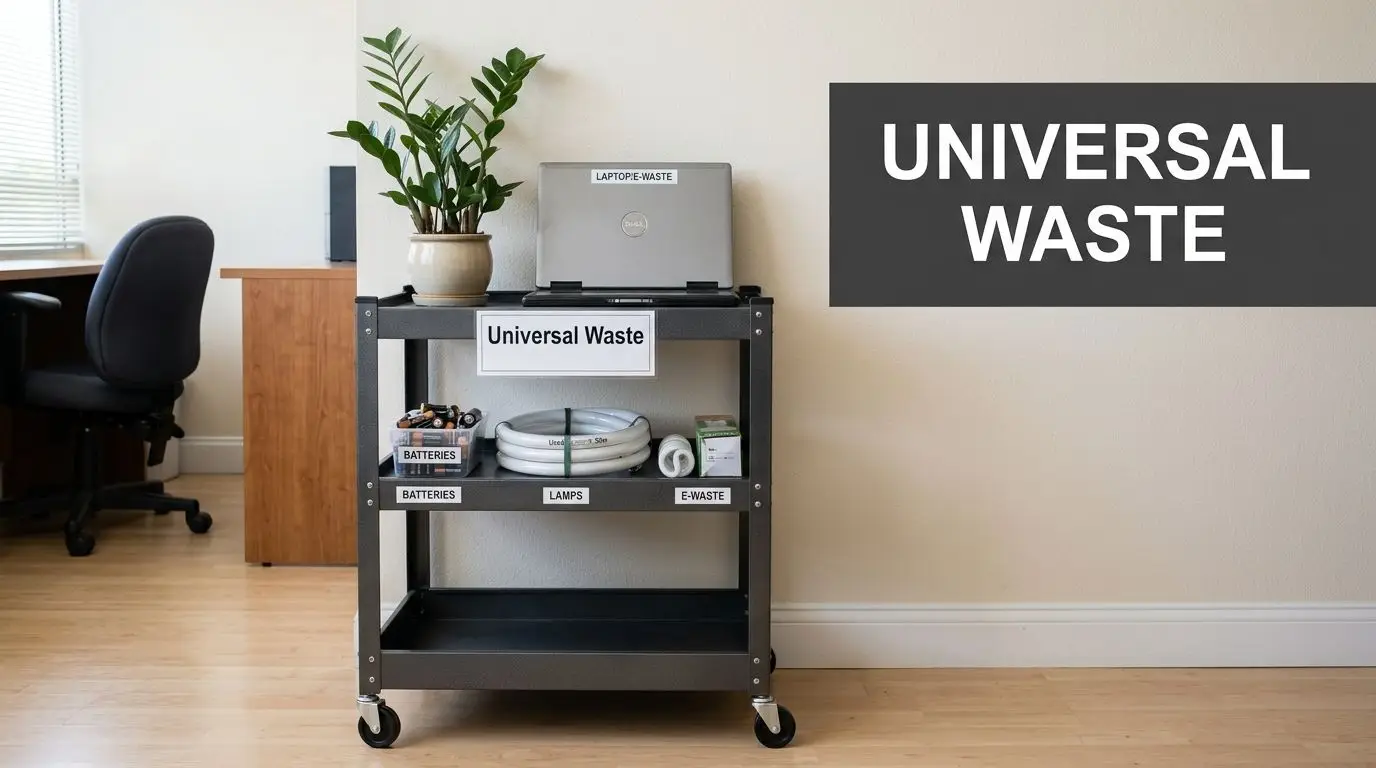
Universal waste refers to specific categories of hazardous waste that are widely generated by businesses. The Environmental Protection Agency (EPA) created this special classification to encourage proper recycling and disposal by simplifying the regulatory requirements. Items like old batteries, fluorescent bulbs, and mercury-containing equipment are so common in commercial facilities that they needed a dedicated management system to prevent them from entering municipal landfills.
For an IT director, facility manager, or procurement professional, understanding universal waste is not just about environmental responsibility—it's a significant operational advantage. The program reduces administrative burdens and disposal costs, making it easier for businesses to comply with federal law and avoid the severe penalties associated with improper hazardous waste disposal.
Why Did the EPA Create Simpler Rules?
The primary objective of the universal waste program is to divert large volumes of toxic materials from municipal solid waste streams. These regulations, established under the Resource Conservation and Recovery Act (RCRA), significantly lighten the administrative load for businesses compared to managing fully regulated hazardous waste.
Key benefits for commercial handlers include:
- Simplified Labeling: Businesses can use straightforward labels instead of complex hazardous waste manifests.
- Extended Storage: Companies can accumulate universal waste on-site for up to one year, allowing for more efficient, cost-effective bulk shipments for recycling.
- Flexible Transport: In many cases, universal waste can be transported to a collection facility without a formal hazardous waste manifest, simplifying logistics.
This streamlined approach is a game-changer for commercial operations, but "simpler" does not mean "optional." Non-compliance with hazardous waste disposal regulations can lead to severe penalties, with fines reaching up to $50,000 per violation, per day. For any IT director or compliance officer, mastering these rules is essential to protect the business from staggering financial risk. Global recycling trends continue to shape these U.S. regulations, as highlighted by weforum.org.
By making compliance more accessible, the universal waste program promotes higher recycling rates for materials that could otherwise harm the environment. This is particularly relevant for businesses managing large volumes of end-of-life IT equipment.
For any company managing technology assets, numerous components fall directly into this category. Proper handling is a federal requirement that protects your company’s reputation and bottom line. Professional universal waste disposal services from a certified partner like Beyond Surplus ensure your business remains fully compliant.
The Four Main Categories of Universal Waste for Businesses
To effectively manage universal waste, businesses must first identify it. The EPA has organized these common, yet potentially hazardous, items into four primary categories. Recognizing these items within your facility is the first and most crucial step toward responsible e-waste management and corporate compliance.
1. Batteries
For any business managing IT assets, this is a significant category. It covers numerous battery types containing heavy metals like cadmium, lead, and mercury, which can leach into soil and groundwater if sent to a landfill.
- Business Examples: Lithium-ion batteries are found in all corporate laptops and mobile devices. Nickel-cadmium (Ni-Cd) batteries often power emergency lighting systems. Sealed lead-acid (SLA) batteries are essential for Uninterruptible Power Supply (UPS) systems in server rooms and data centers.
2. Lamps
Lamps are ubiquitous in any commercial building. The EPA's regulations specifically target lamps containing hazardous materials, with mercury being the primary concern.
- Business Examples: The long fluorescent tubes in office ceilings and compact fluorescent lamps (CFLs) in desk lighting are common examples. High-intensity discharge (HID) bulbs are often used in warehouses or for exterior building lighting. Projector bulbs in conference rooms also fall into this category.
3. Mercury-Containing Equipment
This is a catch-all category for any device containing elemental mercury. Although many of these items are being phased out, they are still present in older facilities and specialized equipment. Identifying them is vital for safety and compliance.
Many older thermostats, barometers, and specialized industrial or medical devices were manufactured with elemental mercury. Regulating them as universal waste is designed to prevent mercury from entering the environment upon disposal.
- Business Examples: Classic examples include older mercury thermostats controlling HVAC systems and mercury switches found in legacy industrial, laboratory, or IT equipment.
4. Pesticides
This category is less common for a standard office but is critical for businesses in agriculture, landscaping, or large-scale property management. It includes recalled, suspended, or unused pesticides that would otherwise require management as fully regulated hazardous waste. For a complete list of items, review our guide on universal waste examples to ensure full facility compliance.
- Business Examples: This covers pesticides that have been suspended or canceled under the Federal Insecticide, Fungicide, and Rodenticide Act (FIFRA), as well as any obsolete pesticides a business has collected for disposal.
How E-Waste and IT Equipment Fit Into Universal Waste Management
While "e-waste" is not a formal federal universal waste category, corporate IT equipment is a primary source of components that are regulated as universal waste. An old server or laptop should be viewed not as a single item but as a container of various materials. Inside, you will find universal waste (e.g., batteries), other hazardous materials (e.g., lead-soldered circuit boards), and non-hazardous materials (e.g., plastic and metal). This complexity is why electronics cannot be discarded in a dumpster; each component has a specific, regulated disposal path.
The Direct Overlap Between IT Assets and Universal Waste
The connection is unavoidable. When corporate technology reaches its end-of-life, it immediately becomes a major generator of universal waste. This includes the most common components found in server rooms and on employee desks.
- Batteries in Laptops and UPS Systems: Every corporate laptop contains a lithium-ion battery. The heavy Uninterruptible Power Supply (UPS) units protecting servers are filled with sealed lead-acid batteries. Both are quintessential examples of universal waste.
- Lamps in Office Equipment: Older projectors, scanners, and some flat-screen monitors utilize fluorescent lamps containing mercury, a major focus of universal waste regulations.
- Mercury Switches in Older Tech: Legacy IT equipment or specialized lab devices may contain mercury switches, another item requiring careful management as universal waste.
This chart illustrates how core universal waste items are integral components of everyday business electronics.

The concept is simple but critical: your e-waste is not universal waste itself, but the vessel that contains it.
Why Correct Component Management is Key for Businesses
A primary goal of the universal waste program is to prevent toxins like mercury from contaminating landfills. However, there is significant room for improvement. In 2019, the U.S. generated 6.92 million tons of e-waste, yet only 15% was documented as recycled. Much of the unrecycled equipment contained universal waste. This global challenge is detailed further in this in-depth analysis of world waste statistics.
This is where a professional IT Asset Disposition (ITAD) partner becomes essential for businesses. A certified ITAD provider doesn't just "recycle" a laptop; they de-manufacture it.
Because electronic devices are a complex mix of different waste types, they cannot be managed with a single disposal method. A certified recycling process is required to segregate universal waste from other hazardous and non-hazardous materials for compliant processing.
This is the core of our service at Beyond Surplus. We understand how to dismantle equipment and route every component—from the plastic casing to the circuit board and battery—to the correct, certified downstream facility. This is all managed through a comprehensive universal waste system designed for business compliance, protecting your company from fines and long-term environmental liability.
Universal Waste Handler Categories: SQHU vs. LQHU
Once universal waste is identified at your facility, the next step is to understand your legal obligations. The EPA defines two types of universal waste generators, or "handlers," based on the quantity of waste accumulated on-site at any given time. Determining your business's category is fundamental to maintaining compliance.
The two tiers are:
- Small Quantity Handler of Universal Waste (SQHU): This applies if your facility accumulates less than 5,000 kilograms (approximately 11,000 pounds) of total universal waste at any time.
- Large Quantity Handler of Universal Waste (LQHU): Your business falls into this category if it accumulates 5,000 kilograms or more. LQHUs have additional requirements, such as notifying the EPA and obtaining an EPA Identification Number.
Most businesses will fall under the SQHU requirements, which are designed to be practical and focus on safe handling and proper transport to a recycling facility.
How to Manage Your Universal Waste Correctly
Regardless of handler status, the EPA mandates several key rules to ensure universal waste is managed safely and to avoid environmental contamination and costly fines. The primary responsibility is to manage the waste in a way that prevents its release. This includes storing batteries in non-conductive containers and placing cracked fluorescent bulbs in a sealed box.
Employee training is also required. You must inform your team how to handle universal waste correctly, including identification, storage procedures, and what to do in case of a spill or breakage. For SQHUs, basic awareness training is typically sufficient.
Universal Waste Handler Requirements at a Glance
This table provides a clear comparison of the core responsibilities for Small and Large Quantity Handlers.
| Requirement | Small Quantity Handler (SQHU) | Large Quantity Handler (LQHU) |
|---|---|---|
| Notification | Not Required | Must notify the EPA and receive an EPA ID Number. |
| Recordkeeping | Not Required | Must keep records of universal waste shipments. |
| Training | Inform employees of proper handling & emergency procedures. | Inform employees of proper handling & emergency procedures. |
| Time Limit | Accumulate for no more than one year. | Accumulate for no more than one year. |
| Labeling | Must label containers or items as "Universal Waste." | Must label containers or items as "Universal Waste." |
| Spill Response | Must immediately contain all releases. | Must immediately contain all releases. |
The core requirements for safe handling, labeling, and storage time are the same for both categories. The primary differences for LQHUs involve official EPA notification and shipment tracking documentation.
The Two Most Critical Rules: Labeling and Time Limits
Two of the most critical responsibilities—and the easiest areas for compliance failure—are labeling and time limits.
Proper Labeling: Every container or individual piece of universal waste must be clearly labeled. For example, a drum of batteries must be marked "Universal Waste—Batteries," and a box of bulbs must be labeled "Universal Waste—Lamps." This is a non-negotiable step. Reviewing specific requirements for universal waste labels is essential for compliance.
One-Year Time Limit: You can store universal waste on-site for up to one year from the date it is generated. You must be able to prove the accumulation start date, typically by writing it on the container.
The one-year accumulation limit is a significant benefit of the universal waste program, allowing businesses to collect enough material for a single, cost-effective recycling shipment. However, exceeding this limit subjects the waste to full, and far more complex, hazardous waste regulations.
State-Level Universal Waste Regulations and Corporate Risk Management
Federal EPA guidelines establish the baseline for managing universal waste, but they are only the starting point. State-level regulations are often stricter and present a significant compliance challenge, especially for businesses operating in multiple states. For example, some states add their own waste categories, shorten the one-year accumulation period, or mandate different labeling requirements.
Your Most Important Risk Management Tools
To navigate this complex regulatory landscape, businesses must adopt two powerful mantras: "check local rules" and "document everything." Never assume the federal standard is sufficient. Verifying state and local regulations is crucial for avoiding major compliance failures.
Equally critical is maintaining detailed records. This documentation serves as your proof of due diligence and is your primary defense against liability. It demonstrates that your company has taken all necessary steps to manage its waste responsibly.
Think of your records as a corporate insurance policy. In the event of an audit, a complete paper trail proves you followed all regulations and successfully transferred liability to your certified downstream vendor.
Your documentation should include:
- Waste Inventories: A log of the types and quantities of universal waste generated.
- Accumulation Dates: Records demonstrating compliance with the one-year time limit.
- Shipment Records: Bills of lading or shipping logs detailing when and where the waste was sent.
- Certificates of Recycling: Official documents from your disposal partner confirming proper processing.
Organizing these records is a core component of your company's risk management strategy. For a deeper dive into these rules, our comprehensive guide to universal waste provides further detail.
How to Streamline Your Universal Waste Compliance with an ITAD Partner

Understanding universal waste regulations is one thing; implementing a compliant, efficient process is another. Partnering with a strategic IT Asset Disposition (ITAD) expert like Beyond Surplus simplifies the entire equation for your business, allowing you to offload the responsibility of navigating a complex and ever-changing regulatory web.
Our comprehensive ITAD and electronics recycling services are designed to automatically manage the universal waste within your end-of-life equipment. We handle everything—from nationwide logistics and certified data destruction to providing the official documentation required for your corporate records.
Your Path to Simplified Corporate Compliance
Partnering with an expert transforms a complex operational burden into a simple, streamlined process. We integrate universal waste management directly into your IT asset retirement workflow, eliminating the need for your team to manage it separately. This integrated approach is especially valuable for companies managing other universal waste streams. The U.S. hazardous waste services market, which reached $9 billion in 2021, reflects the growing demand for comprehensive, no-fuss solutions. You can learn more about this trend from reports on U.S. hazardous waste management services.
Here’s how we make compliance seamless for your business:
- Nationwide Pickup: We coordinate logistics to collect equipment from all your facilities across the contiguous United States.
- Certified Data Destruction: We ensure all data is securely destroyed in compliance with NIST 800-88 and other leading industry standards.
- Official Documentation: We provide a Certificate of Recycling and Data Destruction, transferring liability from your organization and serving as auditable proof of due diligence.
Your primary focus should be running your business—not becoming a waste management expert. We absorb the complexities of compliance, allowing your team to focus on core operational goals.
Beyond Surplus doesn’t just remove old assets; we help you mitigate risk, uphold your corporate environmental responsibilities, and make your compliance process effortless. It is the most effective way to protect your business from liability.
Frequently Asked Questions for Businesses
Navigating waste management regulations raises many questions for IT and facility managers. Here are straightforward answers to common queries to help your business maintain compliance with confidence.
Can I Dispose of Old Office Phones and Keyboards in the Trash?
No. Disposing of items like office phones and keyboards in the trash is a significant compliance risk. These devices contain circuit boards with heavy metals, particularly lead and copper. They often fail the EPA's Toxicity Characteristic Leaching Procedure (TCLP) test, which officially classifies them as hazardous waste. Furthermore, many states, including California and New York, have specific e-waste laws that prohibit them from being landfilled. The only compliant solution is to have a certified ITAD provider manage all end-of-life electronics.
What Is The Difference Between a Universal Waste Battery and a Regular Alkaline Battery?
The EPA’s universal waste rule primarily targets rechargeable batteries due to their higher toxicity and heavy metal content. This includes the lithium-ion, nickel-cadmium (Ni-Cd), and sealed lead-acid batteries found in laptops, emergency lighting, and UPS systems. While federal rules may not classify standard alkaline batteries (e.g., AA, AAA) as universal waste, many state and local regulations do.
Key Takeaway for Businesses: The safest and most efficient strategy is to treat all battery types as universal waste. This creates a single, streamlined recycling process for your entire organization, ensuring full compliance and preventing accidental violations.
Do I Need a Special Permit to Transport Universal Waste?
Generally, no. A major advantage of the universal waste program is its streamlined nature. Businesses can typically transport their own universal waste to a designated collection or recycling facility without a formal hazardous waste manifest or special permit. However, the responsibility remains on your company to ensure the waste reaches an authorized facility. Partnering with a professional provider like Beyond Surplus removes this burden entirely. We manage the complete chain of custody and provide auditable documentation to prove it.
How Long Can My Company Store Universal Waste On-Site?
Both Small Quantity Handlers (SQHUs) and Large Quantity Handlers (LQHUs) can accumulate universal waste on-site for up to one year. The one-year period begins the moment an item is designated as waste. Your business must be able to demonstrate the accumulation start date, typically by dating the container. Exceeding the one-year limit is a serious violation that can subject the materials to much stricter and more expensive hazardous waste regulations.
Ready to simplify your IT asset and universal waste management? Contact Beyond Surplus for certified electronics recycling and secure IT asset disposal. Learn how we can help your business today.