Old laptops are stacked in a server room corner. A few monitors sit under a desk. Someone from operations wants the space back. Legal wants proof the drives were destroyed. Building management wants a pickup window that does not disrupt tenants. If you manage IT in New York City, that is not a cleanup task. It is a compliance project.
That is why e waste recycling nyc looks simple from the outside and becomes complicated the minute a business gets involved. Most public guidance is built for residents. Your company is dealing with chain of custody, transport, audit trails, data-bearing devices, and a city where moving equipment out of a building can be harder than replacing it.
Navigating E Waste Recycling in NYC for Your Business
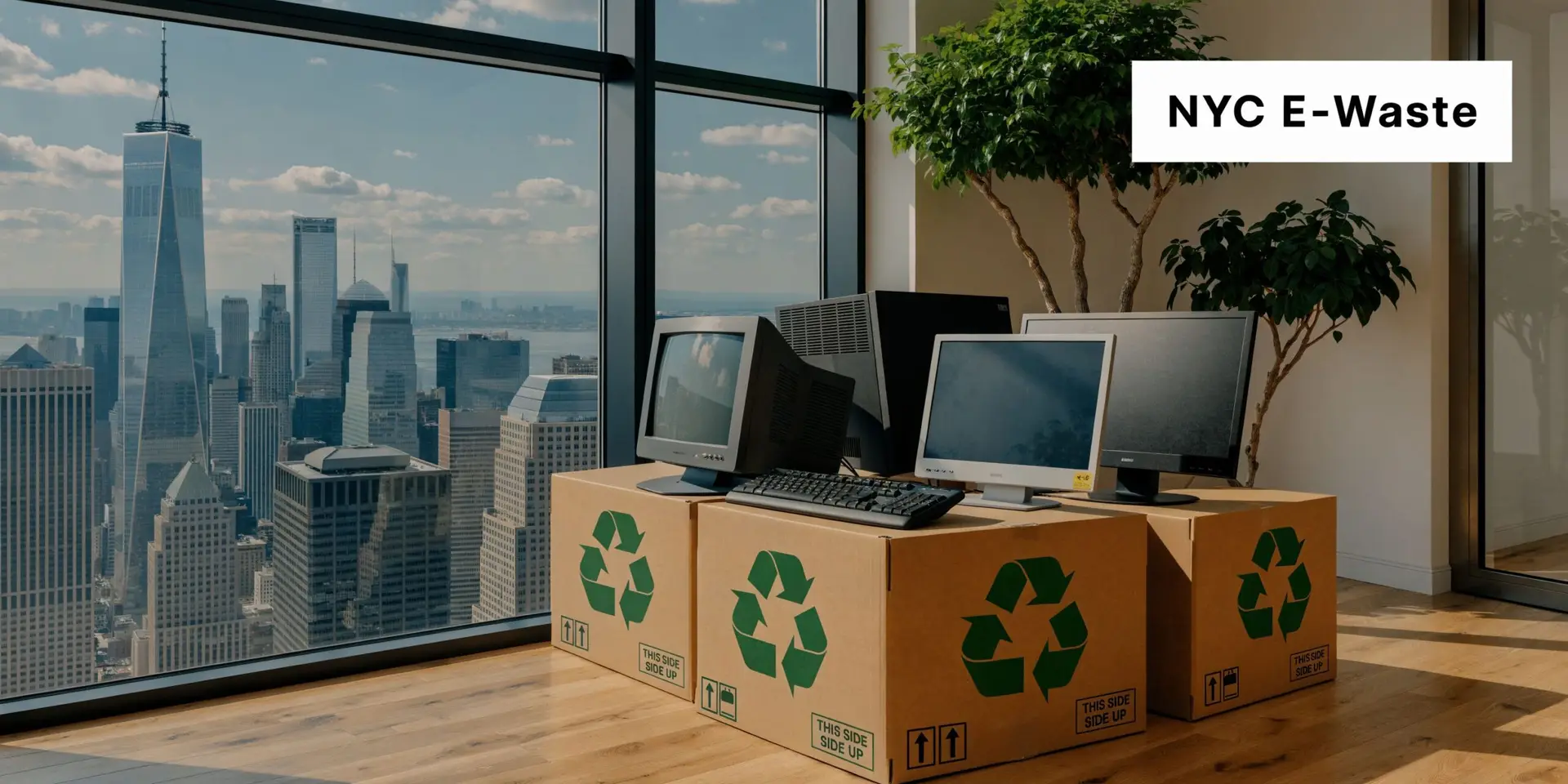
An NYC IT manager usually hits the same wall. The company has finished a laptop refresh, a floor consolidation, or a small data center cleanout. The gear is obsolete, but not harmless. Some devices still hold data. Some contain batteries. Some are mixed with accessories, docks, phones, or network hardware. None of it can go in the trash.
Public messaging does not help much. It points to apartment collections, resident drop-offs, and consumer events. For a commercial team, that is noise. The key issues are whether the recycler is certified, whether pickup can happen without chaos, and whether your company can defend its process in an audit or after a data incident.
A related signal is how much infrastructure New York keeps building around regulated waste streams. Local reporting on projects like Medical Waste Firm Invests 6.7m In Old Bethpage shows the same pattern. Waste handling in the region is getting more specialized, more documented, and less forgiving of casual disposal practices.
What business teams need
Commercial disposal decisions should answer four questions fast:
- Who owns the liability: Your company, or a certified recycler with documented downstream handling.
- How is data destroyed: Logical sanitization, physical destruction, or both.
- How will pickup work: Freight access, dock scheduling, packing, manifests, and secure transit.
- What proof do you get back: Certificates, inventory records, and disposition reporting.
If your vendor cannot explain chain of custody in plain English, they are not ready for enterprise e-waste.
For teams that need a starting point for commercial pickups, business e-waste recycling options in NYC are far more relevant than resident-focused programs. Use that lens for every vendor conversation. If the answer sounds like a consumer drop-off solution, move on.
Understanding NYC and NYS E-Waste Mandates
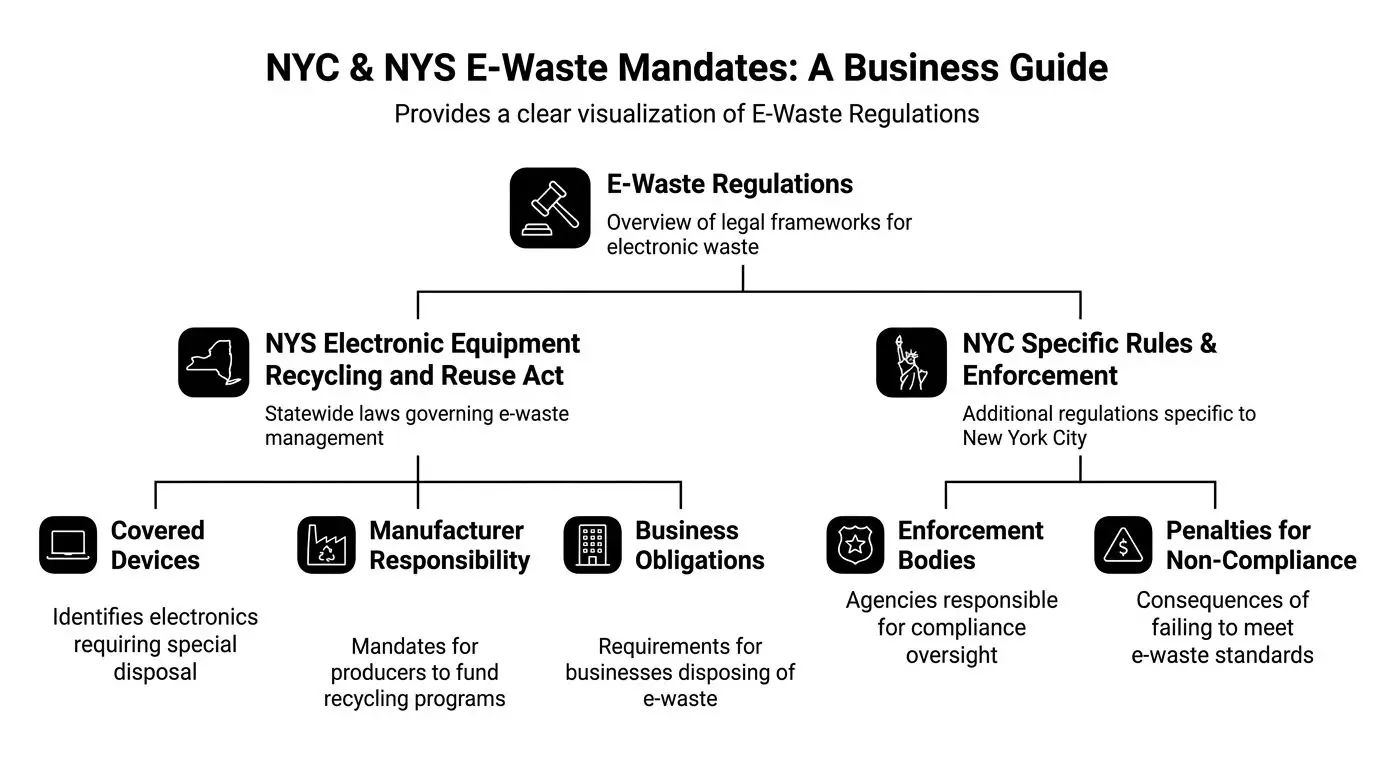
New York does not treat electronics like ordinary trash. The state framework is the Electronic Equipment Recycling and Reuse Act, and the practical rule for businesses is simple. Do not landfill electronics. Do not incinerate them. Use the right channel.
The rule most companies misunderstand
The biggest point of confusion is business size. Most NYC e-waste guidance focuses on residents or small businesses, but enterprises over 50 employees are ineligible for free manufacturer programs and must hire private, certified recyclers, bearing the full cost of transport and compliance to avoid fines up to $5,000/day under NYSDEC rules (NYC DSNY electronics disposal guidance).
That changes the whole operating model for mid-size and large organizations. You are not comparing convenience. You are building a compliant commercial process.
How the mandate works in practice
Think of the rules in this order:
- State law controls disposal. Electronics are regulated and cannot be handled like general office waste.
- City guidance tells you who qualifies for public-facing options. Large businesses generally do not.
- Your company must contract with a private recycler. That recycler needs to handle secure transport, proper processing, and documentation.
A lot of businesses waste time trying to fit enterprise volumes into programs that were never meant for them. That usually ends with storage delays, internal confusion, and rushed pickups.
What IT managers should do next
Use this quick decision table.
| Business situation | Practical takeaway |
|---|---|
| Fewer than 50 employees | Check whether manufacturer take-back applies to your exact equipment mix |
| More than 50 employees | Plan on a private certified recycler from the start |
| Data-bearing devices involved | Treat the project as disposal plus security, not recycling alone |
| Multi-site NYC footprint | Standardize one documented process across offices |
NYC compliance is not just about where equipment goes. It is about whether your company can prove it used the proper channel.
If you need a commercial service overview that meets local requirements, NYC e-waste services for businesses is the kind of page your procurement or facilities team should review, not the resident recycling pages that dominate search results.
Ensuring Data Security and Regulatory Compliance
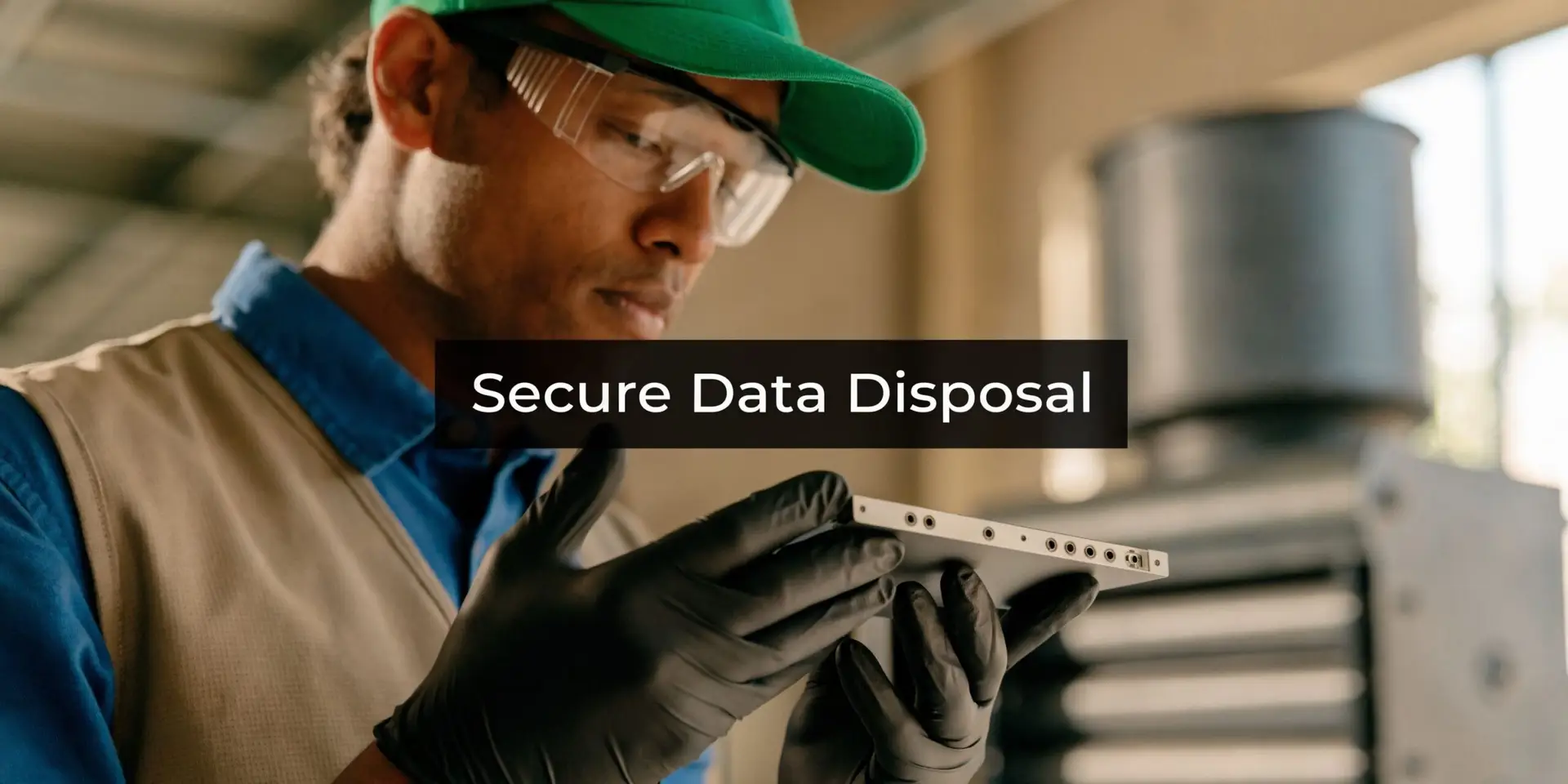
For business e-waste, the highest risk is not the monitor. It is the drive inside the retired laptop, firewall, copier, or server that still contains customer data, employee records, credentials, health information, or internal financial files.
Too many companies still ask one weak question: “Do you wipe drives?” That is not enough. You need to know how, under what standard, and what proof you receive.
The standard that matters
Under 6 NYCRR Part 368-3, improper e-waste disposal can trigger enforcement with fines up to $37,500 per violation, and certified data destruction aligned with the FTC Disposal Rule and NIST 800-88 standards is essential for transferring liability (NYSDEC facility requirements).
For IT managers, that means three concrete requirements:
- Use NIST 800-88 aligned sanitization for devices that can be wiped and redeployed or remarketed.
- Use physical destruction for failed drives, damaged media, or assets with stricter internal handling rules.
- Get a certificate of data destruction tied to the pickup, inventory, or serial-level reporting you approved.
Why certificates matter
A certificate is not marketing paperwork. It is evidence.
When legal, compliance, or cyber insurance asks what happened to retired devices, you need a record that shows:
- the assets were received,
- the data-bearing components were sanitized or destroyed,
- the process matched recognized standards,
- and the chain of custody did not break between pickup and final processing.
That record is what turns disposal into defensible risk management.
What weak vendors get wrong
Some recyclers talk about “secure handling” but stay vague on the details. That is a red flag. Ask whether they support on-site drive shredding, off-site destruction with documented transport, or serialized reporting tied to asset lists. Ask what happens when a drive cannot be wiped. Ask who signs the certificate.
“We recycle everything responsibly” is not a security answer. It is a slogan.
For teams formalizing policy, NIST SP 800-88 data destruction guidance is the benchmark worth using in your vendor review process and internal SOPs.
A practical policy for NYC businesses
If you manage high-risk assets, keep the rule simple:
- Laptops and desktops: sanitize if reusable, destroy if failed or restricted by policy.
- Servers and storage arrays: remove drives under documented custody before transport when possible.
- Copiers, printers, and multifunction devices: treat internal storage as a real data risk, not an afterthought.
- Loose drives: never ship them as miscellaneous scrap.
The right recycler should support your policy. They should not force you to lower it.
How to Choose a Certified E-Waste Recycler
Vendor selection is where many NYC businesses create avoidable exposure. A polished website is meaningless if the facility, paperwork, or downstream handling falls apart under scrutiny.
The market is not uniformly clean. Recent DEC audits revealed 15% of NY recycling facilities were non-compliant, and with e-waste from AI hardware upgrades surging 25% in 2025, businesses must verify recycler certifications like R2 or e-Stewards to ensure secure, audited data destruction and avoid liability (NYSDEC electronic waste recycling guidance).
What certifications should tell you
Certifications are not magic, but they are a useful first filter.
- R2 or e-Stewards: These show the recycler operates inside a recognized framework for responsible electronics handling.
- Documented downstream tracking: You want to know where materials go after initial processing.
- Data destruction procedures: The vendor should be able to describe sanitization and destruction without hand-waving.
Certification alone is not enough. You still need to ask hard questions.
The shortlist test
Put every vendor through this checklist before you approve them.
- Can you provide chain-of-custody documentation from pickup to final processing?
- Do you issue certificates of recycling and certificates of data destruction?
- Can you support on-site services if our policy requires them?
- How do you handle serialized inventory reporting?
- What is your process for failed drives and damaged devices?
- Who are your downstream vendors, and how do you audit them?
- What insurance coverage do you carry for transport and processing?
- Can you manage pickups across multiple offices, not just one location?
What a strong answer sounds like
A strong recycler answers directly. They can explain scheduling, pickup manifests, asset reconciliation, drive handling, and final reporting without switching to generic sustainability language.
A weak recycler gives broad promises, avoids specifics, or assumes your only concern is whether something stays out of landfill.
One commercial option businesses can evaluate is electronics recycling certifications and compliance standards, which outlines the kind of documentation and controls a qualified ITAD provider should be prepared to discuss.
Pick the recycler you can audit on paper, not the one with the nicest truck wrap.
Streamlining Logistics for IT Asset Disposition in NYC
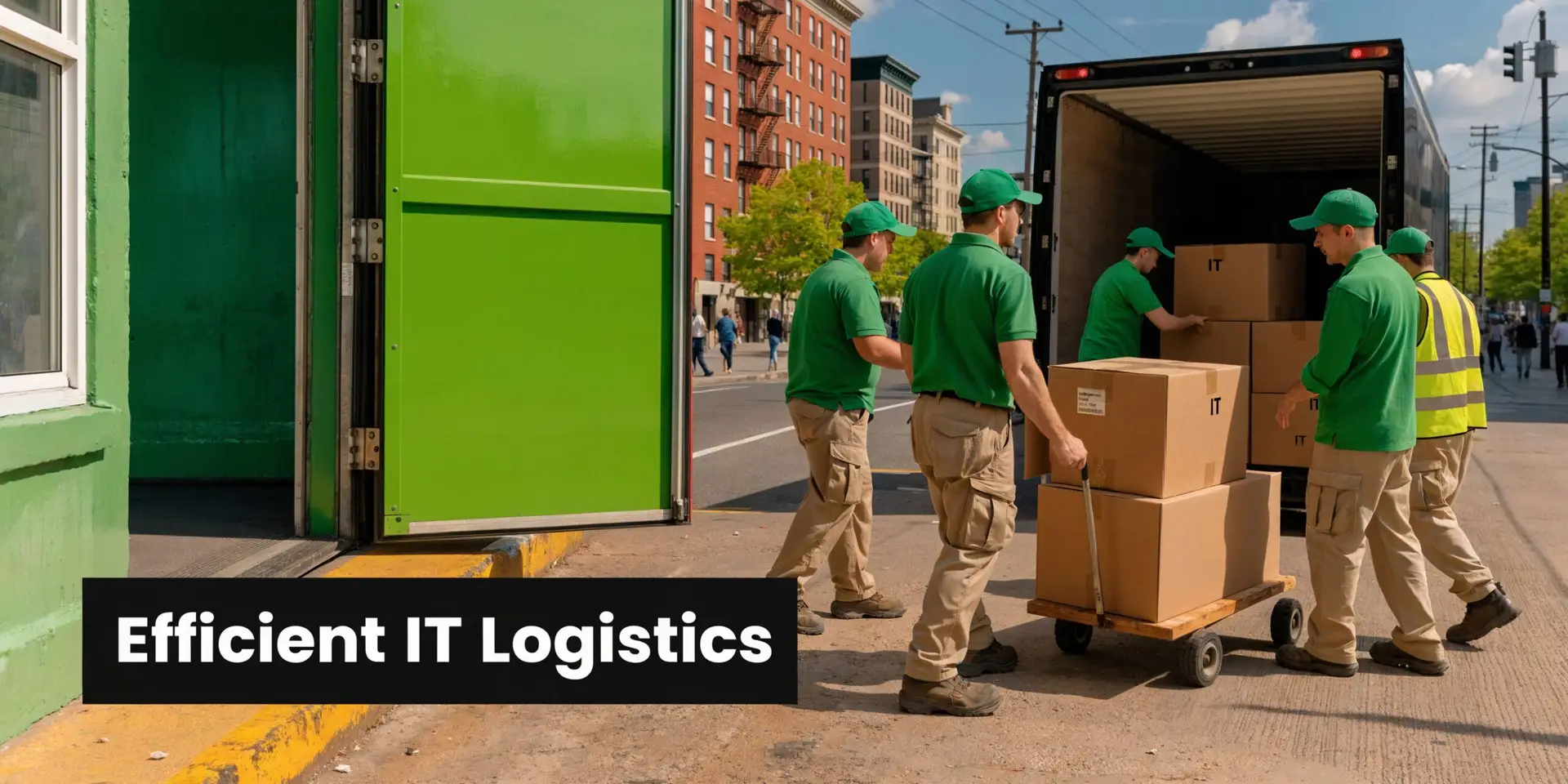
Most internal IT teams underestimate the logistics problem until pickup day. In New York City, even a modest asset removal can involve COI requirements, elevator reservations, loading dock limits, traffic restrictions, packing rules, and a narrow handoff window between building staff and the carrier.
Doing it yourself versus using a full-service pickup
Here is the blunt comparison.
| Self-managed approach | Full-service ITAD pickup |
|---|---|
| IT staff sorts and stages equipment | Vendor helps scope, schedule, and prepare pickup |
| Facilities coordinates building access separately | Vendor works within building and dock constraints |
| Loose devices create chain-of-custody risk | Assets move under documented custody |
| Mixed loads slow removal and reporting | Packing and transport are planned around asset type |
| Final proof may be inconsistent | Certificates and disposition records are standard output |
For NYC offices, logistics is not a side issue. It determines whether the project stays compliant.
What proper processing looks like
The back end matters too. Certified R2/RIOS processes dismantle electronics via secure shredding and downstream smelting, recovering 95-99% of materials and reducing environmental release by 90% compared to landfilling, ensuring compliance with NY's 2015 landfill ban for electronics (NYC e-cycleNYC program page).
That matters for two reasons. First, it confirms the recycler is doing more than hauling things away. Second, it shows why certified processors are worth using when your company needs documented environmental handling as well as security controls.
The pickup model that works
A competent commercial process is straightforward:
- Initial scope: device types, approximate volume, data-bearing assets, and site conditions.
- Scheduling: align with freight access, dock times, and internal approvals.
- On-site handling: palletizing, boxing, labeling, or segregating assets by category.
- Secure transit: documented transfer from your location to the processing facility.
- Final documentation: recycling certificates, destruction certificates, and reporting.
National coverage is beneficial in this regard. NYC companies often have users, branch offices, and storage locations outside the city. One vendor with a repeatable process is easier to govern than a patchwork of local haulers.
Partner with Beyond Surplus for Nationwide E-Waste Solutions
New York State has collected nearly 300 million pounds of e-waste since 2011 under its producer responsibility law (NYSDEC annual report). That is the scale of the stream your company is part of. Treating commercial disposition like an occasional junk removal project is the wrong approach.
NYC businesses need three things from an ITAD partner. Secure data destruction. Clear compliance documentation. Pickup logistics that work in real buildings with real constraints.
That is why a national provider often makes more sense than a small local-only recycler. Your problem may start in Manhattan, Brooklyn, Queens, or the Bronx, but your asset flows rarely stay there. Devices move between offices, users, warehouses, and refresh cycles. The disposal process should stay consistent the whole time.
Beyond Surplus provides commercial electronics recycling, IT asset disposition, secure data destruction, and documented chain of custody for organizations that need one governed process across locations. For NYC IT managers, that means fewer vendor gaps, cleaner reporting, and a disposal program that stands up to procurement, legal, and security review.
If you are holding retired laptops, network gear, medical electronics, lab devices, or data center hardware, do not wait for the pile to become a problem. Build the process now. Set the handling rules. Vet the recycler hard. Get the paperwork right.
Contact Beyond Surplus for certified electronics recycling and secure IT asset disposal. If your NYC business needs pickup coordination, data destruction, and defensible documentation, start with a commercial evaluation and schedule a compliant removal plan.