New Yorkers discard over 400,000 tons of e-waste annually, and in FY2022 the New York City Department of Sanitation diverted 7,262 tons of electronics through its programs, according to this overview of New York e-waste regulations and DSNY diversion data. For an NYC business, that is not just an environmental headline. It is an operations, security, and compliance issue.
Most content about e-waste recycling nyc points businesses toward public drop-off options. That is usually the wrong starting point. A company retiring laptops, replacing network gear, clearing storage rooms, or decommissioning a server room needs documented chain of custody, data destruction controls, and scalable pickup logistics. Municipal convenience programs serve a different use case.
The Scale of NYC's E-Waste Challenge

NYC produces e-waste at a scale that changes how businesses should think about end-of-life IT. In a city this dense, old desktops, monitors, switches, printers, phones, drives, and lab or medical electronics do not disappear. They accumulate in offices, closets, basements, leased spaces, and data rooms until an office move, hardware refresh, merger, or audit forces action.
That is where many internal teams get stuck. They know devices cannot go in the trash. They also know public recycling options exist. What often gets missed is the gap between a public recycling system and a business-ready disposition program.
Why business e-waste is different
A business asset is not just scrap. It may contain regulated data, licensed software, asset tags, encrypted but still recoverable media, or components that need internal signoff before release. Finance, healthcare, legal, education, and government-adjacent organizations usually need proof, not verbal assurances.
Three issues come up repeatedly:
- Volume management: Bulk removals do not fit neatly into public-site rules.
- Security controls: Storage media must be wiped or destroyed under a defined process.
- Documentation: Internal audit, legal, and procurement teams want traceable records.
The environmental side still matters. Beyond the operational risk, improper disposal can create downstream harm through unsafe handling of hazardous components. For a broader sustainability view, Beyond Surplus has a useful primer on the environmental impact of electronic waste.
Practical takeaway: In NYC, the key question is not whether you can recycle electronics. It is whether your organization can defend how those assets moved from active use to final disposition.
What NYC businesses need
A workable commercial process usually includes asset inventory, packaging, pickup coordination, secure transport, serialized reporting where needed, data destruction records, and final recycling documentation. Public programs can play a role for small, simple situations. For routine business IT turnover, they are rarely enough on their own.
Navigating E-Waste Compliance in New York
New York does not treat electronics disposal as a casual housekeeping task. The legal framework matters because once a business starts moving retired IT equipment, it creates a disposal chain that can be examined later.
Under New York's Electronic Equipment Recycling and Reuse Act, violations can lead to fines of up to $25,000 per day, as stated by the New York State Department of Environmental Conservation electronic waste recycling guidance. That gets management attention quickly.
What the law means in practice
At a business level, the rule is simple. Do not landfill or improperly discard covered electronics. Use a compliant recycling path and keep records that show what happened.
The part many managers misunderstand is producer responsibility. Manufacturer programs exist, but that does not remove the need for your organization to verify what happens to your assets. If your team hands equipment to a third party without documentation, you have created risk, not transferred it.
A defensible process usually includes:
- Identifying covered equipment before anything leaves the site.
- Separating data-bearing assets from non-data equipment.
- Using a certified recycling channel with traceable handling.
- Retaining paperwork that shows dates, item categories, and disposition outcome.
Liability does not disappear when equipment leaves the office
I see this mistake often in office consolidations. Facilities teams focus on clearing space fast. IT focuses on keeping the project moving. Procurement assumes the recycler has everything covered. Then no one can produce a complete chain of custody later.
That is why internal policy should connect e-waste handling to security and universal waste procedures, not just office cleanout workflows. This overview of universal waste and EPA handling considerations is a useful operational reference when building or tightening those policies.
Tip: If a vendor cannot explain its intake, storage, downstream handling, and reporting process in plain language, do not assume the process is compliant.
The compliance distinction for NYC businesses
Small eligible entities may have access to free manufacturer recycling options under the producer take-back framework. That does not make those options ideal for enterprise fleets, mixed equipment loads, or data-sensitive assets. NYC businesses need a process that stands up to internal review. Compliance is not just where equipment goes. It is how clearly you can prove it.
Preparing IT Assets for Secure Disposition
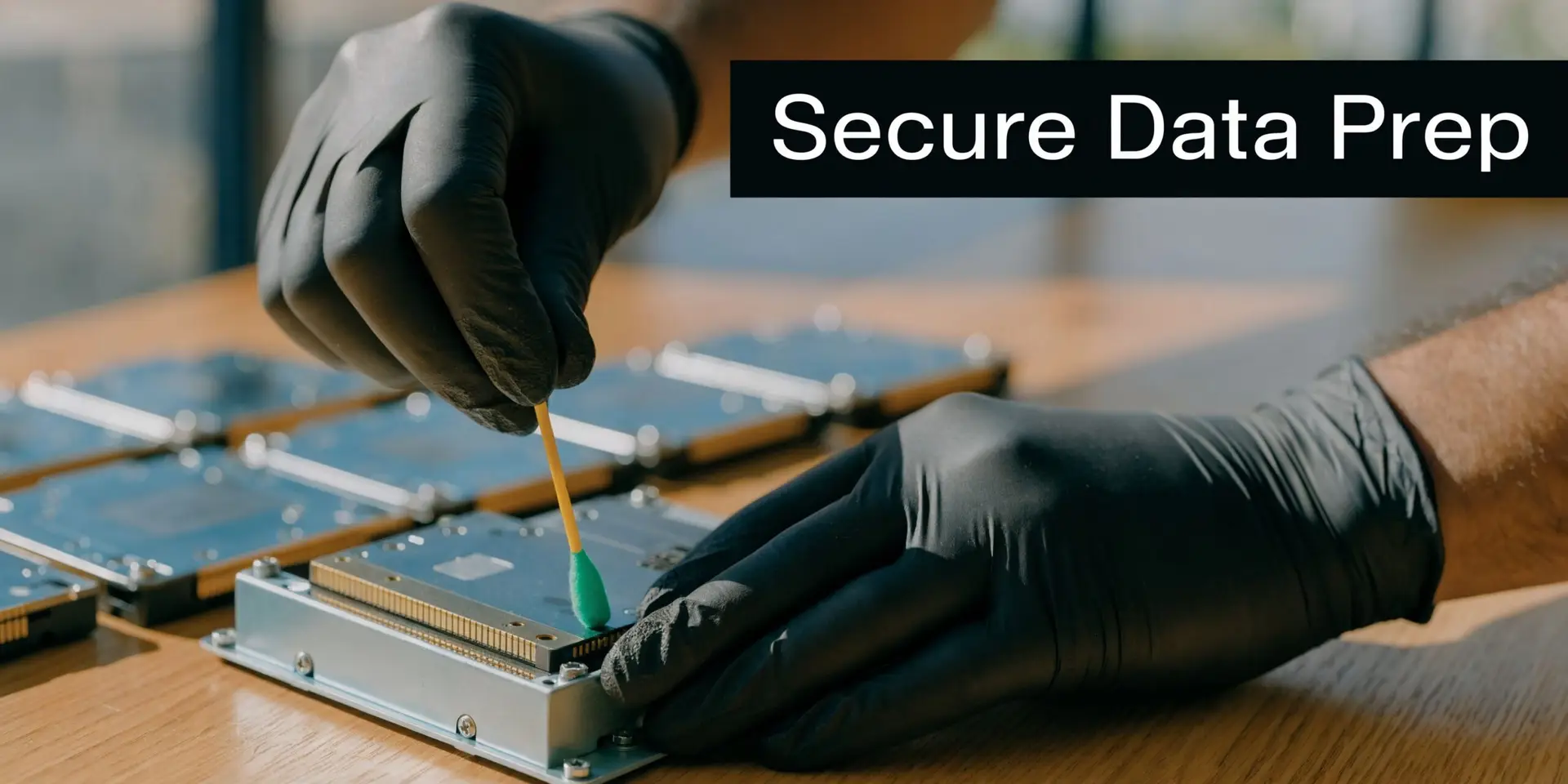
Before pickup, the biggest mistake is treating disposition like junk removal. It is closer to a controlled handoff. The prep work inside your organization determines whether the project stays clean or turns into a compliance headache.
Start with the asset record
Build a working inventory before anything moves. It does not need to be complicated, but it does need to be usable.
Include:
- Asset identifier: Internal tag, serial number, or hostname where available.
- Device class: Laptop, desktop, server, switch, printer, drive, tablet, phone, medical or lab device.
- Data status: Data-bearing, encrypted, wiped pending verification, or destroy only.
- Location: Floor, closet, branch office, rack row, or room.
This inventory becomes the basis for chain of custody, reconciliation, and exception handling. It also helps separate resale candidates from scrap.
Decide how data will be handled
Not every device should follow the same path. Some equipment can go through documented wiping. Some media should be physically destroyed. The right choice depends on the asset, the sensitivity of the data, and your policy.
Common internal categories look like this:
- Reuse or remarketing candidates: Laptops and desktops that still have value may go through wiping if policy allows.
- High-risk media: Failed drives, legacy storage, and equipment from regulated environments often go straight to shredding.
- Infrastructure gear: Servers, arrays, and appliances need a device-specific plan because drives, controllers, and embedded storage are easy to miss.
For organizations that need a tighter destruction workflow, this page on secure destruction of hard drives outlines what a documented process should include.
Key takeaway: If you cannot identify every data-bearing component before pickup, you are guessing about risk.
Prepare the site, not just the devices
Secure disposition also depends on physical controls. Designate a staging area. Restrict access. Label pallets or containers. Assign one person to release assets to the transporter. If multiple departments are contributing equipment, reconcile the list before loading starts.
That sounds basic, but it prevents the common failures: missing drives, unlisted assets, mixed loads, and disputes about what was removed.
Comparing E-Waste Recycling Paths in NYC
NYC businesses usually have three possible disposal paths. Public municipal programs. Manufacturer take-back programs. Certified ITAD providers. On paper, all three sound workable. In practice, they serve very different needs.
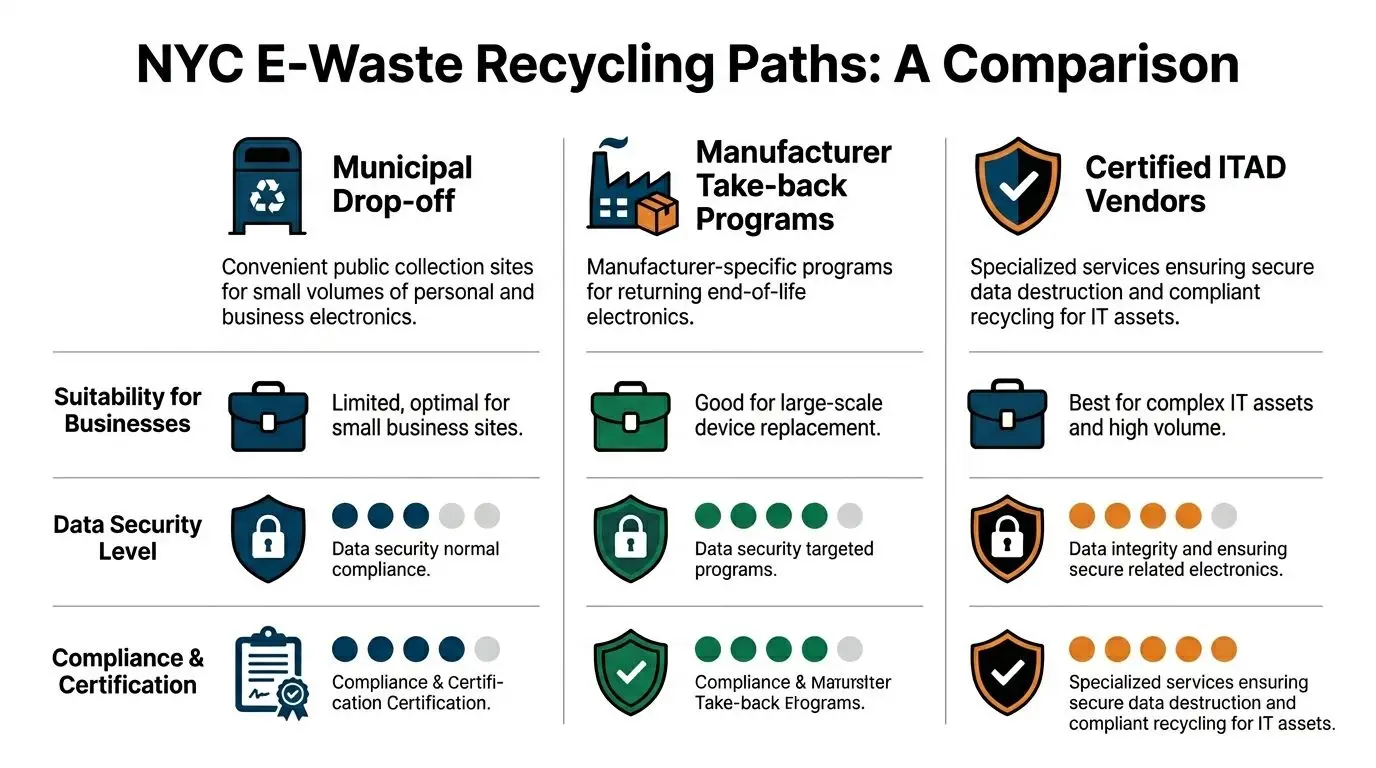
The core business question is not which option exists. It is which option fits your volume, security requirements, and reporting expectations.
Municipal programs
NYC offers drop-off sites, events, and related public-facing electronics collection options. Those programs are useful for local convenience, but the city also makes clear that they have limitations for businesses. Many sites restrict item types and quantities, often excluding bulk IT assets, and public options typically do not provide the certificates of data destruction needed for corporate compliance and liability transfer, according to the NYC electronics disposal guidance.
For a single office with a few peripherals, a public option may help. For a scheduled technology refresh, a branch closure, or a mixed load with data-bearing equipment, it is usually a poor fit.
Manufacturer take-backs
Manufacturer programs make sense when you have a narrow stream of covered products from a participating brand and your volume fits their rules. They are less useful when your load includes multiple manufacturers, legacy devices, unsupported categories, or equipment outside program thresholds.
They also tend to be weak on project coordination. Most IT managers do not retire one vendor’s equipment in isolation. They clear whatever the environment contains.
Certified ITAD providers
A business-focused ITAD process is built around controlled pickup, media handling, reporting, and final documentation. That matters more than convenience. For NYC companies dealing with offices, medical environments, labs, warehouses, and data rooms, this path usually aligns best with risk management.
The certification side is important because “we recycle electronics” is not enough. This overview of electronics recycling certifications is a good filter for evaluating whether a vendor’s claims match a recognized operating standard.
NYC E-Waste Options Business Suitability Comparison
| Feature | DSNY Municipal Programs | Manufacturer Take-Backs | Certified ITAD Provider (e.g., Beyond Surplus) |
|---|---|---|---|
| Best use case | Small, simple drop-offs | Brand-specific returns | Business and enterprise projects |
| Volume handling | Often limited | Varies by program | Built for scheduled pickups and bulk loads |
| Mixed equipment loads | Often difficult | Usually narrow | Commonly supported |
| Data destruction records | Typically not provided | Not usually the focus | Standard business requirement |
| Chain of custody | Limited for enterprise needs | Varies | Central to service model |
| Project logistics | Self-managed | Program dependent | Coordinated pickup and transport |
| Audit support | Weak | Limited | Stronger documentation path |
Decision rule: If your project involves servers, drives, regulated data, multiple departments, or more equipment than one team can carry to a site, use a commercial ITAD workflow.
Your Vendor Checklist for Certified E-Waste Recycling
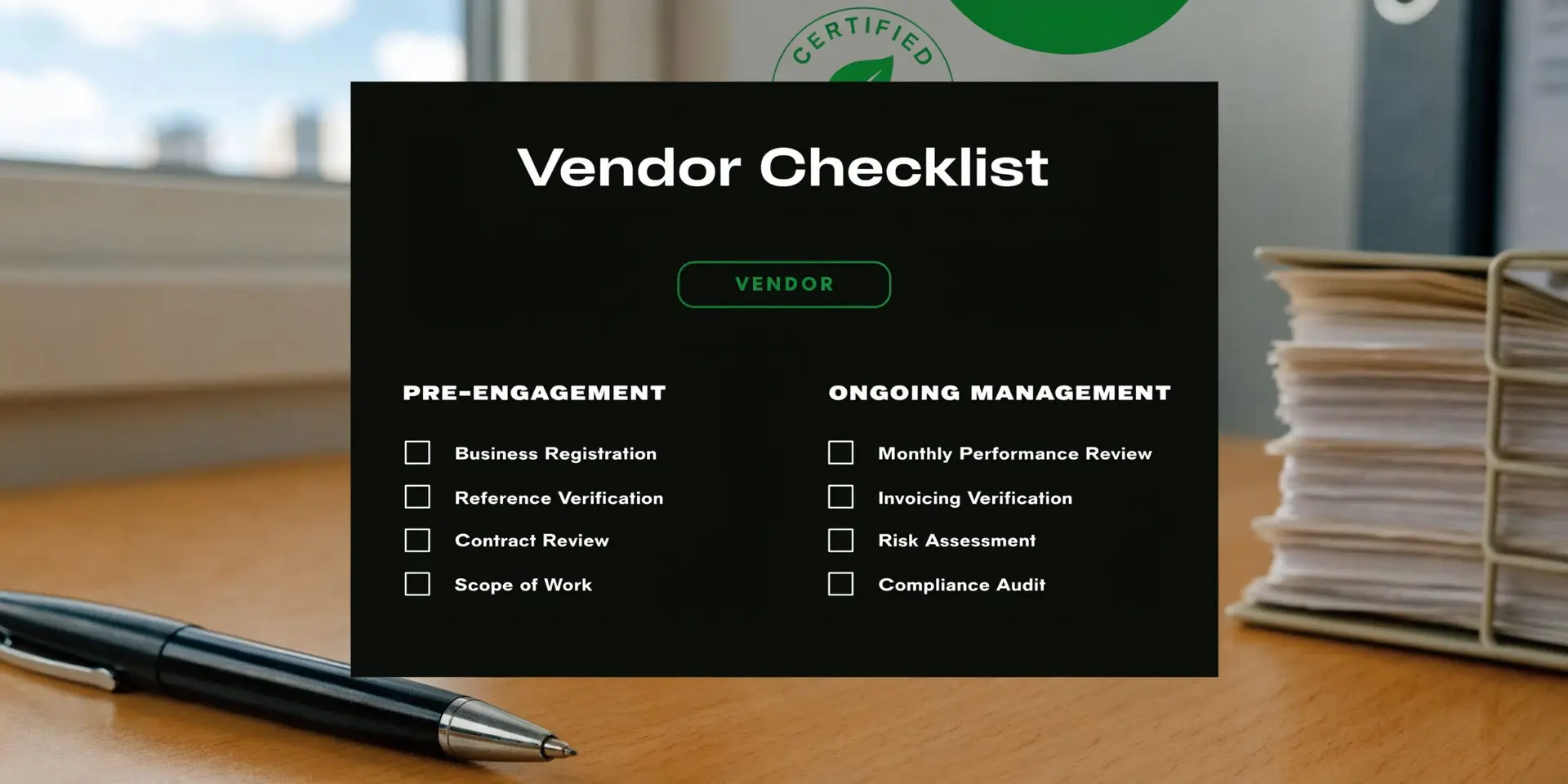
A vendor should reduce your risk, not ask you to trust marketing language. In NYC, that means checking process details before the first pickup, not after a problem appears.
What to ask before onboarding
Use this checklist in procurement, security review, or facilities planning:
- Certification proof: Ask for current certification details and the scope they cover.
- Data handling method: Require a clear explanation of wiping, shredding, and exception handling for failed media.
- Chain of custody: Confirm how equipment is labeled, loaded, transported, received, and reconciled.
- Sample documentation: Review certificates of recycling and data destruction before signing.
- Downstream transparency: Ask where material goes after intake and processing.
- Insurance and incident process: Find out how the vendor handles loss, damage, or reporting errors.
A good due diligence framework should continue after onboarding, not stop at contract signature. This vendor due diligence checklist is a practical reference for building that review process.
The international compliance question
For businesses in NYC, especially in finance or healthcare, cross-border handling matters. Effective January 1, 2025, Basel Convention amendments impose strict controls on cross-border shipments of hazardous e-waste, which means your ITAD partner must prove it uses certified, environmentally responsible processors with documented tracking, as described on the NYC DSNY ecycleNYC program page.
That issue is easy to overlook when a local pickup looks straightforward. It becomes much less easy to ignore if material is later moved through downstream vendors you never reviewed.
Signs a vendor is not ready for enterprise work
Some warning signs are obvious:
- Vague answers about where equipment goes after pickup.
- No sample certificates available during review.
- No distinction between data-bearing and non-data equipment.
- No documented intake process at the receiving facility.
Others are more subtle. If the sales conversation focuses only on “free recycling” and skips data security, inventory reconciliation, and downstream controls, the vendor is telling you what it is built to do.
Understanding Costs and Logistics for Businesses
Commercial e-waste projects are priced and executed based on complexity, not just on whether someone can haul items away. That matters when budgeting an office refresh or planning a site closure in NYC.
What shapes the cost
The biggest cost factors are usually the equipment mix, the pickup environment, and the level of security required.
A project with palletized monitors and no data-bearing media is operationally different from a mixed load of servers, failed drives, network gear, and access-controlled pickup points. Add de-installation, after-hours work, or multi-floor removal, and the logistics change again.
Costs can move in either direction depending on:
- Asset condition: Reusable devices may create value recovery opportunities.
- Media destruction needs: Physical shredding and witness requirements add handling steps.
- Site access: Freight elevator scheduling, loading dock rules, and building restrictions can slow a job.
- Packaging and labor: Loose equipment takes more time than organized, labeled assets.
Why piecemeal disposal usually costs more
A fragmented approach looks cheaper at first. One department schedules a small pickup. Another sends equipment to a different recycler. A branch office uses a local drop-off. IT keeps the drives “for later.”
That creates hidden cost in staff time, inconsistent records, and repeat transportation. It also makes final reporting harder. A coordinated ITAD project usually produces cleaner reconciliation and less internal rework.
Practical advice: Ask for the operating plan, not just the quote. Pickup window, access assumptions, packaging responsibility, data handling, and final documents should all be clear before service starts.
Logistics that matter in NYC
New York logistics are rarely simple. Buildings impose rules. Freight access can be narrow. Some removals must happen outside normal business hours. Multi-site organizations may need one process across offices, clinics, labs, or storage locations.
That is why a business-grade provider should be able to coordinate pickup, packing, transport, and documentation as one workflow rather than a series of disconnected tasks.
Secure Your NYC E-Waste with Beyond Surplus
NYC businesses face a specific mix of pressure. Local disposal rules are strict. Public programs are limited for bulk business use. Security teams need proof of data destruction. Operations teams need equipment gone on schedule without disrupting the site.
That combination is why e-waste recycling nyc for businesses works best when handled as an ITAD project rather than a recycling errand.
A qualified provider should offer:
- secure pickup and transportation
- documented data destruction
- certificates of recycling and destruction
- support for office, warehouse, lab, and data center environments
- reporting that procurement, compliance, and IT can all use
Beyond Surplus is one example of a provider that offers nationwide business pickups, secure data destruction, electronics recycling, and IT asset disposition services for organizations that need a documented chain of custody rather than a public drop-off solution.
For an IT manager, the goal is straightforward. Move retired equipment out of the environment without creating a new legal, security, or audit problem. The right process handles both sides of that equation. It clears the space and preserves the record.
If your organization is planning a refresh, relocation, decommissioning project, or recurring pickup program in New York City, build the disposal plan early. Waiting until the room is full usually produces rushed decisions and weak documentation.
Frequently Asked Questions About NYC E-Waste Recycling
Can a business use NYC public electronics recycling programs
Sometimes, but public options are often a poor fit for commercial volume and compliance needs. Restrictions on item types, quantities, and lack of business-grade documentation make them unreliable for most office cleanouts or IT refreshes.
What is the difference between electronics recycling and ITAD
Electronics recycling focuses on end-of-life material handling. IT asset disposition includes that, but also adds chain of custody, data destruction, inventory reconciliation, remarketing where appropriate, and compliance records. Businesses usually need ITAD, not just recycling.
Do businesses need certificates of data destruction
If your organization handles sensitive, regulated, or confidential information, certificates matter. They support internal audit, legal defensibility, and vendor accountability. A public drop-off site does not usually provide that level of documentation.
Should all devices be shredded
No. The right method depends on the asset and your policy. Some equipment can be wiped and reused or remarketed. Some storage media should be physically destroyed. The key is to decide that before pickup and document the result.
What about servers, network gear, and storage hardware
These assets require closer review because data can exist in more places than teams expect. Drives are obvious. Embedded storage, controller modules, and retained configurations are easier to overlook. Enterprise infrastructure should be inventoried and processed with a device-specific plan.
Can a business recover value from retired IT assets
Yes, in some cases. Reuse-ready devices may have residual value if they are in serviceable condition and can be lawfully remarketed after approved data handling. That should be part of the project evaluation, not an afterthought.
How should an NYC company choose a recycler
Start with process, not price. Ask how the vendor handles pickup, intake, inventory, data-bearing devices, downstream processing, and final reporting. If the answers are vague, keep looking.
Contact Beyond Surplus to schedule certified electronics recycling and secure IT asset disposition for your NYC business, including pickups, data destruction, and documented compliance support.