For businesses in Atlanta, Georgia, managing outdated IT equipment is a critical operational responsibility, not a task to be deferred. A secure, compliant IT Asset Disposal (ITAD) strategy is essential for any enterprise handling sensitive corporate data. Partnering with a professional service for electronics recycling in Atlanta ensures your company is protected from data breaches, environmental non-compliance, and regulatory penalties associated with improper disposal of commercial e-waste.
Your Partner for Business Electronics Recycling in Atlanta
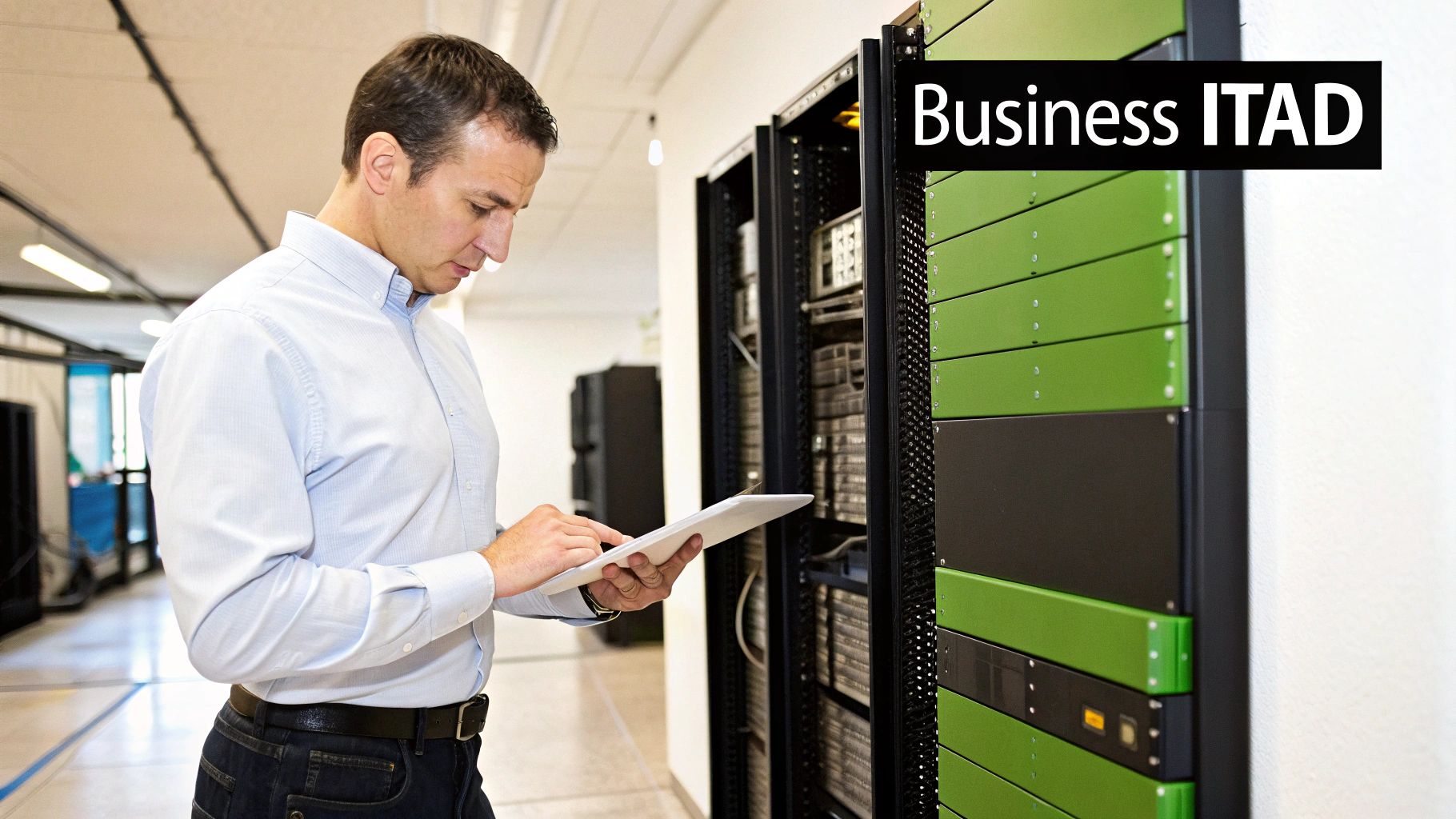
Managing the end-of-life for your company's technology assets is a high-stakes process. Obsolete servers, outdated laptops, and retired networking gear are repositories of sensitive corporate data, customer information, and valuable intellectual property. Standard recycling services are insufficient for commercial needs, as the risk of a data leak or a compliance violation under regulations like the FTC Disposal Rule is far too significant.
This is where a specialized B2B partner for electronics recycling in Atlanta becomes indispensable. Unlike consumer-focused services, a commercial ITAD provider understands the unique security and logistical challenges that businesses face. The objective shifts from mere disposal to a fully documented, secure process that guarantees both data security and environmental responsibility.
Core Services for Atlanta Businesses
A professional ITAD strategy is built on key services designed to protect your organization. These are not optional add-ons but fundamental components of a secure IT equipment disposal plan for any enterprise.
A professional service should always include:
- Certified Data Destruction: This goes far beyond simple file deletion. It involves processes like NIST 800-88 compliant data wiping or physical hard drive shredding to ensure information is completely unrecoverable.
- Secure Logistics and Pickup: Professional crews manage the on-site packing, inventorying, and secure transportation of your assets directly from your facility, maintaining a secure chain of custody.
- Compliance Documentation: Upon completion, your business receives official documentation, including Certificates of Data Destruction and Recycling, which serve as proof of proper disposal for audits.
- Asset Value Recovery: Many retired IT assets retain residual market value. An ITAD partner can assess this equipment and provide a financial return, turning a disposal cost into a revenue opportunity.
Choosing the right partner means transforming a potential liability into a managed, risk-free process. It's about ensuring every retired asset is handled with the same level of security and professionalism as your active network.
Here's a quick look at how these services break down for Atlanta businesses.
Atlanta Business E-Waste Services at a Glance
| Service Category | Common Equipment Handled | Core Business Benefit |
|---|---|---|
| Data Destruction | Servers, Laptops, Hard Drives, PCs | Protects sensitive data and ensures regulatory compliance. |
| Secure Logistics | Data Center Equipment, Networking Gear | Minimizes internal resource drain and guarantees a secure chain of custody. |
| IT Asset Disposition | Computers, Monitors, Phones, Tablets | Recovers value from retired assets, turning costs into revenue. |
| Certified Recycling | All electronics, including cables & peripherals | Ensures environmentally responsible disposal and provides compliance proof. |
This table highlights how a dedicated B2B service addresses the specific needs of a business, from security to financial returns.
The ultimate goal is to provide complete peace of mind. By working with a certified expert, you delegate the complexities of data security, environmental compliance, and logistics to a team equipped to handle them. This allows your IT and facilities staff to focus on core business operations, confident that your retired assets are being managed responsibly.
For a deeper look into how these processes work, you can learn more about our business IT equipment recycling and disposal services. This strategic approach is what separates simple recycling from true IT asset management.
Why Certified IT Asset Disposal Is Non-Negotiable
When your Atlanta business retires a server, laptop, or hard drive, the subsequent steps are critically important. Entrusting this equipment to an uncertified recycler is a significant risk, as you lose control over where your devices—and the data they contain—will end up.
In contrast, partnering with a certified IT Asset Disposal (ITAD) provider ensures a secure, documented chain of custody. Every step is tracked, secured, and accounted for, transforming a potential liability into a managed, risk-free process. For most businesses, this is not a matter of preference but a legal and financial imperative.
Navigating the Maze of Compliance Regulations
Many companies in Atlanta are subject to strict data protection laws that dictate how sensitive information must be handled, even after the hardware is obsolete. Failure to comply can result in substantial fines, legal action, and significant reputational damage.
A certified ITAD process is designed to meet these complex requirements. Key regulations that make professional disposal essential include:
- HIPAA (Health Insurance Portability and Accountability Act): Healthcare providers and associated businesses must ensure patient health information (PHI) is rendered unrecoverable from retired equipment.
- GLBA (Gramm-Leach-Bliley Act): Financial institutions have a legal obligation to protect consumers' private financial information, with stringent rules for the disposal of records and storage media.
- FTC Disposal Rule: This rule requires businesses to take "reasonable measures" to protect against unauthorized access to consumer information during its disposal.
An informal agreement with a local scrap hauler offers no protection against violations of these regulations. Only a certified process provides the auditable proof required to demonstrate due diligence.
The Power of Documentation and Chain of Custody
The primary distinction between casual recycling and professional ITAD lies in the documentation. A certified partner provides a clear paper trail that formally transfers liability from your company and proves responsible action. This is a non-negotiable for any business that values its security and reputation.
An undocumented disposal is an unproven disposal. If a data breach is ever traced back to your old equipment, the burden of proof is on you. A Certificate of Data Destruction is your official evidence of compliance.
This documented chain of custody creates a transparent record of your assets from the moment they leave your facility. It includes detailed asset tracking, serialized inventory lists, and the crucial final Certificate of Data Destruction. This certificate is your ultimate safeguard, verifying that all data was irretrievably destroyed according to industry standards. This focus on security and compliance is a core component of IT asset disposition. Learn more about the full scope of what IT asset disposition covers in our detailed guide.
The sheer volume of e-waste generated underscores the need for professional management. For businesses, this highlights the importance of selecting a partner who can guarantee both data security and proper environmental processing. By prioritizing certified ITAD for your electronics recycling in Atlanta, you protect your data, maintain compliance, and uphold your commitment to corporate responsibility.
A Practical Guide to Secure Data Destruction
When a business in Atlanta retires its IT assets, the hardware's value is minimal compared to the data it contains. That sensitive information is far more valuable—and vulnerable. Ensuring that customer lists, financial records, or proprietary secrets are completely and permanently destroyed is a fundamental aspect of risk management. This guide outlines professional methods for secure data destruction.
Understanding these options is the first step toward making an informed decision to protect your company's most critical information.
Choosing The Right Destruction Method
The appropriate data destruction method depends on your industry, compliance requirements, and risk tolerance. A technology startup may find certified, off-site data wiping suitable for retired laptops. In contrast, a healthcare provider managing patient records under HIPAA will likely require on-site physical shredding.
There are three primary professional data destruction methods:
- NIST 800-88 Compliant Data Wiping: This process uses specialized software to overwrite the entire hard drive with random data, making the original information unrecoverable. This method is ideal for newer, valuable equipment intended for refurbishment and resale.
- Degaussing: This technique employs a powerful magnetic field to scramble the magnetic coating on a hard drive or backup tape, instantly obliterating the stored data. It is a fast and effective method for making storage media unreadable.
- Physical Shredding: This is the most definitive form of data destruction. An industrial shredder pulverizes the hard drive into small, unrecognizable metal fragments, making it the preferred method for devices that held highly sensitive information or for failed media.
The initial decision, however, is choosing between a certified or uncertified recycler.
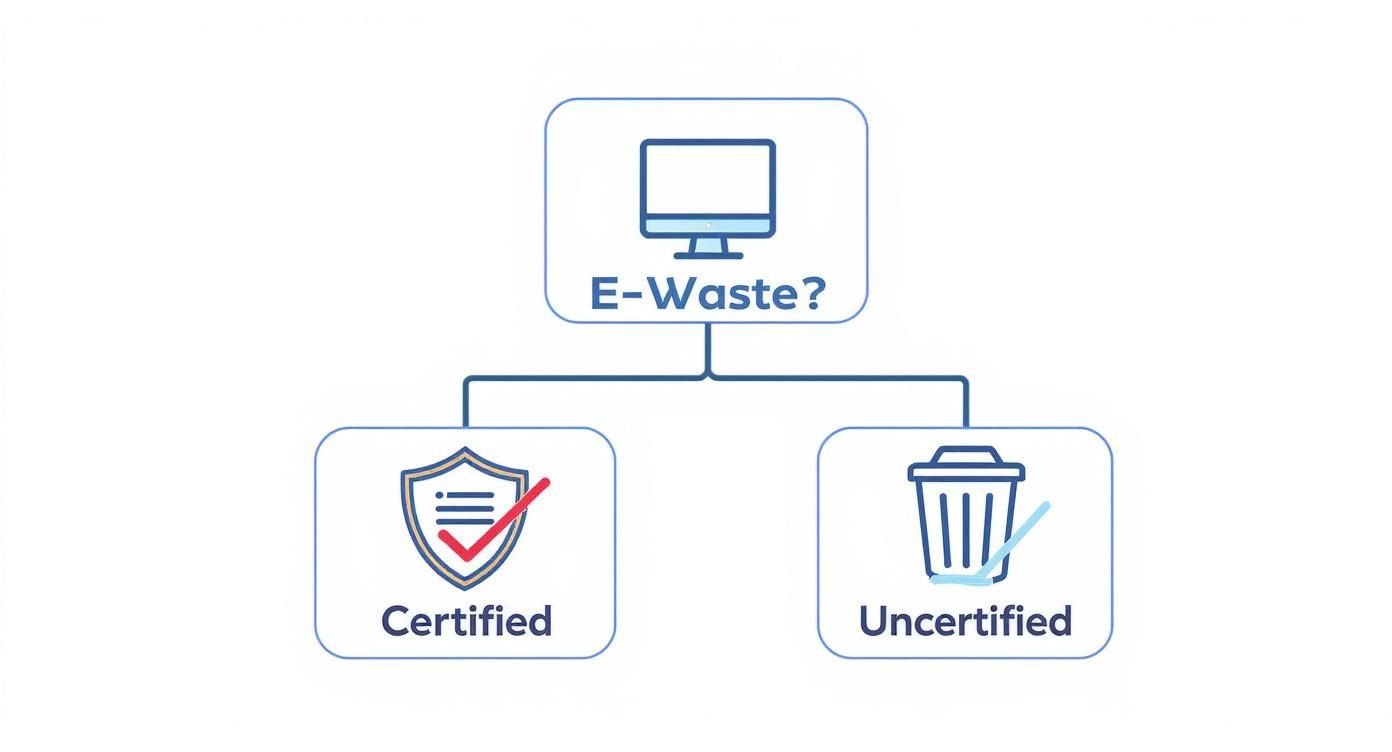
As illustrated, only a certified partner guarantees both data security and proper environmental handling, which is the foundation of a secure and compliant e-waste strategy.
Security Levels And Compliance Alignment
Each destruction method offers a different level of security and aligns with specific compliance regulations. Understanding how to wipe a computer hard drive correctly is crucial, as software-based approaches must meet strict standards, such as those from the National Institute of Standards and Technology (NIST), to be considered compliant.
The ultimate goal of data destruction is irretrievability. Whether through software or physical force, the chosen method must guarantee that no trace of the original data can ever be reconstructed.
For instance, NIST 800-88 provides a clear framework for media sanitization, assisting organizations in selecting the appropriate level of data wiping. However, physical destruction is often considered the gold standard for maximum security because it provides absolute visual proof of disposal. This is why many organizations with strict compliance mandates, such as in finance or healthcare, opt for on-site shredding services.
For an added layer of security, many companies use robust encryption techniques for data protection long before hardware is decommissioned.
The table below compares these methods to aid in your decision-making.
Comparing Data Destruction Methods For Businesses
Choosing the right data destruction method is crucial for protecting sensitive information and meeting compliance standards. This table compares the top three professional methods to help you decide which is best suited for your business's needs.
| Destruction Method | How It Works | Security Level | Best For |
|---|---|---|---|
| Data Wiping (NIST 800-88) | Software overwrites the entire drive with random data, making original information unrecoverable. | High | Reusable assets (laptops, servers) that will be refurbished or resold; meeting most compliance needs. |
| Degaussing | A powerful magnetic field erases the magnetic data on hard drives and tapes, rendering them useless. | Very High | End-of-life magnetic media (HDDs, tapes); quick and effective for large volumes of media. |
| Physical Shredding | An industrial shredder grinds the hard drive into small metal fragments, completely destroying it. | Maximum | Highly sensitive data (government, healthcare); failed or obsolete drives; provides visual proof of destruction. |
Ultimately, a certified partner for electronics recycling in Atlanta can help you assess your needs and select the most appropriate method. By matching the destruction technique to your specific risk profile, you ensure your company's information is handled with the highest level of care, turning a potential liability into a securely managed and documented process.
Handling Specialized Commercial Equipment
Beyond standard office IT, many Atlanta businesses utilize specialized commercial equipment that typical recyclers are not equipped to handle. The disposal of these complex assets requires expertise, meticulous planning, and an understanding of industry-specific regulations. A true IT Asset Disposition (ITAD) partner excels in managing such high-stakes projects for various industries.
Whether decommissioning a data center or retiring sensitive medical devices, the process is far more complex than a standard office cleanout. These tasks demand a partner capable of managing intricate logistics, ensuring absolute data security, and providing documentation that satisfies stringent audits.
Data Center Decommissioning Services
Decommissioning a data center is a massive undertaking with no margin for error. It is a highly coordinated effort that involves more than just unplugging servers. A successful project requires meticulous planning and flawless execution to prevent operational downtime, data loss, and physical risks.
The logistical challenges are significant and necessitate a seasoned team. The process involves:
- Project Management: A dedicated project manager coordinates every phase, from the initial site survey to final asset removal, ensuring the project stays on schedule and within budget.
- Server Rack and Equipment Removal: Safely disconnecting, de-racking, and transporting hundreds or thousands of servers, switches, and storage arrays requires specialized equipment and trained technicians.
- Cable Management and Abatement: Managing and recycling extensive copper and fiber optic cabling is a major part of the process, leaving the facility clean and ready for its next use.
- Secure On-Site Data Destruction: For maximum security, many data center projects include on-site hard drive shredding or wiping before any equipment leaves the premises.
A data center decommissioning isn't just a cleanup job; it's a strategic migration of critical infrastructure. The right partner minimizes risk and disruption, ensuring a seamless transition from old hardware to new.
Medical and Laboratory Equipment Disposal
For healthcare facilities and research laboratories in Atlanta, the disposal of electronic equipment is governed by extremely strict regulations designed to protect patient privacy and prevent hazardous contamination. Compliance with regulations like the Health Insurance Portability and Accountability Act (HIPAA) is mandatory. Failure to properly sanitize or destroy patient data from medical devices can result in severe penalties.
Specialized recyclers understand these unique requirements. The process for handling medical and lab equipment includes several critical steps:
- HIPAA-Compliant Data Destruction: Any device containing protected health information (PHI), such as patient monitors, imaging machines, and diagnostic equipment, must undergo certified data destruction.
- Proper Handling of Biohazards: Equipment from labs or clinics may require special handling to ensure it is free from biological contaminants before recycling.
- Chain-of-Custody Documentation: Detailed records are created to track each asset from your facility to its final destruction, providing a clear, auditable trail for compliance.
Beyond typical office IT, businesses often need to dispose of electronic components from larger machinery, like industrial battery chargers, in an environmentally responsible manner. These items, like medical devices, fall outside the scope of generic recyclers and require a partner who can manage a wide range of commercial electronics. By working with a specialist in commercial electronics recycling in Atlanta, organizations in sensitive fields can ensure their retired assets are managed securely, compliantly, and responsibly.
The Logistics of Commercial E-Waste Pickup
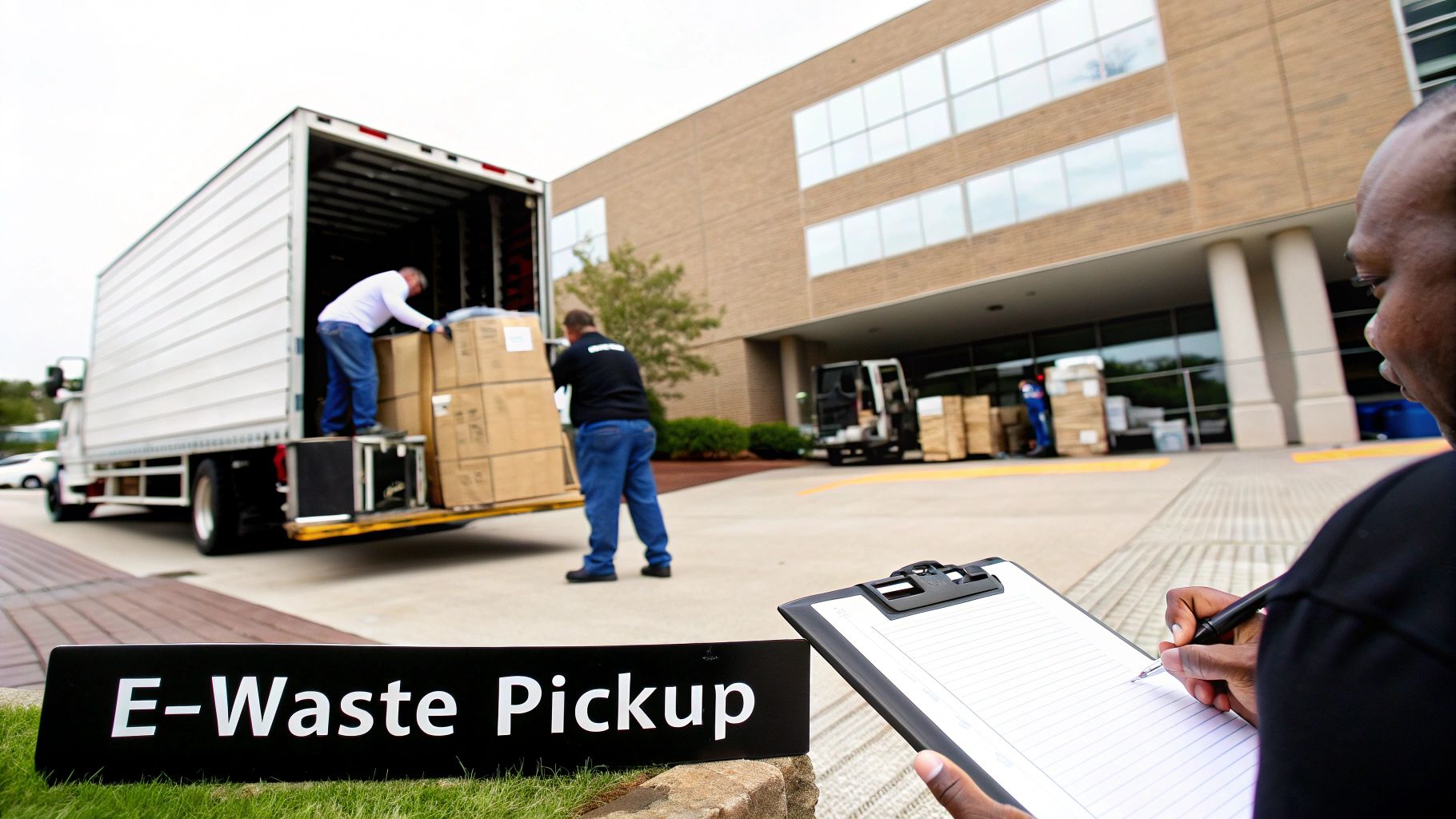
How does a pallet of obsolete servers get from your data center to a secure recycling facility? For businesses in Atlanta, a professional e-waste pickup is designed to be seamless and transparent. It's a carefully managed process that eliminates the typical challenges of large-scale equipment removal.
The entire operation is structured to minimize disruption to your workflow while maximizing security and accountability. A professional logistics plan transforms a complex task into a straightforward, worry-free experience.
From Initial Quote To Scheduled Pickup
The process begins with an inquiry. Your business provides a basic inventory of the IT assets for disposal, including the type of equipment, quantity, and location within your building. Based on this information, a professional ITAD partner will provide a clear, upfront quote.
This initial step is crucial. It helps determine if your pickup qualifies for free service, if there are costs for specialty items, or if your assets have resale value that could generate a return. Once terms are agreed upon, a pickup is scheduled at a convenient time, including after hours or on weekends.
On-Site Packing and Secure Transport
On the scheduled day, a trained and insured logistics team arrives at your Atlanta location to manage the entire removal. This is a white-glove operation designed to protect your property and assets.
The on-site crew handles everything:
- Professional Packing: Equipment is carefully packed and palletized on-site using appropriate materials to prevent damage during transport.
- Secure Loading: Your assets are loaded onto a secure, GPS-tracked vehicle, maintaining a constant, monitored chain of custody from the moment they leave your premises.
- Minimal Disruption: The team works efficiently and professionally to remove the equipment with minimal impact on your daily operations.
This level of service defines professional electronics recycling in Atlanta and is distinct from the risks associated with unvetted haulers. You can see the full scope of our process in our guide to Atlanta recycling and disposal logistics.
The Importance of Complete Documentation
The documentation is perhaps the most critical part of the process. This paperwork formally transfers liability away from your company and provides the auditable proof of compliance you need.
Every professional pickup should end with you receiving critical documents. An asset list confirms exactly what was taken, while a transfer of liability form legally hands over responsibility for the equipment.
This commitment to responsible recycling aligns with national objectives, such as the 2021 National Recycling Strategy from the U.S. EPA. Professional recyclers help advance a circular economy model by focusing on resource reuse and waste minimization. This documented, by-the-book approach ensures accountability at every step, providing your business with complete peace of mind.
Turning Retired IT Assets into Revenue
Disposing of outdated technology does not have to be solely an expense. For many Atlanta businesses, a strategic IT Asset Disposition (ITAD) plan can convert old equipment into a new revenue stream. This approach, known as IT Asset Value Recovery (ITAVR), focuses on maximizing the remaining financial life of your equipment.
ITAVR is most effective for relatively recent equipment that no longer meets your company's high-performance standards but is still valuable on the secondary market. This includes servers, networking gear, and laptops that are only a few years old.
How Asset Value Recovery Works
The process is straightforward. A certified ITAD partner assesses your inventory of retired assets to determine their fair market value, considering factors like age, condition, configuration, and current market demand.
If the equipment has value, it undergoes a comprehensive refurbishment process:
- Secure Data Destruction: All data is professionally wiped according to NIST 800-88 standards, prioritizing the security of your sensitive information.
- Testing and Repair: Technicians test all components, performing necessary repairs or upgrades to restore the hardware to optimal performance.
- Cosmetic Refurbishment: The equipment is thoroughly cleaned to ensure it is in marketable condition.
A buyback program transforms a disposal project into a financial win, directly maximizing the return on your initial technology investment. This is the difference between simply throwing tech away and making a strategic financial decision.
From Cost Center To Revenue Stream
Once refurbished, the equipment is sold through established resale channels. Your business receives a portion of the proceeds through a buyback or profit-sharing agreement. This provides a direct financial return that can offset the cost of recycling non-valuable assets or supplement your IT budget. For a deeper dive, check out our guide on how businesses can benefit from Atlanta IT asset disposal and profit sharing.
This professional focus on ITAVR is part of a larger environmental effort. By choosing professional electronics recycling in Atlanta, your company not only improves its bottom line but also contributes to positive local and national sustainability trends.
Atlanta Business Recycling FAQs
When disposing of corporate IT assets, many questions arise. To assist IT managers, facility supervisors, and business owners in Atlanta, we have compiled answers to frequently asked questions about our commercial electronics recycling and IT asset disposal services.
Our services are designed specifically for the security, compliance, and logistical needs of businesses.
What Types of Businesses in Atlanta Do You Service?
We focus exclusively on serving commercial and enterprise clients throughout the Atlanta metro area. Our partners include:
- Corporations and Enterprises: From small businesses to Fortune 500 companies managing regular asset refresh cycles.
- Data Centers: We handle complex decommissioning projects and the secure removal of server room equipment.
- Healthcare Facilities and Hospitals: Our services feature strict HIPAA-compliant data destruction and proper disposal of medical equipment.
- Government Agencies and Educational Institutions: We assist these organizations in meeting their stringent data security and disposal requirements.
Our entire process is structured for business-to-business (B2B) needs; we do not service residential or household e-waste.
Is There a Cost for Your Recycling Pickup Service?
For most of our business clients, there is no cost. If you have a significant volume of valuable IT equipment—such as newer servers, laptops, and networking gear—our pickup and recycling services in Atlanta are typically free.
A fee may apply for items with high recycling costs and no resale value, like old CRT monitors, or for certain on-site services. However, our IT asset value recovery program often generates a cash return from your valuable equipment, which can cover any fees and potentially provide a net profit to your company.
What Documentation Does My Company Receive?
Comprehensive documentation is the cornerstone of a compliant ITAD strategy. We provide a complete set of documents to give your business a clear, auditable trail of the entire disposal process.
A documented chain of custody is your proof of due diligence. This paperwork formally transfers liability away from your organization and demonstrates compliance with regulations like the FTC Disposal Rule.
Upon completion of our service, your company will receive:
- A Certificate of Recycling: Verifying that your assets were managed in an environmentally responsible manner.
- A Certificate of Data Destruction: Confirming that all data was permanently destroyed according to certified standards.
- Detailed Asset Reports: A serialized inventory of all processed equipment for your records.
How Do I Schedule a Pickup for My Atlanta Office?
Scheduling a pickup is a simple and straightforward process. The first step is to contact our team with a general overview of your inventory, including the types and approximate quantities of equipment.
We will then provide a prompt quote and work with you to schedule a pickup time that fits your schedule and minimizes operational disruption. Our professional logistics team handles all on-site tasks, from packing and palletizing to the secure transport of your assets.
Contact Beyond Surplus for certified electronics recycling and secure IT asset disposal. Schedule a pickup or learn more about our services for your Atlanta business at https://technostolic.com.