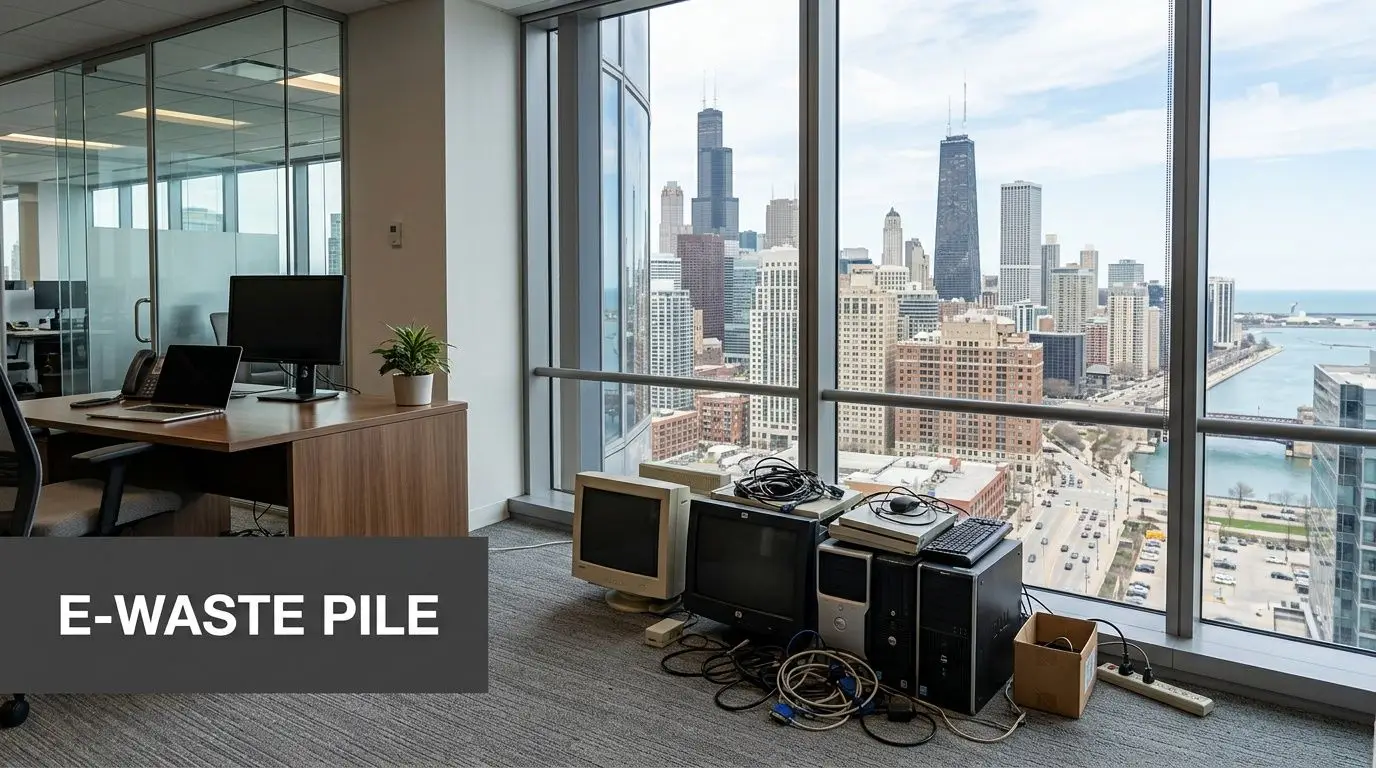
Chicago IT managers usually start with a practical problem. A storage room is filling up with retired laptops, aging switches, monitors from an office refresh, and a few servers that came out of a rack last quarter. Someone types ewaste store Chicago into search, hoping for a quick answer.
That search term makes sense. It sounds efficient. Find a place, drop off the gear, move on.
For a business, that shortcut often misses the fundamental issue. Old electronics aren't just waste. They are data-bearing assets, regulated assets, and sometimes recoverable assets. The disposal decision touches security, legal exposure, procurement, facilities, and finance. If your company operates in healthcare, finance, legal services, manufacturing, or any environment with sensitive records, the wrong disposal path can create a problem long after the equipment leaves your office.
The E-Waste Challenge for Chicago Businesses
A Chicago business doesn't need a global lecture on waste. It needs a workable answer for equipment sitting in a Loop office, a suburban warehouse, or a clinic with limited storage. Still, the scale matters because it explains why simple disposal models break down so often.
In 2022, the world generated a record 62 million tonnes of e-waste, an 82% increase from 2010. Projections indicate 82 million tonnes by 2030, yet only 22.3% is currently collected and recycled, according to the Global E-waste Monitor 2024.
That headline figure becomes a business problem in ordinary ways:
- Office relocations: Old desktops, docking stations, and phones surface all at once.
- Lease returns: Equipment has to move on a deadline, not whenever a drop-off site is convenient.
- Security reviews: Legal or compliance teams ask for destruction records that a casual recycler may not provide.
- Multi-site cleanup: A single Chicago HQ may also need collection from branch offices.
The phrase ewaste store usually points people toward convenience. Businesses need process. They need inventory control, pickup planning, documentation, and a defined handoff. That's why companies looking for e-waste recycling services often discover that disposal isn't the hard part. Proving what happened to each asset is.
Practical rule: If your equipment ever held customer, employee, patient, or financial data, this is an ITAD decision before it's a recycling decision.
Decoding the E-Waste Store Model
An ewaste store is usually built around a simple operating model. Bring electronics to a fixed location. Staff accepts the items. Materials move into a recycling stream. That can work for small volumes and low-risk items.
For commercial use, the model has limits.
What the model is built for
Think of an ewaste store like a public mailbox. It's useful when the item is small, the transaction is simple, and the sender doesn't need special handling. Most stores are optimized for intake, not enterprise asset control.
The problem isn't that drop-off is wrong. The problem is that business disposition needs more than intake.
The fixed-location approach often fails when a company has bulk equipment, multiple addresses, or a requirement for one continuous chain of custody across all assets, as reflected in Illinois electronics collection models discussed by the Illinois EPA electronics recycling collection information.
Where businesses run into friction
A Chicago IT manager usually needs answers to questions an ewaste store may not be set up to handle:
- Who picks up from our office or warehouse?
- How are serialized assets tracked from removal through processing?
- What documentation will legal, audit, or procurement receive?
- Can the vendor coordinate multiple sites under one project?
- Is there any asset remarketing or buyback option?
A general ewaste store service model may help with basic collection. It usually doesn't solve logistics, documentation, and liability management at business scale.
A business asset doesn't become low risk because it's old. It becomes higher risk if nobody can prove how it was handled.
The key misunderstanding
Many companies search for an ewaste store because they think the choice is about where equipment goes. The primary choice is about how equipment leaves your control.
That distinction matters. Once hardware leaves your premises, your exposure depends on whether the vendor can document custody, data handling, downstream processing, and final disposition in a way your organization can defend later.
E-Waste Store vs. Strategic ITAD Partner A Critical Comparison
The cleanest way to evaluate options is side by side. A drop-off recycler and a strategic ITAD partner are not the same service with different branding. They solve different problems.

What changes when risk is the lens
An ewaste store focuses on collection. An ITAD partner focuses on asset control, data destruction, compliance evidence, and value recovery.
That sounds like a subtle difference. In practice, it's the entire decision.
| Feature | Typical E-Waste Store | Professional ITAD Partner (Beyond Surplus) |
|---|---|---|
| Data handling | Basic acceptance of devices | Documented data destruction workflows |
| Pickup model | Customer drop-off | Scheduled pickup and logistics coordination |
| Chain of custody | Limited or informal | Auditable chain of custody |
| Reporting | Basic receipt, if any | Asset-level reporting and certificates |
| Compliance use | General recycling record | Documentation suited for internal audit and regulated environments |
| Value recovery | Usually none | Refurbishment, resale, and buyback where applicable |
| Multi-site support | Often limited | Coordinated commercial projects across locations |
The comparison that matters in procurement
Security teams ask one set of questions. Finance asks another. Facilities asks a third. A strategic ITAD provider has to satisfy all three.
Consider the practical trade-offs:
- Data security: An ewaste store may accept your hardware. That doesn't mean it offers certified wiping or physical destruction records.
- Compliance posture: A recycler may process material responsibly, yet still not provide the documentation your auditors expect.
- Operational scale: One office with ten devices is different from a hospital group, law firm, or manufacturer moving assets from several sites.
- Residual value: Equipment that still has market value shouldn't be treated the same way as scrap.
The due diligence work is where weak vendors usually get exposed. If you need a framework for evaluating controls, documentation, and downstream handling, this ITAD vendor due diligence checklist is the kind of review procurement and IT should run before any pickup is scheduled.
A useful decision test
If your company needs any of the following, you're not looking for a simple ewaste store:
- Audit-ready records
- Serialized asset tracking
- Pickup from business locations
- Certified destruction documentation
- Buyback or remarketing review
- Project management for decommissions
The wrong vendor can remove the pile from your office and leave the risk behind.
Essential Services Beyond Basic Electronics Recycling
The difference between basic recycling and business-grade ITAD shows up in the services that happen before and after the truck arrives.

For businesses in regulated sectors, choosing an ITAD provider is a data governance decision. The certificate of destruction and auditable chain of custody are essential for liability transfer and for aligning with standards such as the FTC Disposal Rule and NIST 800-88, as discussed by STS Electronic Recycling on secure documentation and compliance.
Secure data destruction
Not all retired equipment should be shredded immediately. Some assets are suitable for software-based sanitization under controlled procedures. Others should be physically destroyed because the media condition, policy requirements, or risk profile demand it.
What matters is not the marketing label. It is whether the method is documented, repeatable, and tied to the specific asset.
A proper process typically includes:
- Asset identification: Devices are logged before destruction activity starts.
- Method selection: Wipe, degauss, shred, or a combination based on media type and policy.
- Verification records: The organization receives evidence, not just verbal assurance.
One useful primer for teams aligning retirement workflows with broader operations is this overview of best practice supply chain management strategies. The same discipline that protects inventory in motion also protects retired IT assets in transit.
Chain of custody and reporting
Many ewaste store options fall short in this area. Businesses don't just need a place to send equipment. They need a record of possession and transfer.
That means:
- Pickup documentation at origin
- Tracked movement between facilities
- Clear reconciliation of what was received
- Final reporting tied to the disposition outcome
A formal explanation of IT asset disposition practices helps clarify why disposal, data destruction, transport, and reporting have to work as one system.
Operational advice: If a provider can't explain how custody is documented from your loading dock to final processing, stop the evaluation there.
Logistics that fit business reality
Chicago companies rarely retire equipment from one perfect location. Hardware sits in branch offices, labs, closets, and server rooms. A professional ITAD program accounts for staging, packing, pickup windows, access restrictions, and after-hours coordination.
That isn't convenience. It's control.
Navigating Compliance The FTC Disposal Rule and Beyond
Compliance failures usually start with assumptions. A manager assumes drives were wiped. Procurement assumes the recycler provides adequate records. Legal assumes the vendor's standard receipt is enough.
Those assumptions are expensive.

Enterprises can achieve 20-30% cost reduction through consolidated pickups and value recovery, but the larger financial issue is risk mitigation. With the average cost of a data breach at $4.45 million, 100% auditable chain-of-custody tracking and certified data destruction are critical safeguards, according to ERI's discussion of e-waste recycling metrics and risk controls.
What the FTC Disposal Rule means in practice
For an IT manager, the rule is less about legal theory and more about evidence. If equipment contained sensitive consumer information, your company needs a disposal process that is reasonable, documented, and defensible.
That usually means your records should show:
- What assets were removed
- When custody changed
- How data was destroyed
- What certificate or report closed the transaction
A simple drop-off interaction often doesn't create that paper trail. That's the gap.
Why standards matter
Standards such as NIST 800-88 give organizations a common framework for media sanitization decisions. They help IT, compliance, and audit speak the same language.
If your team needs a practical reference point, NIST SP 800-88 guidance for data sanitization is useful because it frames destruction as a control, not a clerical afterthought.
The hidden cost of weak documentation
The hard part after an incident isn't only remediation. It's proving that your organization followed a defensible process.
Without that, questions pile up quickly:
- Who had the device last?
- Was the serial number logged?
- Was the drive wiped, destroyed, or neither?
- Did the vendor issue a certificate that maps to the actual asset list?
If your disposal records wouldn't satisfy your own internal audit team, they won't look stronger during a breach review.
The Financial Case for Professional IT Asset Disposition
Too many companies treat end-of-life equipment as a hauling problem. That misses the financial upside.
The better approach is to separate assets into categories. Some should be destroyed. Some should be recycled. Some should be refurbished or remarketed because they still hold value.
Refurbishment usually beats scrap
Expert ITAD operators recommend prioritizing refurbishment because it can extend a server's life by 2-3 years and achieve 80-90% material reuse, compared with recycling's 22% rate. Mid-tier servers can fetch $100-$500 per unit in resale, according to Human-I-T's overview of data center recycling and refurbishment.
That changes the economics of a decommissioning project.
A procurement or finance team should ask:
- Which assets still have secondary-market demand?
- Which components can be harvested for reuse?
- Which items are only worth processing as scrap?
- Which devices should bypass resale entirely because policy requires destruction?
Value recovery is also operational discipline
Organizations usually lose money in one of three ways.
First, they mix recoverable hardware with scrap and never evaluate resale potential.
Second, they delay disposition so long that useful hardware ages out of the secondary market.
Third, they choose a vendor that can recycle but can't triage for remarketing.
None of this means every retired asset should be sold. It means every asset should be evaluated intentionally.
The strongest ITAD programs don't ask, "How do we get rid of this?" They ask, "What is the right disposition path for this specific asset?"
Your IT Disposition Strategy for Chicago Businesses A Clear Path Forward
If you're in Chicago and your team is sitting on retired equipment, keep the process simple and controlled.
Start with the asset list
Build an inventory before you schedule anything. Include device type, quantity, location, and whether each item contains storage media. If serials are available, capture them now instead of reconstructing them later.
Match the disposition path to the risk
A server from a finance environment doesn't belong in the same workflow as a non-data-bearing peripheral. Separate assets that need certified destruction from assets that may qualify for refurbishment or resale.
A useful companion to that discipline is this guide to IT asset management best practices. The core idea is sound. Good retirement outcomes start with good asset control upstream.
Schedule commercial pickup and close the file properly
For business projects, the handoff should include pickup coordination, chain-of-custody documentation, final reporting, and certificates for your records. Beyond Surplus provides commercial pickup, secure data destruction, recycling documentation, and IT asset recovery workflows for organizations managing end-of-life equipment across single or multiple sites.
Stop searching for an ewaste store when the actual requirement is risk-controlled IT asset disposition.
Contact Beyond Surplus for certified electronics recycling and secure IT asset disposal.