A lot of IT teams only think about ATL when a shipment is already scheduled, a truck is loaded, and someone is asking which entrance to use. That’s usually too late. If you’re coordinating a server pickup, a data center de-install, or outbound asset recovery, the hartsfield jackson atlanta international airport location is not just a map pin. It affects routing, handoff timing, chain of custody, and whether your team spends the day moving equipment or waiting in traffic.
For business logistics, especially around retired IT assets, the airport’s location matters because every avoidable delay creates risk. Drivers get pushed toward passenger areas. Freight cutoffs get missed. Secure loads sit longer than planned. That’s why Atlanta teams often build airport access into the pickup plan itself, not as an afterthought.
Why the Airport's Location Matters for Business Logistics
A common situation looks like this. An IT director has approved a refresh across multiple offices. The hardware is palletized, drives need secure handling, and one part of the load may need to move quickly through Atlanta. At that point, the airport’s location becomes operational, not informational.
Hartsfield-Jackson Atlanta International Airport served 108.1 million passengers in 2024, supported by 796,224 aircraft operations, and generated a $34.8 billion direct economic impact in metro Atlanta according to the Atlanta Airport Chamber. That scale is exactly why ATL helps and complicates logistics at the same time.
What works
- Planning airport access early so the trucking route matches the actual cargo destination.
- Separating passenger navigation from freight navigation in dispatch instructions.
- Using local pickup support when equipment needs controlled movement from office, lab, or data center to a secure downstream handoff, such as Atlanta e-waste pickup services.
What does not
- Sending a commercial driver with only the airport name and no gate-level instructions.
- Treating ATL like a single drop point.
- Scheduling sensitive IT loads with no room for road congestion or perimeter delays.
Practical rule: If the shipment is sensitive enough to document by serial number, it’s sensitive enough to route by exact airport access point.
Pinpointing the Hartsfield Jackson Atlanta International Airport Location
The core location data needs to live in your dispatch notes, not just in someone’s browser history.
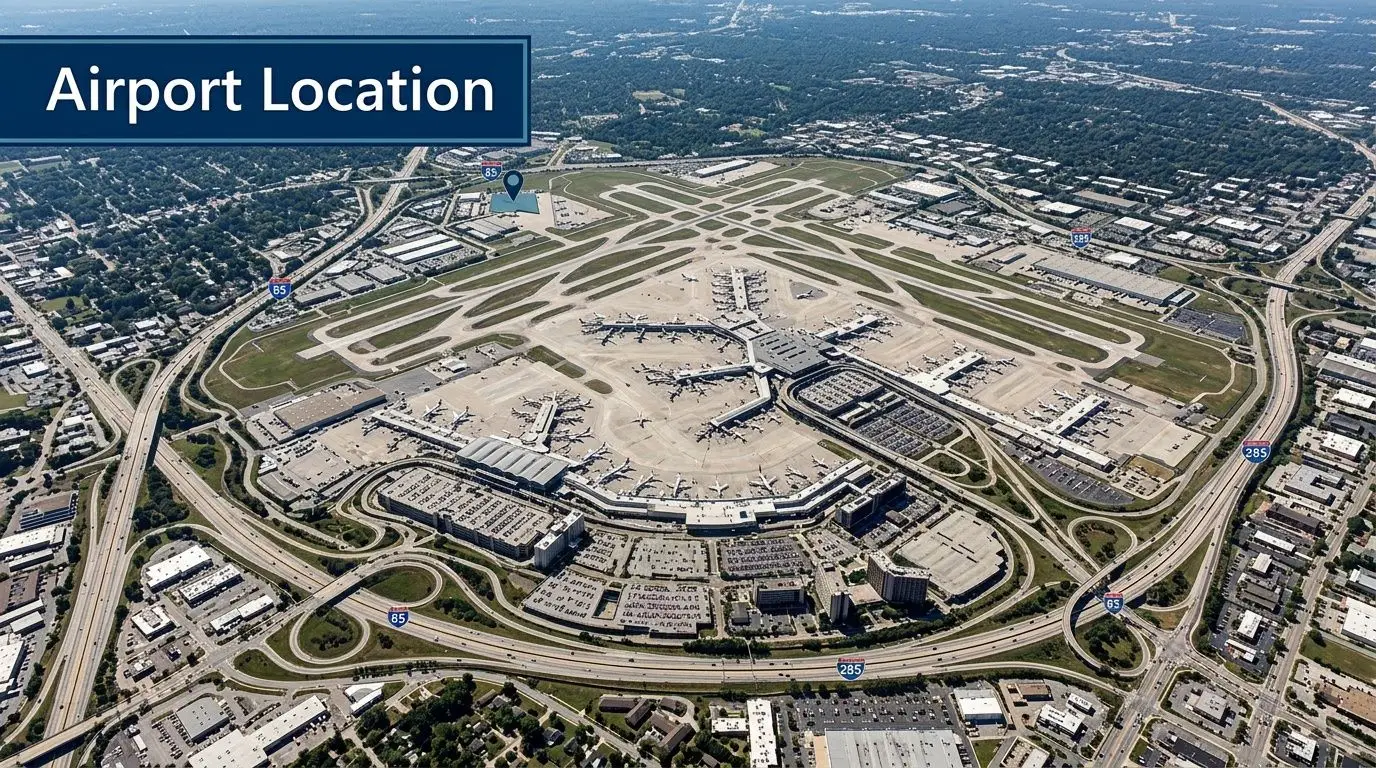
ATL is located at 33°38'12.1186"N, 084°25'40.3104"W, at an elevation of 1,026.2 ft, and sits 7 miles south of downtown Atlanta. Its proximity to I-85 and I-75 is a key logistics advantage, as noted by AirNav’s KATL airport profile.
The location details that matter
For business routing, use these points as your baseline:
- Official airport area in Atlanta, Georgia
- Coordinates for fleet systems instead of relying on a terminal search
- South of downtown Atlanta, which matters when dispatching from office corridors north of the city
- Direct relationship to I-75 and I-85, which is why ATL works well for regional consolidation
Why this changes dispatch quality
Typing “ATL” into a navigation app is fine for a traveler. It’s weak for a box truck, sprinter van, or secure electronics pickup. Commercial loads need route instructions tied to the exact side of the airport complex they’re approaching.
A good route note includes:
- The airport coordinates or confirmed destination point
- The intended access side
- A reminder that passenger terminal routing may be incorrect for commercial handoff
Passenger directions get people to a building. Logistics directions get assets to the right facility.
Navigating the Airport Layout for Commercial Access
ATL isn’t one building. It’s a 4,700-acre operating environment, and that scale changes how commercial teams should move through it. A key expansion was the Maynard H. Jackson Jr. International Terminal, which supported continuing passenger and cargo growth, according to the airport overview on Wikipedia.

Think in zones, not terminals
For IT asset movement, the passenger view of ATL is the wrong mental model. What matters is the difference between public terminal access and operational areas used by freight, support vehicles, and controlled handoffs.
Key commercial planning zones include:
- Cargo facilities where freight processing happens
- Perimeter access gates where vehicle entry control matters
- CBP-related areas when a shipment has international handling requirements
- Support and service areas that can affect where a driver is allowed to stage
The practical mistake to avoid
Many teams send drivers toward the most recognizable terminal. That’s usually the wrong move for commercial electronics loads. The better approach is to treat ATL like a campus. Confirm the exact facility, then match the approach road and entry side to that facility.
For companies handling loading, packing, and secure removal at the client site first, onsite electronics recycling in Georgia often simplifies the airport handoff because the material is already sorted and documented before transport begins.
Ground Transportation and Commercial Staging Zones
Ground access is where well-planned jobs still go sideways. The truck reaches airport property, then loses time because the driver is mixed in with passenger traffic, circulation loops, or the wrong curbside flow.

Separate public curb access from commercial staging
Passenger pickup logic doesn’t transfer well to secure IT logistics. Curbside areas are built for short dwell times and traveler turnover. Commercial teams need a route that supports check-in, paperwork, controlled unloading, and a clean departure path.
Use this operating checklist
- Confirm the receiving party first. Don’t dispatch until the cargo contact, handler, or receiving dock is identified.
- Route to the correct side of the airport. “Airport delivery” is too vague for a secure chain-of-custody job.
- Stage offsite if needed. If the truck arrives early, holding nearby is often safer than circling inside airport traffic.
- Keep paperwork accessible. Drivers shouldn’t be searching for manifests or asset lists at the gate.
Best practice for Atlanta pickups
For loads coming from business districts, medical campuses, data centers, or mixed office environments, it helps to finalize asset packaging before the airport leg begins. That reduces dwell time once the vehicle enters the airport area.
A coordinated IT equipment pickup in Georgia usually works best when the airport transfer is treated as the final segment of a controlled logistics chain, not the point where sorting and decisions start.
A secure load should arrive ready to move, not ready to be figured out.
Optimizing Logistics with Smart Travel Time Planning
ATL’s location is strong for regional reach, but timing around it can be unforgiving. Recent analysis found that the airport perimeter experiences 20-30% higher congestion than comparable hubs, with average delays of 25 minutes during peak hours, and that freight haulers face a 15% failure rate in on-time arrivals when schedules don’t account for that traffic, according to Waze directions data and analysis for ATL.
When planning usually breaks down
The weak assumption is that a route estimate equals a real-world arrival time. Around ATL, that’s often false during busy windows. Perimeter congestion, lane choice, and the final approach into the airport complex all affect arrival consistency.
Better scheduling habits
| Planning choice | Result |
|---|---|
| Dispatching at peak traffic with no buffer | Higher risk of missed handoff windows |
| Sending a truck directly into airport circulation too early | More idle time and less control |
| Building a time cushion into the route plan | Better on-time performance and cleaner chain of custody |
A few rules help:
- Avoid peak-hour assumptions. Morning and late afternoon windows need extra protection in the schedule.
- Protect the final mile. Most missed timelines happen near the perimeter, not at the origin site.
- Use dispatch checkpoints. Confirm departure, perimeter arrival, and final gate approach.
Build the schedule around the airport’s friction, not the map’s optimism.
Strategic Planning for IT Asset Disposition at ATL
When IT asset disposition involves multiple offices, leased facilities, or decommissioned server rooms, ATL becomes useful because it sits at the I-75/I-85 nexus and supports 24-hour customs operations. That combination enables 15-25% faster ground handling and customs clearance for cargo handlers, according to Unisco’s ATL airport logistics profile. For time-sensitive asset recovery, that matters.

Where location intelligence helps ITAD
A secure ITAD workflow depends on more than destruction standards. It also depends on whether the transport path is predictable enough to preserve custody and meet downstream timing.
That means:
- routing loaded vehicles through the most practical airport approach
- avoiding unnecessary dwell time near public terminal traffic
- matching paperwork, packaging, and receiving instructions before the load moves
What strong operators do differently
Strong operators treat ATL as a logistics node inside a larger disposition plan. They coordinate site removal, serialization, packing, secure transport, and final transfer as one process. They don’t let the airport leg become a standalone scramble.
For organizations that need local handling plus broader coordination, Beyond Surplus in Atlanta operates in the market where these airport-related logistics decisions are made every day.
Your Partner for Secure Atlanta Logistics
Understanding the hartsfield jackson atlanta international airport location helps IT teams make better decisions long before a truck is loaded. The right coordinates improve dispatch. The right access point reduces confusion. The right traffic buffer protects deadlines and chain of custody.
That’s especially important when the cargo isn’t generic freight. Retired servers, storage arrays, network gear, and regulated devices need controlled movement from pickup through final disposition. If the route plan is sloppy, the risk shows up immediately in delays, documentation gaps, and unnecessary handling.
Teams that manage Atlanta-area removals well usually rely on local operating knowledge, disciplined scheduling, and a documented process from site exit to final processing. For Georgia organizations that need that support, Beyond Surplus Georgia is positioned in the market where those logistics details matter.
If your business needs certified electronics recycling, secure IT asset disposition, data destruction, or coordinated equipment pickups in Atlanta and beyond, contact Beyond Surplus.