When IT managers search for "recycling at best buy," they are typically looking for a simple, convenient solution to dispose of outdated company electronics. However, the critical question for any business is whether this consumer-focused program meets the stringent security and compliance requirements of a commercial enterprise.
For businesses, the answer is a firm no. While Best Buy's recycling program provides an excellent service for individuals disposing of personal devices, it is fundamentally ill-equipped to handle the volume, data security, and compliance needs of corporate IT asset disposal. It is a consumer solution, not a commercial one.
Consumer Convenience vs. Business Security Requirements
For any organization, IT asset disposal is not merely about clearing out storage space; it is a critical function involving data security, legal compliance, and liability management. The perceived simplicity of a retail drop-off can create a dangerous false sense of security, obscuring significant risks to your business.
Best Buy’s program is explicitly designed for households, demonstrated by its three-item-per-household-per-day limit. This policy alone makes it an impractical solution for any IT department, even for a small office refresh. More importantly, the process lacks a documented chain of custody and offers no certified proof that your company’s sensitive data has been destroyed in accordance with legal and industry standards.
The chart below highlights the fundamental differences between consumer recycling and professional IT asset disposal.
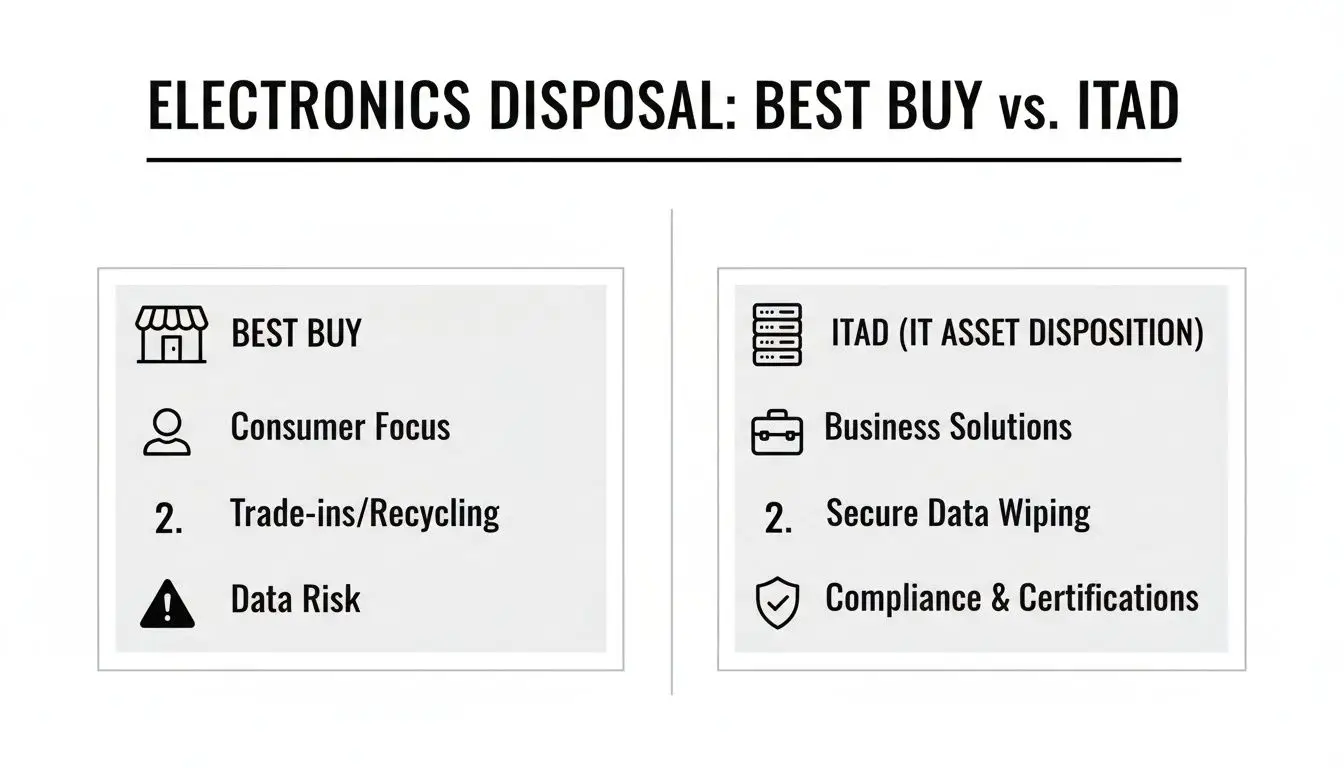
The distinction is clear: retail recycling is designed for consumer convenience, while professional IT Asset Disposition (ITAD) is engineered to protect and serve the interests of a business.
Why This Distinction Matters for Your Business
The moment a company asset is dropped into a retail recycling bin, your organization loses all control and traceability. There is no formal transfer of liability, no serialized asset tracking, and no guarantee that the data contained on the device will be destroyed according to regulatory standards.
Here is a summary of the critical business risks:
- Data Security: A retail program’s data wiping methods are a "black box," with no verification that they meet compliance standards. In contrast, a professional ITAD provider like Beyond Surplus delivers auditable data destruction with formal certificates.
- Compliance: Regulations like HIPAA, GLBA, and the FTC Disposal Rule mandate verifiable proof of secure data handling. A retail store receipt is insufficient for an audit; a Certificate of Data Destruction is required.
- Logistics and Scale: Businesses retire equipment in bulk. A true ITAD partner manages scheduled pickups, asset tagging, and logistics for any volume, from a few pallets of PCs to a complete data center decommissioning project.
Let's examine a direct comparison to further clarify the choice for businesses.
Best Buy Recycling vs. Professional ITAD for Businesses
| Feature | Best Buy Recycling (Consumer Focus) | Beyond Surplus (Professional B2B ITAD) |
|---|---|---|
| Data Security | Basic data wiping, not certified or auditable. | Certified, documented data destruction (NIST 800-88 standards). |
| Documentation | Standard retail receipt. | Certificate of Destruction, serialized reporting, chain of custody. |
| Volume Limits | 3 items per household per day. | No limits. Scaled for bulk corporate pickups. |
| Liability | Liability remains with your business. | Formal transfer of liability to the ITAD vendor. |
| Logistics | You must transport items to the store. | Secure, scheduled pickups from your business location. |
| Compliance | Does not meet business compliance needs (HIPAA, etc.). | Designed to ensure full compliance with data privacy laws. |
This table demonstrates that while both services provide value, they serve entirely different audiences and purposes. For a business, the risks associated with using a consumer-grade service for commercial assets are unacceptable.
For a business, choosing a disposal method is a risk management decision. A consumer-focused program introduces unacceptable liability, whereas a certified ITAD service is designed to eliminate it.
Ultimately, this is about using the right tool for the job. Best Buy offers a valuable service to address the challenge of consumer e-waste. But for business assets containing proprietary, customer, or financial data, the only responsible choice is to partner with a certified ITAD specialist.
To better understand the comprehensive process, you can learn more about what is it asset disposition and how it protects your organization from start to finish.
The Hidden Risks of Using Retail Recycling for Company Assets
Dropping off a few old office laptops at a retail store might feel like an efficient way to clear out a storage closet. However, that simple action can create significant security and compliance blind spots for your business. The convenience of a local program like Best Buy's recycling often conceals the serious risks that IT managers and business owners face.

The most significant issue is the lack of a secure chain of custody. The moment your company’s equipment enters a retail system, you lose all verifiable tracking and control over it.
The Broken Chain of Custody
When an employee hands over a company laptop at a customer service desk, the secure chain of custody is instantly broken. There is no formal transfer of liability, no serialized tracking of that specific asset, and no documentation proving your device was handled securely from that point forward.
This informal handover is fundamentally different from the strict protocols of a professional ITAD service, where every asset is tagged, tracked, and accounted for from your facility to its final disposition. Without that documented trail, your business has no way to prove due diligence to auditors, stakeholders, or regulators.
The biggest risk in electronics disposal isn’t the cost of recycling—it’s the cost of a data breach. A broken chain of custody makes proving you took the right steps impossible, leaving your entire organization exposed.
"Data Wiping" vs. Certified Data Destruction
Retail programs often state that their partners "wipe data" before recycling. While this may sound sufficient, the term is dangerously ambiguous in a business context. The process is rarely transparent, auditable, or certified to meet government and industry standards like NIST 800-88.
Consider these critical differences:
- Retail "Wiping": This is a black-box process. You have no way of knowing if the wipe was successful, what software was used, or if the hard drive was missed entirely.
- Certified Destruction: This is a fully documented process using approved software or physical shredding. Afterward, you receive a Certificate of Data Destruction—a legally defensible document proving compliance.
Best Buy is a major collector of e-waste, having processed over 2.5 billion pounds of electronics since 2009. Best Buy's e-waste solution impact is substantial, but it highlights the consumer-centric scale of these operations.
Imagine a single old laptop containing client financials or employee PII slipping through that uncertified process. The consequences can be catastrophic, leading to severe fines and irreparable damage to your company’s reputation. To understand the severity, review these real-world examples of data breaches from improper equipment disposal. This is why a simple verbal assurance or a generic policy statement is never enough to protect your business.
The Reality Check on Best Buy's Recycling Program
On its surface, Best Buy’s recycling program appears to be a convenient drop-off solution. However, a closer look at the details reveals it is built for individual consumers, not the needs of any business. The program’s rules create immediate disqualifiers for any company seeking to responsibly retire its IT assets.
The most significant roadblock is the limit of three items per household per day. This rule alone renders the program unworkable for business use. Disposing of just ten workstations would require an employee to make four separate trips to the store, creating a logistical nightmare. For a company-wide hardware refresh or data center decommissioning, it is entirely unfeasible.
Hidden Costs and Logistical Inefficiencies
Beyond the strict volume cap, the fee structure and logistics are not designed for commercial-scale recycling. The available options are priced for individuals, not for efficient business operations.
Best Buy offers a home pick-up service for approximately $200 or mail-in boxes starting at $22.99. These services are logical for disposing of a single appliance or a few small gadgets. For a business, however, these per-item or per-trip fees accumulate quickly, making it a costly and inefficient method for asset disposition. You can read more about how these consumer-focused models leave businesses behind.
Furthermore, tasking employees with transporting company equipment introduces unnecessary risk. What happens if a company laptop is lost or damaged en route? This process lacks the secure chain of custody and professional oversight provided by a dedicated ITAD partner.
Why the "Accepted Items" List Is a Problem for Businesses
The list of what Best Buy accepts and declines creates another major challenge for businesses. While many common electronics are accepted, the restrictions can disrupt a corporate cleanout.
Commonly Accepted Items (and the business-related problems):
- Computers and Laptops: They are accepted, but only three at a time and without any guarantee of certified data destruction.
- Monitors and TVs: These are often limited by size (typically under 50 inches) and may incur recycling fees that vary by state.
- Cables, Keyboards, and Mice: These are simple to drop off, but they are low-value accessories that a professional ITAD provider would bundle as part of a single, comprehensive pickup service.
The real problem isn’t just what they accept, but how they accept it. Businesses need a single, streamlined service that handles all their assets—not a patchwork approach that forces you to find different solutions for different items.
Ultimately, Best Buy's program is a valuable public service, but it was never designed to meet the security, logistical, and compliance demands of commercial electronics recycling. Businesses require scalable pickups, a secure chain of custody, and certified data destruction—all elements absent from a retail drop-off model. Knowing these differences is critical, and our guide on what to look for in recycling center options can help you identify what your business truly needs.
Why Certified ITAD Is the Gold Standard for Business Compliance
If your organization handles customer data, patient records, or proprietary information, compliance is not just a goal—it is a legal and ethical imperative. This is where the distinction between a retail drop-off service like Best Buy's recycling and a certified IT Asset Disposition (ITAD) provider is most pronounced. For any serious business, partnering with a certified specialist is the only prudent course of action.
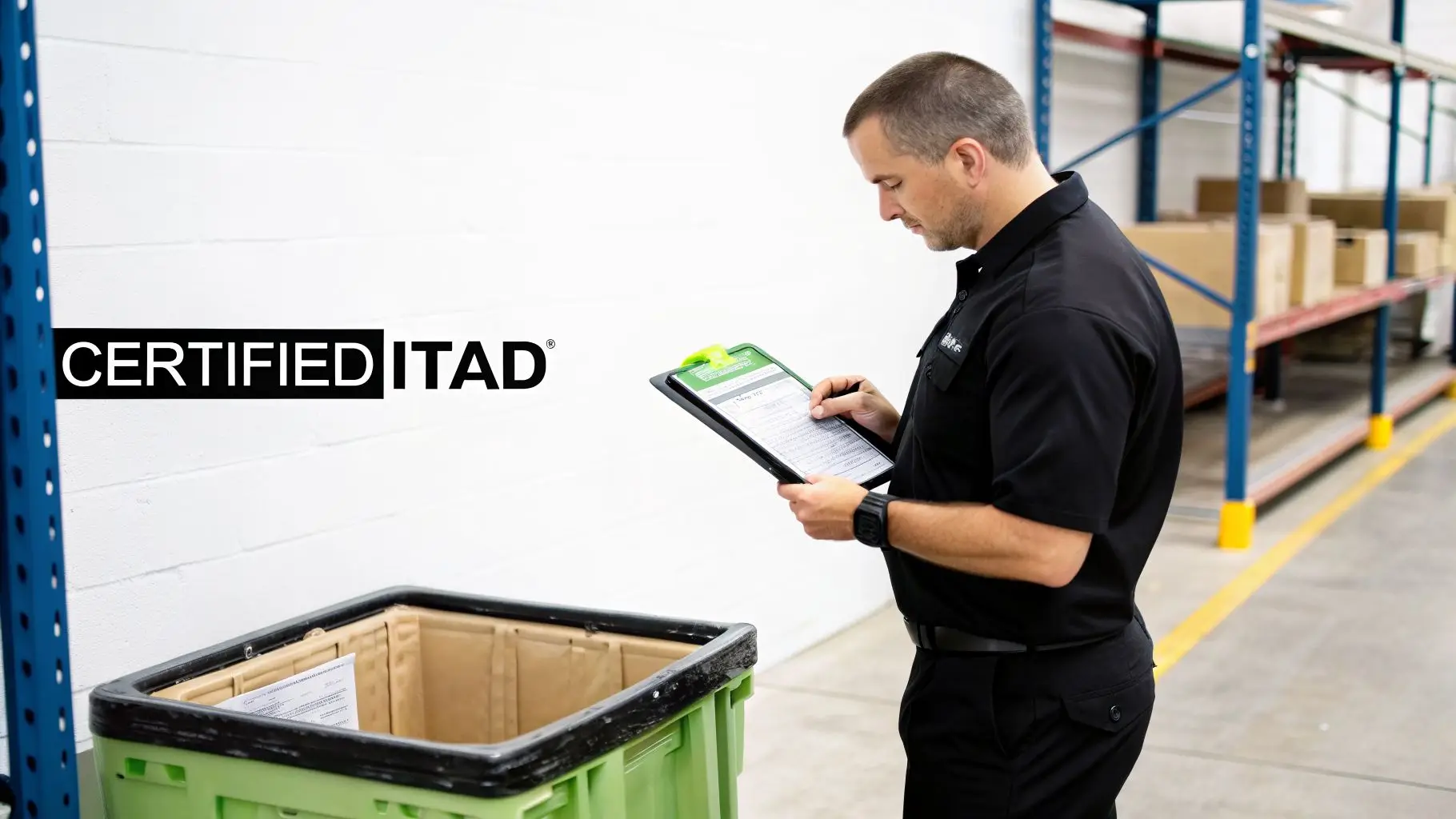
Certifications are not just logos for a website; they are your defense against data breaches, significant legal penalties, and environmental liability.
Demystifying R2v3 and e-Stewards Certifications
When an ITAD vendor holds certifications like R2v3 (Sustainable Electronics Reuse & Recycling) and e-Stewards, it signifies that they have passed rigorous third-party audits. These audits verify that the company adheres to strict standards for data security, chain of custody, environmental protection, and worker safety.
- R2v3 Certification: This standard covers the entire electronics lifecycle, mandating a documented chain of custody, secure data destruction, and ensuring hazardous e-waste is not illegally exported or landfilled.
- e-Stewards Certification: Regarded as the most stringent standard, e-Stewards enforces a zero-tolerance policy against exporting hazardous e-waste to developing nations. It also mandates complete data destruction and full accountability for all downstream recycling partners.
A certified ITAD provider doesn't just promise they’ll handle your assets correctly; they prove it. These certifications are your guarantee that your old equipment will be managed in a way that is legally compliant and environmentally sound, protecting your brand's reputation from risk.
For a deeper understanding of what these credentials mean for your company's security, you can learn more about electronics recycling certification and why it is a non-negotiable requirement when choosing a vendor.
The Power of Legally Defensible Documentation
The most significant advantage of using a certified ITAD partner is the documentation. Unlike a simple store receipt from a retail program, this documentation provides legally defensible proof that you have met your compliance obligations. This is a key area where Best Buy’s admirable goals do not align with business needs. An internal target, such as a 90% waste-diversion rate, is an internal metric, not a legally binding document for your compliance records. You can explore Best Buy's path to zero-waste facilities for more on their corporate goals.
There are two critical documents you should always expect from a B2B ITAD provider:
- Certificate of Data Destruction: This document serves as official proof that all data on your devices has been sanitized or physically destroyed according to standards like NIST 800-88. It includes serial numbers, confirming you have fulfilled data privacy duties under laws like HIPAA, GLBA, and the FTC Disposal Rule.
- Certificate of Recycling: This certificate formally transfers the liability for the physical assets from your company to the ITAD vendor. It documents that your e-waste was processed in an environmentally responsible manner, shielding you from fines related to improper disposal.
These certificates are more than just paperwork. They provide crucial peace of mind for the entire executive team, from the IT Director to the CEO and legal counsel. They are your official record that you took all necessary steps to protect your company, its data, and its reputation.
How to Choose the Right E-Waste Partner for Your Business
Moving beyond a retail drop-off program is the first critical step for any business serious about its technology lifecycle management. But with many vendors claiming to offer secure solutions, how do you properly vet them? Selecting a professional IT Asset Disposition (ITAD) partner that aligns with your company's security and compliance needs requires asking the right questions.
The right partner can manage everything from a few laptops to a complete data center decommissioning. A good starting point is to inquire about scalability. Will their service model grow with your business, and can they provide a consistent level of service across all your locations?
Evaluating Logistics and On-Site Capabilities
A vendor's logistical capabilities are paramount. If your business has multiple offices or a remote workforce, a partner with a nationwide reach is essential. Can they coordinate secure pickups from different cities, or are they limited to a single metropolitan area?
Beyond pickups, consider what services they can perform at your facility. On-site services offer the highest level of security and transparency, as sensitive assets never leave your premises before being neutralized.
Key on-site services to inquire about include:
- On-site hard drive shredding: This is the gold standard for data destruction, providing immediate, physical proof that your data is irrecoverably destroyed.
- Asset inventory and serialization: Can their team scan and inventory every device at your location? This establishes a robust chain of custody before anything is transported.
- Secure packing and transport: What type of locked containers and dedicated, GPS-tracked trucks do they use? You need assurance that your assets are secure from the moment they leave your facility.
A vendor’s ability to perform critical tasks at your facility is a strong indicator of their commitment to a transparent and secure process, moving the relationship from a "trust us" model to a "show us" one.
Assessing Value Recovery and Financial Returns
Do not assume all of your retired equipment is worthless. Many IT assets, particularly enterprise-grade servers, networking gear, and newer laptops, retain significant market value. A top-tier ITAD partner should offer a robust IT buyback program to help you recover that value. This process, known as value recovery, can transform a disposal project from a cost center into a revenue source.
Ask any potential vendor how they determine the fair market value of your equipment. Do they have established, transparent channels for reselling enterprise hardware? You should expect detailed reports that break down the value of each asset and the final amount remitted to your business.
Making the right choice comes down to due diligence. Our comprehensive vendor due diligence checklist provides a detailed guide for asking the tough questions. It is designed to help you find a partner who minimizes your risk while maximizing your return. Choosing the right partner is not just about disposal; it is about protecting your organization from every angle.
Frequently Asked Questions About Business Electronics Recycling
When it comes time to dispose of old office electronics, IT managers often question if a simple retail drop-off is sufficient. While the question is reasonable, the answer for a business is not straightforward. Let's address some of the most common questions that arise when comparing a program like Best Buy's to a dedicated ITAD service.
Does Recycling at Best Buy Provide a Certificate of Data Destruction?
The answer is no. Best Buy’s program is designed for consumers and therefore does not issue the formal Certificates of Data Destruction that businesses require for compliance and internal audits.
A professional ITAD service like Beyond Surplus provides this certified document as a standard part of its process. This certificate is your legal proof that company data was verifiably destroyed according to standards like NIST 800-88, which is critical for meeting compliance mandates under HIPAA, GLBA, and the FTC Disposal Rule.
Can My Business Recycle a Large Volume of Computers at Best Buy?
No, the program is not designed to handle business-level volumes. The policy strictly limits drop-offs to three items per household per day, making it completely impractical for an office cleanout or hardware refresh. Disposing of 30 desktops would require 10 separate trips, representing a significant waste of time and resources.
A professional ITAD provider is built for scale. We offer scheduled, secure pickups and logistics to manage any quantity of equipment. Whether you have a dozen laptops or hundreds of servers across multiple locations, an ITAD partner has the resources to handle the project efficiently.
Is the Data on Our Old Office Laptops Actually Safe?
Relying on a retail program for the disposal of devices containing sensitive business data is a significant and unnecessary gamble. While their recycling partners may perform some form of data wipe, the process lacks the verifiable, auditable, and certified procedures that are non-negotiable for corporate assets.
You are left with no formal confirmation that a data wipe was attempted, let alone successfully completed, on your specific devices. For sensitive company information, you need a guaranteed method like on-site hard drive shredding and a documented, secure chain of custody. These are the core services that a professional ITAD company provides to protect your organization from a costly data breach.
When your business requires guaranteed security, compliance, and peace of mind, a retail drop-off program is not a viable solution. Beyond Surplus provides certified electronics recycling and secure IT asset disposal with nationwide pickup services for commercial clients. Contact us today for a free consultation.