For Georgia businesses, simply deleting files or formatting old hard drives is a significant risk, leaving sensitive corporate data exposed. True secure hard drive disposal in Georgia requires professional, certified destruction to prevent a disastrous data breach. This is not just an IT task; it is a critical business strategy for protecting your organization.
Why Secure Data Disposal Is A Business Imperative In Georgia
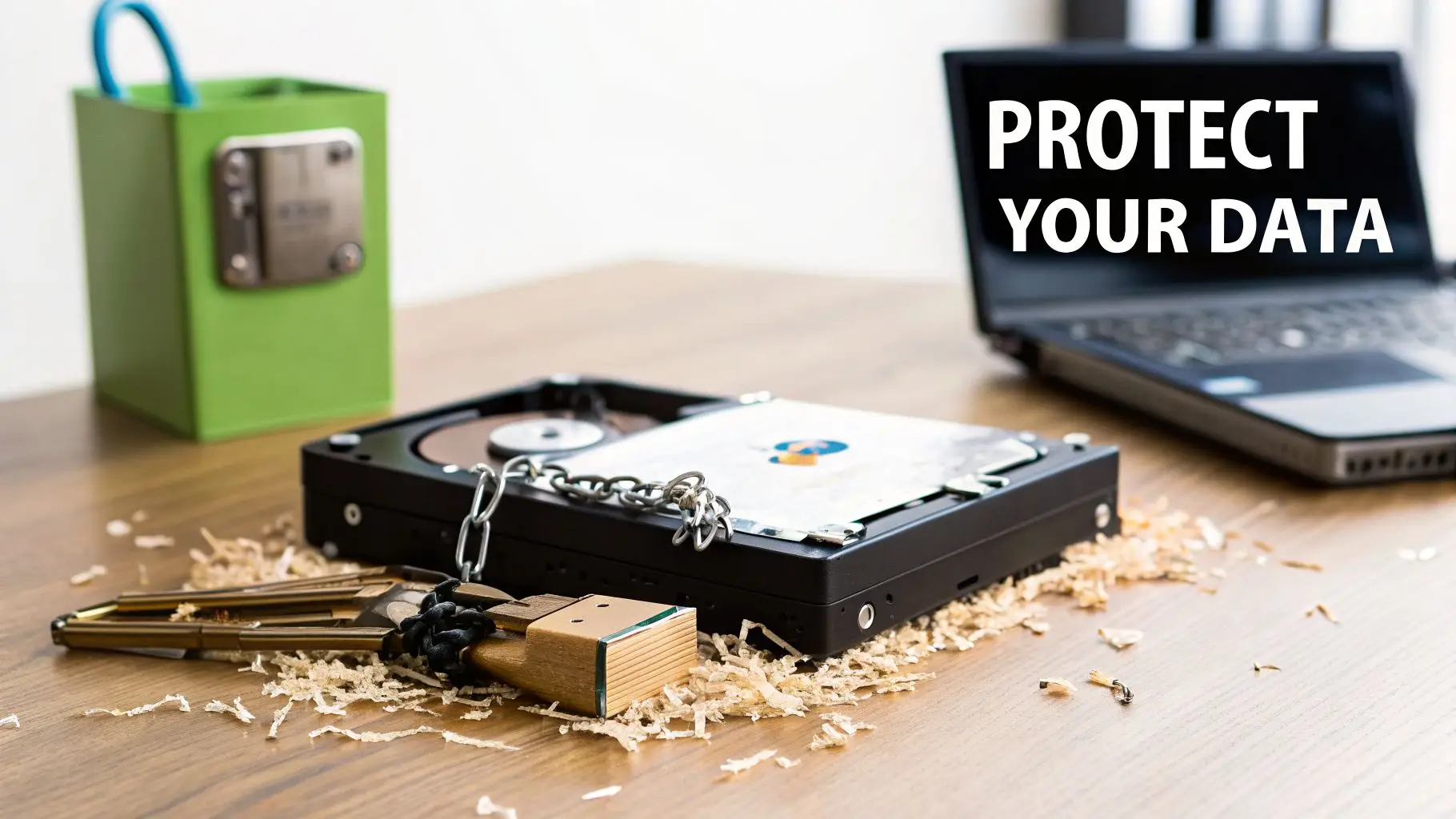
When a corporate server, company laptop, or office desktop is retired, the hard drive inside remains a major liability. Simply deleting files only removes the computer’s pointer to the data, leaving the information itself intact and recoverable with basic software. Formatting the drive is not a secure solution for business assets.
Think of your data like writing on a document. Deleting a file is like crumpling it up and tossing it in a bin—anyone can retrieve it, smooth it out, and read the contents. Professional destruction, such as shredding, is akin to running that document through a cross-cut shredder until it is confetti. The original information is permanently and irretrievably destroyed.
The High Cost of Inaction
Failure to properly destroy business data can lead to severe consequences. The financial and reputational damage from a data breach is staggering. Recent reports show the average cost of a data breach for American companies has soared into the millions, a figure that does not include the long-term loss of customer trust and brand damage.
A single improperly disposed hard drive can trigger a reportable data breach under Georgia's Personal Identity Protection Act (GPIPA), leading to mandatory notifications, regulatory scrutiny, and significant financial penalties. This turns a simple piece of old hardware into a major corporate risk.
This risk is especially high in Georgia’s key industries. Businesses in healthcare, finance, and technology are prime targets due to the sensitive information they handle daily.
- Healthcare: Patient records (PHI) are strictly protected by HIPAA, and breaches result in massive fines.
- Finance: Financial data is governed by the GLBA, which mandates stringent data protection measures.
- Technology: Proprietary code, trade secrets, and customer data are incredibly valuable and pose a significant risk if compromised.
For companies in these sectors, certified data disposal is non-negotiable.
From IT Task to Business Strategy
Ultimately, managing the disposal of end-of-life data-bearing devices must be viewed as a core business function, not just an item on an IT checklist. Every retired hard drive is a potential Trojan horse, capable of inflicting enormous damage if it falls into the wrong hands.
Understanding and neutralizing this threat is fundamental to modern corporate risk management. Partnering with a certified IT Asset Disposition (ITAD) provider ensures this risk is completely eliminated. Businesses can also benefit from understanding the broader context; learn more about the environmental impact of electronic waste in our detailed article.
Understanding Your Data Destruction Options
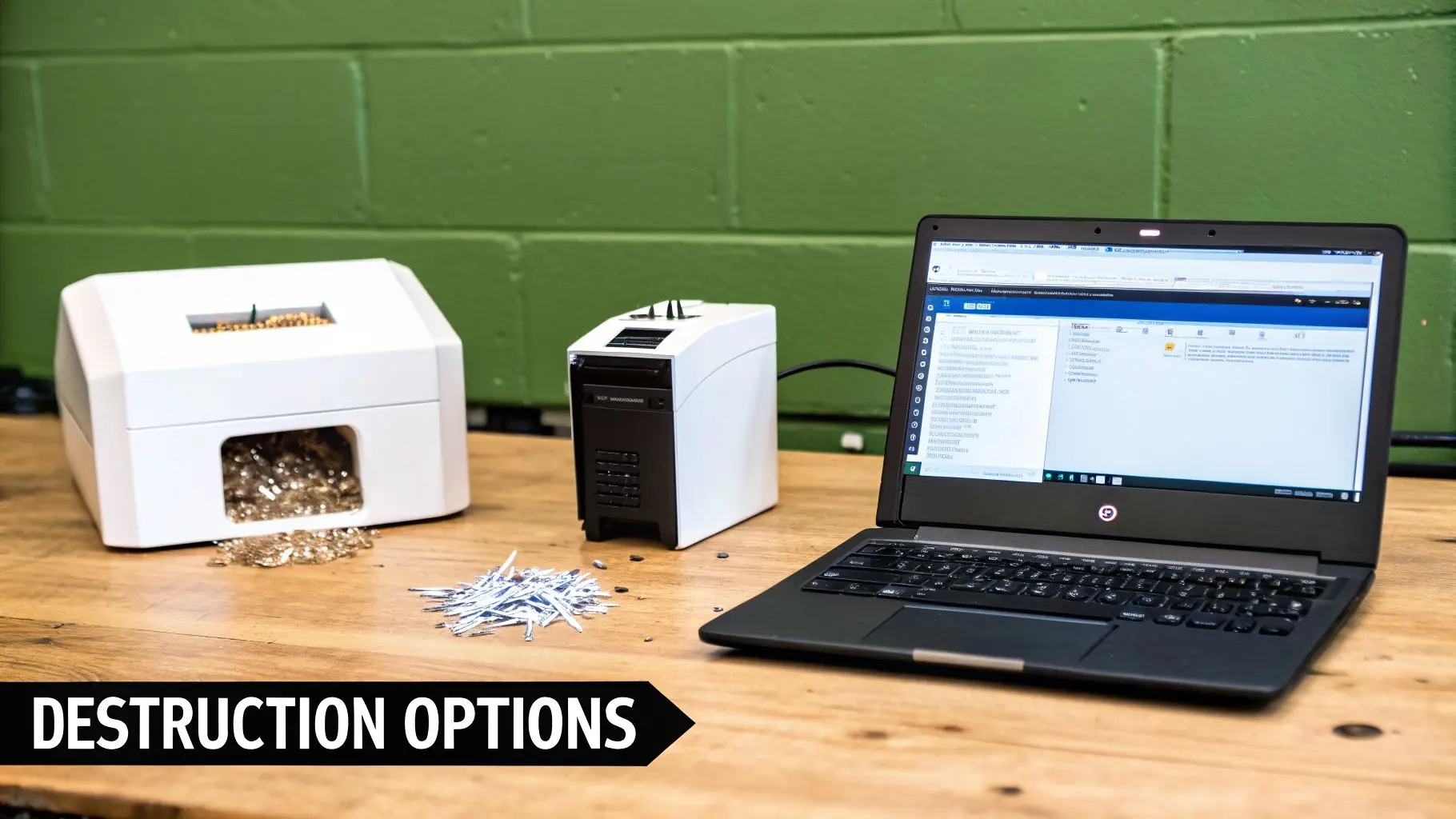
Once your business decides to dispose of old hard drives, the critical question becomes how. Not all data destruction methods offer the same level of security, and the right choice for your Georgia business depends on your specific operational needs.
Your decision will be influenced by industry compliance requirements, internal security protocols, and whether you plan to reuse or resell the hardware. Let's examine the three main options for commercial IT asset disposal.
Physical Destruction (Shredding)
Physical destruction is the most foolproof method to guarantee data is permanently destroyed. It represents the absolute end-of-life for a hard drive, offering irreversible destruction and visual proof for your records.
Industrial-grade shredders are used to pulverize hard drives, SSDs, and other media into tiny, confetti-like pieces of metal. This machinery is powerful enough to tear through the drive's platters and internal circuits where data is stored. Once shredded, there is zero possibility of recovery.
This is why shredding is the gold standard for organizations with the highest security requirements, such as those in government, healthcare, and finance. It provides tangible evidence that sensitive information has been permanently destroyed.
Degaussing
Degaussing is another highly effective method that uses a powerful magnetic field to instantly erase the data stored on a hard drive's magnetic platters.
This process is analogous to using a strong magnet to wipe a cassette tape, but on a much more powerful and complete scale. A specialized machine called a degausser exposes the drive to a magnetic pulse that scrambles the magnetic alignment of the data, rendering it completely unreadable.
Important Note: Degaussing only works on magnetic media like traditional hard disk drives (HDDs) and backup tapes. It does not work on Solid-State Drives (SSDs), which use flash memory and have no magnetic components. For SSDs, physical destruction is the only guaranteed option.
Software-Based Data Wiping (Sanitization)
Data wiping, or sanitization, is a software-based approach that overwrites every sector of a hard drive with random data. The key advantage is that this process does not physically damage the drive, allowing for its reuse.
Secure data wiping software digitally overwrites old data with new data, often multiple times, to ensure complete obliteration.
- Overwriting Passes: The software writes patterns of zeros, ones, and random characters across the entire drive, typically in multiple passes.
- Compliance Standards: Professional services use methods that meet or exceed standards like DoD 5220.22-M, which specifies a 3-pass overwrite process.
- Verification: After wiping, a verification check is performed to confirm that the original data is no longer accessible.
This method is ideal for businesses that want to extend the life of their IT assets by redeploying drives internally or by recovering value through resale. For a more detailed look, check out our guide on how to completely wipe a hard drive.
Comparing Hard Drive Disposal Methods
This table breaks down the key differences to help Georgia businesses choose the best fit for their security, compliance, and budget needs.
| Method | Process | Security Level | Best For | Asset Reuse Possible? |
|---|---|---|---|---|
| Physical Shredding | Drives are pulverized into small metal fragments. | Highest (Irreversible) | Maximum security, compliance-heavy industries (HIPAA, DoD), end-of-life drives. | No |
| Degaussing | A powerful magnetic field erases data from magnetic media. | High | Destroying data on traditional HDDs and magnetic tapes quickly. | No |
| Data Wiping | Software overwrites all existing data with random characters. | High (When done to standards) | Reusing drives, reselling newer hardware, recovering asset value. | Yes |
Ultimately, each method provides a certified path to secure data destruction. Your choice depends on whether the physical hard drive has future value or if its only purpose is to be completely destroyed.
Navigating Data Disposal Compliance In Georgia
For any business in Georgia managing client, employee, or proprietary information, disposing of old hard drives is a legal requirement. Improper disposal can lead to significant fines and legal action. Your responsibility for the data on a drive does not end when it leaves your facility.
Understanding the regulations for secure hard drive disposal in Georgia is the first step in creating a compliant data destruction plan. Georgia enforces a combination of federal and state regulations that every business must follow.
Federal Laws With Local Impact
Several major federal laws set the standard for how businesses across the country, including in Georgia, must handle and dispose of sensitive information. Compliance is not optional; these laws carry serious penalties.
- The FTC Disposal Rule: This rule requires businesses to take "reasonable measures" to protect consumer information during disposal. If you have customer or employee files, this rule applies to you.
- HIPAA (Health Insurance Portability and Accountability Act): For any Georgia-based healthcare provider, clinic, or their business associates, HIPAA has strict security rules for Protected Health Information (PHI). Improperly disposing of a hard drive with patient records is a direct violation that leads to massive fines.
- GLBA (Gramm-Leach-Bliley Act): Financial firms are bound by the GLBA. Its Safeguards Rule requires them to securely dispose of customer financial data to prevent identity theft.
- FACTA (Fair and Accurate Credit Transactions Act): This law applies to nearly any business that handles consumer credit reports, requiring proper destruction of that information.
This focus on data privacy has spurred market growth. The global market for hard drive destruction equipment is projected to grow at a 5.2% CAGR, reaching $1,927 million by 2027. North America leads this trend, largely due to these regulations.
Proving Your Compliance
Adhering to these laws requires more than just choosing a destruction method. You need verifiable proof of compliance to present to auditors. This is where a professional ITAD service and its documentation become indispensable. It is also vital to understand how to handle data deletion requests to remain fully compliant.
A Certificate of Data Destruction is a legal document that officially transfers liability for the data from your company to your certified disposal partner. It serves as your primary line of defense in an audit or a data breach investigation.
This documentation is essential. A partner like Beyond Surplus provides exactly what you need to close the loop on your compliance obligations.
The Power Of Certified Documentation
The documentation from a certified partner is critical for two main reasons:
- Chain of Custody: This is a detailed, unbroken record that tracks your hard drives from the moment they leave your office. It includes serial number tracking, secure transport logs, and final confirmation of arrival at a secure destruction facility.
- Certificate of Data Destruction: Once the drives are destroyed, you receive a formal certificate. This document lists the serial numbers of every device destroyed, confirms the method used (e.g., shredding), and states the exact date of destruction.
These documents provide the legally defensible proof needed to demonstrate that you took all necessary steps to protect sensitive information. For Georgia businesses seeking to secure their compliance, partnering with professional data destruction services in Georgia is the most secure path forward.
Choosing Between On-Site And Off-Site Shredding
When your business is ready to dispose of old hard drives in Georgia, a key decision is where the destruction should occur. The choice between on-site and off-site shredding depends on the right balance of security, cost, and convenience for your business.
Both methods achieve the same outcome—certified, permanent data destruction. However, they cater to different operational needs and security policies.
On-Site Shredding: Maximum Security and Peace of Mind
On-site shredding brings the highest level of security and transparency directly to your facility. We arrive at your Georgia location with a specialized truck equipped with an industrial-grade shredder, and the entire destruction process occurs on-site while you watch.
Your team can physically witness every hard drive, SSD, and backup tape being fed into the shredder and reduced to irretrievable pieces.
For organizations handling highly sensitive information—such as healthcare, finance, or government agencies—on-site shredding is the preferred method. Witnessing the destruction firsthand provides indisputable proof of compliance and eliminates any questions about the chain of custody.
This immediate, verifiable destruction is ideal for any business operating under strict regulations like HIPAA or GLBA, as it eliminates any risk of a data breach during transit.
Off-Site Shredding: Secure, Efficient, and Cost-Effective
Off-site shredding offers a compliant and highly secure alternative that is often more budget-friendly. With this service, we come to your location to collect your hard drives, place them in locked and sealed containers, and transport them in a secure, GPS-tracked vehicle to our destruction facility.
At our secure plant, the containers are opened under continuous video surveillance, and your drives are destroyed using the same rigorous standards as on-site shredding. The entire process is documented from pickup to final shred.
Off-site shredding offers clear advantages for businesses:
- Cost-Effectiveness: It is generally more economical, especially for large quantities of drives. We process media from multiple clients simultaneously, creating efficiencies that save you money.
- Convenience: The process causes minimal disruption to your workday. Your team only needs to gather the old assets for our secure pickup.
- Certified Security: From secure transport to destruction in an audited facility, the entire process is designed to ensure compliance and provide complete peace of mind.
While you do not witness the shredding in person, the process is documented with a Certificate of Destruction, providing the same legal proof you need. To learn more about our on-site services, see the details on our on-site data destruction services in Georgia.
Whether you choose on-site or off-site, working with a certified vendor ensures you receive the proper documentation to protect your business and prove compliance.
The Certified ITAD Process With Beyond Surplus
Partnering with a certified ITAD provider like Beyond Surplus transforms a complex compliance task into a simple, secure, and transparent process. We manage every detail, ensuring your old assets are handled with the highest security standards while meeting all environmental regulations.
This process is designed to provide total peace of mind and close the loop on your compliance duties, starting with a consultation to define your needs.
Initial Consultation and Transparent Quoting
The first step is a straightforward conversation. Our team works with you to understand the IT assets you need to retire, including the types and quantities of hard drives, servers, and other data-bearing devices. Based on this inventory, we provide a clear, upfront quote with no hidden fees.
The quote will detail the costs for pickup, data destruction, and recycling. If your equipment has residual market value, we will also include a potential buyback offer, which can often reduce or eliminate the cost of service.
Secure Pickup and Monitored Logistics
Once you approve the plan, we schedule a secure pickup from your Georgia location at a time that works for you. Our professional logistics team arrives to collect the assets, establishing a documented and secure chain of custody from the moment the equipment leaves your control.
- Serialized Asset Tagging: Every device is inventoried and tagged by serial number before leaving your facility.
- Secure Transport: Your assets are transported in locked, GPS-tracked vehicles directly to our secure facility.
- Professional Handling: Our trained and background-checked staff manage the collection, ensuring minimal disruption to your business operations.
This meticulous, step-by-step approach guarantees no security gaps, which is critical for compliance with regulations like HIPAA and the FTC Disposal Rule.
Choosing Your Destruction Method
Upon arrival at our facility, your hard drives are immediately segregated and prepared for destruction. You choose the method that best fits your corporate security policy—either physical shredding or certified data wiping. We offer both on-site shredding at your location or off-site shredding at our facility.
The infographic below illustrates how both our on-site and off-site shredding processes guarantee complete data elimination.

While on-site shredding allows you to witness the destruction, our off-site process maintains an unbroken, secure chain of custody and is often a more cost-effective option for businesses.
Final Certification and Responsible Recycling
The final and most important step is the documentation. After we destroy your hard drives, we issue a serialized Certificate of Data Destruction. This is a legally defensible document that serves as your official proof of compliance, listing every asset destroyed, the method used, and the exact date of destruction.
This certificate is your shield. It formally transfers liability from your organization to Beyond Surplus and provides the auditable evidence needed to satisfy any regulatory inquiry or internal audit.
The demand for certified destruction is growing rapidly. The global hard drive destruction market, valued at USD 1.65 billion in 2024, is projected to reach USD 5.05 billion by 2035. North America drives this trend due to strict data privacy laws, making Georgia a key hub for compliant ITAD.
All non-data-bearing components and shredded materials are responsibly processed through our audited recycling stream, ensuring zero hazardous e-waste ends up in a landfill. To see our full range of services, explore our Beyond Surplus ITAD services in Georgia.
Answering Your Hard Drive Disposal Questions
Even with a solid plan, questions often arise regarding the specifics of secure hard drive disposal in Georgia. We have compiled the most common questions from Georgia businesses to provide clear, straightforward answers.
What Types Of Hard Drives And Media Can Be Destroyed?
Professional data destruction services are not limited to the hard drives in old desktops and servers. Certified services can destroy nearly any device that stores information.
Modern industrial shredders are designed to completely pulverize a wide range of media, ensuring no data can be recovered, regardless of the device. This includes:
- Standard desktop and laptop hard disk drives (HDDs)
- Modern solid-state drives (SSDs)
- High-capacity server drives from data centers
- Portable external hard drives
- Legacy media like magnetic tapes (LTO, DLT)
- Optical media such as CDs, DVDs, and Blu-ray discs
- Small-format media like flash drives and memory cards
When you partner with a professional like Beyond Surplus, we will confirm our capability to handle your specific inventory during the initial consultation, ensuring every data-bearing asset is accounted for.
How Much Does Secure Hard Drive Disposal In Georgia Cost?
The price for secure hard drive disposal is not a flat rate; it varies based on several factors. The main determinants are the number of drives, the chosen destruction method (on-site shredding is typically priced at a premium), and any specific logistical requirements.
It is best to view this as an investment in protecting your business. The cost of professional destruction is a fraction of what a data breach could cost in regulatory fines, legal fees, customer notifications, and lasting brand damage.
Furthermore, many professional ITAD partners offer IT asset buyback programs. If your retired equipment has resale value, you can use that value to offset or even cover disposal costs, potentially resulting in a positive return for your business.
Is A Certificate Of Destruction Enough For Legal Compliance?
Yes. A Certificate of Data Destruction from a certified and reputable ITAD provider is the key legal document you need to prove compliance with data protection laws. It is your official, auditable proof that you disposed of your assets according to regulations like HIPAA, FACTA, and the FTC Disposal Rule.
Think of this certificate as your legal shield. It formally transfers the liability for the data from your organization to the destruction vendor and provides the necessary proof to satisfy any audit or legal inquiry that might arise.
This document contains crucial details, including:
- A serialized list of the assets destroyed.
- The specific method of destruction used (e.g., physical shredding).
- The date and location of the destruction.
- A statement of compliance affirming the process met industry standards.
Without this certificate, it is extremely difficult to prove you took the necessary steps to protect sensitive information.
What Happens To The Shredded Hard Drive Materials?
After your drives are physically destroyed, the remaining pieces of metal, plastic, and circuitry are not sent to a landfill. A responsible, certified partner like Beyond Surplus ensures these materials enter a secure and fully audited recycling stream. This commitment to environmental stewardship is a core part of the process.
The raw commodities are carefully separated and processed at a specialized recycling facility. Metals like aluminum and steel, along with precious metals from the circuit boards, are recovered and refined.
These reclaimed materials are then returned to the manufacturing supply chain to create new products. This eco-friendly, circular approach keeps hazardous e-waste out of landfills while aligning your company's IT disposal with its corporate sustainability goals.
Contact Beyond Surplus for certified electronics recycling and secure IT asset disposal. Beyond Surplus offers professional services for businesses across Georgia and nationwide, ensuring your data is destroyed and your assets are recycled responsibly. Contact Beyond Surplus today for a free quote.