A universal waste disposal company is your business's specialized partner for managing regulated waste streams like old batteries, lamps, and IT equipment. Working with a certified expert like Beyond Surplus isn't just about getting rid of junk; it's about protecting your business from the serious financial, legal, and reputational risks that come with mishandling these common items.
Why Your Business Needs a Disposal Partner
Think about how you manage your company’s finances. You wouldn't trust an amateur with your accounting, and you shouldn't leave regulated waste to chance, either. A universal waste disposal company acts as your compliance specialist, making sure materials that seem harmless—like old office laptops or fluorescent bulbs—are handled according to strict federal and state laws.
Improper disposal is never a minor oversight; it's a major liability. A single discarded server, for instance, can lead to a devastating data breach if its hard drives aren't professionally destroyed. Tossing old batteries or mercury-containing lamps into the regular trash can trigger steep fines and environmental cleanup costs, and your company is the one left holding the bag.
Mitigating Critical Business Risks
A professional disposal partner shields your organization from a whole range of threats. The biggest benefit is risk transference. When you hire a certified company, you get documentation—like a Certificate of Destruction—that legally proves you did your due diligence. That paperwork is your first and best defense in an audit or legal challenge.
To get a clearer picture, here’s a look at common universal waste items and the risks they pose if not handled correctly.
Universal Waste Categories and Key Business Risks
| Waste Category | Common Examples in Business | Primary Business Risk |
|---|---|---|
| Electronics (E-Waste) | Laptops, servers, monitors, smartphones, networking gear | Data Breaches from unsecured hard drives and memory. |
| Batteries | Lithium-ion, lead-acid, NiCad batteries from laptops and UPS systems | Fire Hazards and Environmental Fines for soil/water contamination. |
| Lamps | Fluorescent tubes, compact fluorescent lamps (CFLs), HID lamps | Environmental Liability due to mercury content, leading to cleanup costs. |
| Mercury-Containing Devices | Thermostats, switches, and some medical equipment | Health Hazards and Strict Regulatory Penalties for improper disposal. |
This table shows just how easily everyday office items can become significant liabilities. A certified partner helps you manage these specific risks effectively.
A professional partner helps you tackle a few key areas:
- Data Security Breaches: Securely destroying data on old computers, laptops, and servers stops sensitive corporate or customer information from getting into the wrong hands.
- Regulatory Fines: These partners know the ins and outs of EPA regulations and varying state laws, helping you avoid penalties that can run into thousands of dollars per violation.
- Environmental Liability: Proper recycling and disposal prevent hazardous materials from contaminating soil and water, which protects both the environment and your brand’s public image.
By outsourcing this function, IT and facility managers aren't just clearing out storage rooms. They're implementing a crucial part of their corporate risk management strategy. This proactive approach safeguards the company's bottom line and reputation.
Understanding what qualifies as universal waste is the first step. You can see a detailed breakdown and an example of universal waste in our guide. Ultimately, hiring a specialist is an investment in operational security and business continuity, ensuring the end-of-life for your assets doesn't become the start of a major problem.
Decoding Universal Waste Regulations for Your Business
Trying to make sense of waste regulations can feel like getting lost in a maze of legal jargon. The good news? The U.S. Environmental Protection Agency (EPA) created the universal waste program to give businesses like yours a much clearer, simpler path for compliance. These rules, part of the Resource Conservation and Recovery Act (RCRA), are your roadmap for handling common but hazardous items without all the usual red tape.
Think of it as an express lane for waste management. Instead of the strict, complicated rules that apply to most hazardous waste—which often involve extensive manifests and very short storage times—the universal waste program is far more manageable. The goal is to encourage businesses to recycle things like batteries and lamps instead of tossing them out, which is often illegal and always harmful.
Core Federal Requirements You Need to Know
While the program is designed to be simpler, there are still a few key federal rules that every facility manager, IT director, or compliance officer needs to have on their radar. These form the baseline for compliance no matter where you are in the U.S.
Here are the big ones:
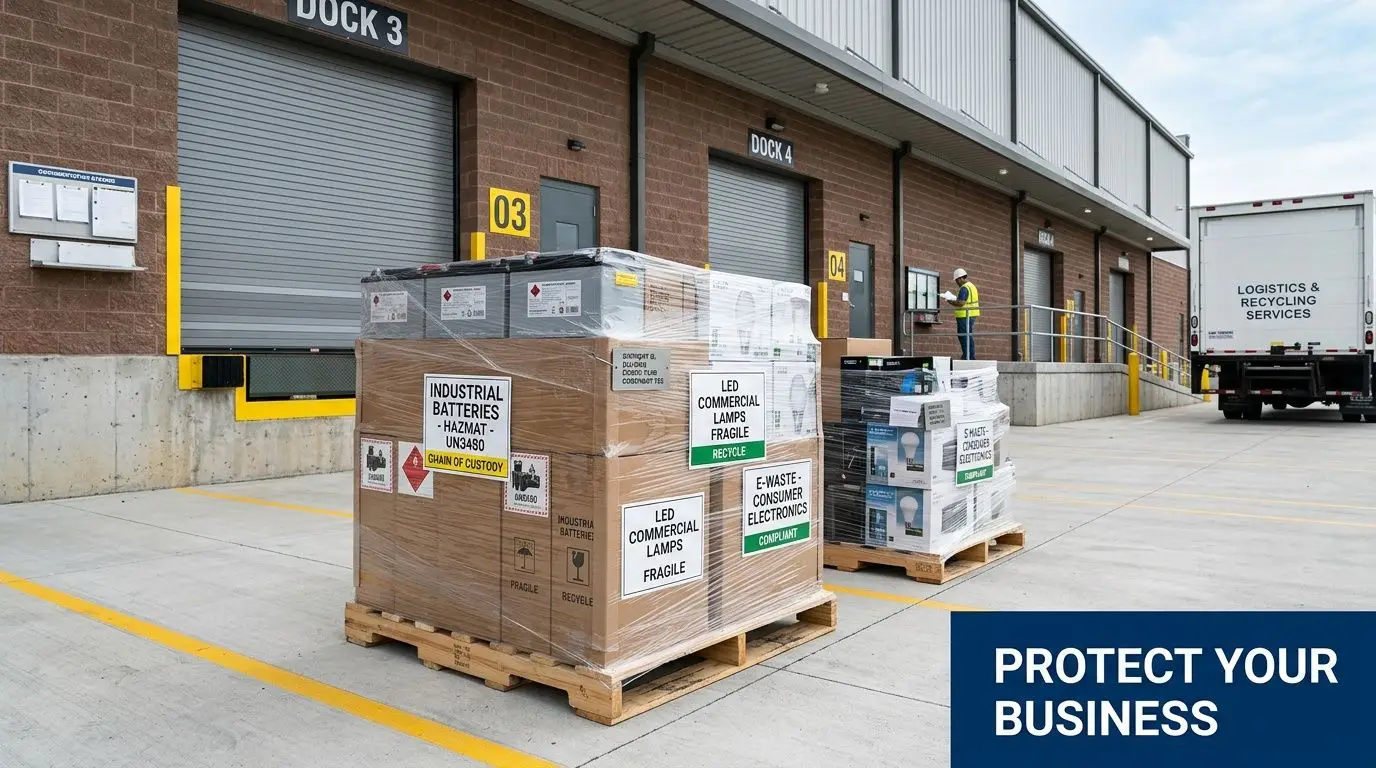
- Labeling: Every container or individual piece of universal waste needs to be clearly marked. For example, a drum of used batteries should be labeled "Universal Waste—Batteries," and a pallet of old monitors needs a "Universal Waste—Electronic Devices" label.
- On-Site Accumulation: You can store universal waste on-site for up to one year from the day it's generated. Make sure you mark that start date on the container or keep a detailed internal log.
- Employee Training: Anyone on your team who handles universal waste must know the proper procedures, especially for emergencies. This training ensures they can respond correctly if a fluorescent lamp cracks and releases mercury vapor or if a container of batteries spills.
- Proper Shipping: When it's time to send the waste off-site, you have to use a certified universal waste transporter or send it directly to a designated facility, like a certified recycler. You can't just hand it over to a standard shipping carrier without making the proper arrangements.
Getting these basics right is the first step to avoiding violations. For companies in sensitive fields, like labs that have protocols for handling hazardous drugs, mastering waste regulations is even more critical.
The Importance of State-Specific Regulations
Here's something you absolutely can't overlook: the EPA's federal rules are just the starting point. Many states have their own, often stricter, universal waste regulations. A state might add more items to its list of what's considered universal waste or give you less time to store it on-site.
Key Takeaway: Federal regulations set the floor, not the ceiling. Your business is legally required to follow the rules of the state you operate in. A good universal waste disposal partner will be an expert in both federal and your specific state laws.
For instance, states like California define all electronic devices with a circuit board as universal waste—a much broader category than the federal standard. If you're not aware of these state-level details, you could face hefty fines, even if you think you're perfectly aligned with federal guidelines. This is where a certified partner becomes invaluable, ensuring your disposal plan is compliant from top to bottom.
To stay compliant, you also need to get the paperwork right. You can dive deeper into the required documentation in our guide on the universal and hazardous waste manifest. By working with an expert disposal company, you bring a specialist onto your team who stays on top of these ever-changing rules, protecting your business from expensive compliance mistakes.
The Undeniable Value of R2 and E-Stewards Certifications
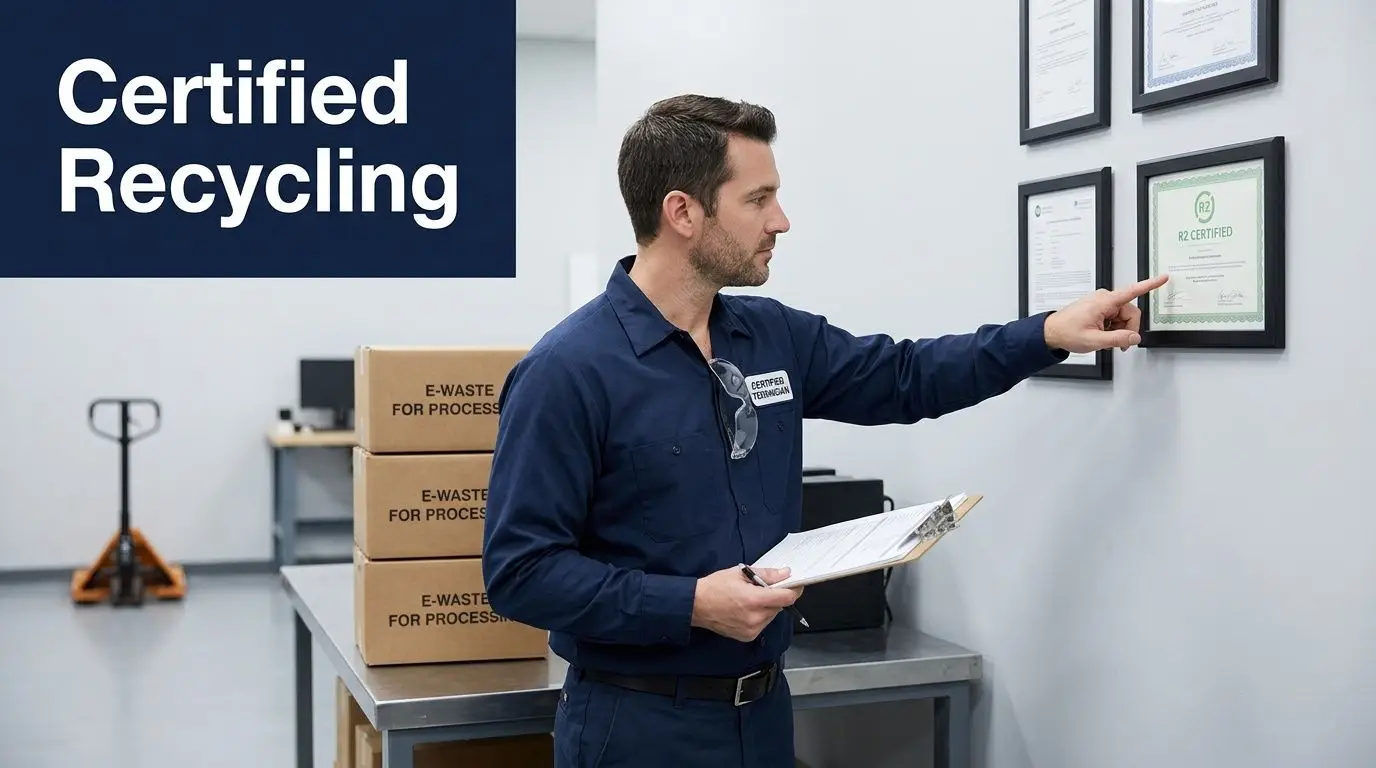
When you're choosing a company to handle your universal waste, especially electronics, it's easy to think all vendors are the same. They're not. The clearest sign of a vendor's commitment to security and environmental responsibility is a third-party certification like R2 (Responsible Recycling) or e-Stewards.
Think of it this way: you wouldn't hire an unlicensed handyman to rewire your office. Choosing a certified partner is your best defense against risk, providing a layer of protection that unvetted vendors simply can't offer.
These certifications are far more than just a logo on a website. They signal a deep, ongoing commitment to upholding the highest industry standards. To get certified and stay certified, a company has to pass demanding audits that examine every corner of its operations, from employee safety to the final destination of every piece of recycled material.
What Do These Certifications Guarantee?
For an IT director or facility manager, these certifications aren't just about feeling good—they provide tangible assurances that protect your business. They are your proof that a vendor operates professionally and transparently, taking the liability off your shoulders.
So, what are you really getting with a certified partner?
- A Secure Chain of Custody: Certified recyclers are required to track every asset from the moment it leaves your building until it’s fully processed. This is how you prevent equipment from getting lost, stolen, or illegally dumped.
- Data Security Protocols: Both R2 and e-Stewards have strict, non-negotiable rules for data sanitization and destruction. They ensure that all information on your retired IT assets is wiped clean and made completely unrecoverable.
- Environmental Compliance: These standards outright prohibit the illegal export of hazardous e-waste to developing nations. They also mandate that all materials are handled in an environmentally sound way.
- Worker Health and Safety: Certified facilities must follow rigorous safety standards to protect their team from the hazards of handling electronic waste.
Ultimately, these certifications deliver peace of mind. You can rest assured knowing your retired assets won't become the source of a data breach or an environmental mess that traces right back to your company.
The Role of Compliance Documentation
One of the most critical benefits of working with a certified universal waste disposal company is the official paperwork they provide. Once a project is complete, you should receive a Certificate of Recycling and a Certificate of Data Destruction.
These documents are not just receipts; they are legally defensible records that formally transfer liability for the disposed assets from your organization to the disposal vendor. During a compliance audit, this paperwork serves as undeniable proof of your due diligence.
Before you hand over electronics for certified destruction, you might need to extract data from failing devices. In these cases, it's wise to consider professional data recovery services first. Once that data is retrieved or you've determined it's not needed, the certified destruction process can begin.
The scale of professional waste handling shows just how important this certified process is. Take Universal Waste Systems, a major player since 1986. They operate a transfer station that processes over 45,000 tons of solid waste every year. With revenues hitting $42.1 million, their sheer volume underscores the massive need for professional, accountable waste management.
For any business, but especially those in regulated fields like healthcare or finance, these certificates are non-negotiable parts of a solid risk management program. They officially close the loop on your asset’s lifecycle, giving you a clear and defensible endpoint. To dive deeper into what makes these certifications so important, you can explore our guide that explains what is R2 Certification and why it's a must-have for your business.
Key Services of a Full-Service Disposal Partner
A true universal waste disposal partner does a lot more than just pick up your old equipment. They offer a whole range of specialized services designed to tackle the tricky compliance and security headaches that businesses face. When you know what to look for, you can find a single, expert partner for all your regulated waste.
This is what makes a company like Beyond Surplus such a valuable resource for managing sensitive materials across the United States. Let’s walk through the essential services you should expect from a top-tier provider.
IT Asset Disposition and Value Recovery
IT Asset Disposition (ITAD) is a foundational service that goes way beyond simple disposal. A great partner will look at your retired IT equipment—things like old servers, laptops, and networking gear—to see if any of it still has resale value. This process can actually turn outdated technology into a new revenue stream for your business.
This service is perfect for companies going through a tech refresh. Instead of seeing old equipment as a liability that’s just taking up space, a smart ITAD program helps you get back some of your original investment while making sure all your data is handled securely.
Certified Electronics Recycling and E-Waste Management
For all the electronics that no longer have any market value, certified e-waste recycling is the right move. This ensures every piece is processed in an environmentally sound way, keeping hazardous materials out of our landfills. Your partner will de-manufacture the devices, separating materials like plastics, metals, and circuit boards so they can be properly recycled.
This is a critical part of managing the huge amounts of e-waste that come from office cleanouts or data center decommissioning projects. A certified recycling program gives you the paperwork you need to prove your company followed all environmental regulations.
Secure Data Destruction Services
For any business, secure data destruction is probably the most important service of all. A quality universal waste disposal company will offer several ways to make sure your sensitive information is gone for good and completely unrecoverable.
These services usually include:
- On-Site Hard Drive Shredding: For total peace of mind, a mobile shredding truck comes right to your facility. You can watch as they physically destroy your hard drives, SSDs, and other media.
- Off-Site Shredding: Your assets are securely transported to a controlled facility for destruction. A full chain of custody and video verification should be available.
- Data Wiping: Using software that meets NIST 800-88 standards, all data is forensically erased. This allows the physical drive to be reused or resold, which is a great, sustainable option.
These destruction services are absolutely essential for staying compliant with data privacy laws like HIPAA, FACTA, and GDPR.
Specialized Disposal Programs
Beyond just electronics, a full-service partner should also be able to manage other common universal wastes that businesses create. These specialized programs make sure every type of regulated waste is handled the right way.
- Battery Recycling: Compliant collection and recycling for all kinds of commercial batteries, including lithium-ion, lead-acid, and alkaline.
- Lamp and Ballast Disposal: Safe handling of fluorescent tubes, CFLs, and other lamps that contain mercury to prevent environmental contamination.
- Medical and Laboratory Equipment Disposal: Managing non-hazardous electronic equipment from healthcare and research facilities, with a special focus on data security for any device that might hold patient information.
These kinds of tailored services show a vendor can truly be a one-stop solution. You can see this trend across the industry, with companies like Universal Waste Disposal handling a wide variety of waste streams, as noted in their profile on RocketReach.co. This mirrors what we do here at Beyond Surplus with our own certified on-site and off-site shredding, which provides certificates to formally transfer liability. When you find a versatile provider, you can consolidate all your disposal needs under one expert roof.
How to Vet Your Universal Waste Disposal Company
Picking a universal waste disposal company isn't just another item on your procurement to-do list—it's a critical decision that impacts your company's security and legal standing. The right partner protects you from data breaches, steep environmental fines, and a damaged reputation. A solid vetting process is the only thing standing between your business and a risky vendor who could leave you exposed.
This guide will walk you through the decision, whether you need IT Asset Disposition (ITAD), secure data destruction, or certified recycling for your universal waste.
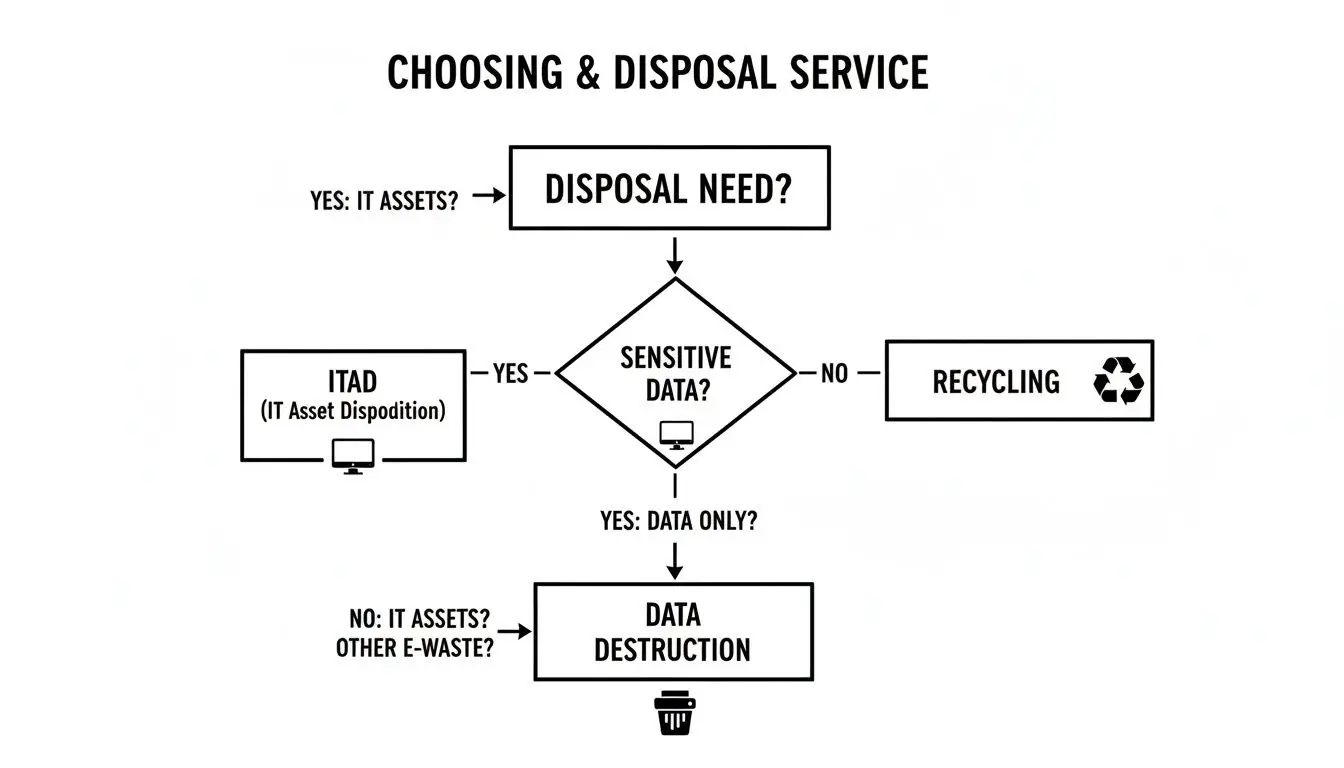
This flowchart breaks down the main service paths, helping you match your exact needs with the right disposal solution to stay compliant and secure.
Initial Vetting Checklist
Before you even think about signing a contract, you need to ask some direct questions. This is how you separate the real experts from the vendors who just talk a good game. A true professional will welcome the questions and have transparent answers ready. Your goal is to check their credentials in four key areas: certifications, insurance, security, and their own downstream partners.
Here are the non-negotiable questions you should start with:
- Certifications: Are you certified to a standard like R2 or e-Stewards? Can I see a copy of your current certificate?
- Insurance: What kind of insurance do you hold? Ask specifically about general liability, pollution liability, and errors and omissions, then request a Certificate of Insurance (COI).
- Data Security: Walk me through your data destruction process. Does it align with NIST 800-88 guidelines?
- Downstream Vendors: How do you audit your recycling partners? Can you show me a transparent chain-of-custody report?
If a vendor hesitates or refuses to provide clear documentation for any of these, consider it a major red flag. For a more exhaustive list of questions, check out our guide on creating a comprehensive vendor due diligence checklist.
Vendor Vetting Checklist: Green Flags vs. Red Flags
As you talk to potential vendors, you'll start noticing clear signs that separate a reliable partner from a potential liability. Learning to spot these green and red flags is key to making a choice you can stand behind. This quick-reference table will help you identify the good and avoid the bad.
| Vetting Criteria | Green Flag (Reliable Partner) | Red Flag (Potential Risk) |
|---|---|---|
| Certifications | Holds current R2 or e-Stewards certification and provides proof. | Lacks industry-recognized certifications or certificates are expired. |
| Data Security | Follows NIST 800-88 and offers on-site or witnessed destruction. | Vague about data destruction methods or outsources it without transparency. |
| Insurance | Carries comprehensive liability, pollution, and E&O insurance. | Has minimal insurance coverage or refuses to provide a COI. |
| Transparency | Welcomes site visits and provides a clear downstream vendor map. | Has a closed-door policy and offers no visibility into their process. |
| Documentation | Provides sample Certificates of Destruction and Recycling upon request. | Fails to provide sample documentation or offers generic, unverified templates. |
| Financial Viability | Is financially stable, established, and specialized in e-waste. | Operates as a "side business" or shows signs of financial instability. |
Making a smart, defensible choice comes down to identifying these markers of professionalism and accountability. Don't settle for a partner who raises more questions than they answer.
Request Documentation and Conduct a Site Visit
Talk is cheap, especially on a flashy website. The only way to truly confirm a vendor's claims is to see the proof for yourself. This means asking for sample documents and, if you can, scheduling a site visit.
Crucial Tip: Always ask for a sample Certificate of Destruction and Certificate of Recycling before signing anything. These documents are your legal proof that your assets were handled correctly, so you need to know exactly what they will look like.
A site visit, whether you go in person or do it virtually, provides insight you just can't get from a phone call. It’s your chance to see their security measures, watch their operational workflow, and get a feel for their professionalism firsthand. Any reputable universal waste company will have an open-door policy for potential clients—they should be proud to show off their compliant, secure facility. Taking this final step will give you the confidence that you're trusting your company's assets and reputation to a partner who can actually deliver.
Partnering With an Expert for Your Disposal Needs
Trying to manage universal waste on your own can feel like wading through a sea of confusing regulations. The easiest and safest route is to work with a certified universal waste disposal company. A partner like Beyond Surplus helps you stay compliant, keep your data secure, and act responsibly toward the environment. This turns what could be a major headache into a simple, worry-free process.
Bringing in an expert isn't just about clearing out old equipment; it's a strategic move. It shields your business from costly data breaches and steep fines for non-compliance while proving your commitment to sustainability. When you hand over your disposal needs to a professional, you're not just offloading equipment—you're transferring the risk.
Your Path to Compliant Disposal
Working with an expert should be a straightforward and transparent experience. At Beyond Surplus, we’ve developed a clear system to help businesses across the country handle their disposal challenges. We have years of experience with large companies, healthcare networks, and data centers, so we know how to meet your specific needs.
Here’s our simple, three-step process to get started:
- Initial Consultation & Assessment: We start by listening to you. We'll identify the types and amounts of universal waste you’re dealing with, whether it's old IT hardware, batteries, or retired lab equipment.
- Scheduling Nationwide Pickup: After we understand your needs, we handle all the logistics. Our team will arrange a secure pickup from any of your sites in the contiguous United States, maintaining a solid chain of custody all the way to our facility.
- Final Compliance Documentation: Once your materials are processed, you'll receive official Certificates of Recycling and Data Destruction. This is the paperwork you need to prove your due diligence and close the loop on your assets.
By following this proven path, your organization gains a defensible record of compliant disposal. This documentation is your key to confidently navigating any regulatory audit, proving that you took every necessary step to protect your data and the environment.
With a single point of contact, you can manage the end-of-life for all your technology assets, regardless of where your offices are. Finding the right partner is easier than you might think. You can explore our guide to learn more about selecting from the top ITAD companies near you and what sets a true expert apart. This ensures you make a choice that aligns with your security, compliance, and operational goals. Let us help you solve your universal waste challenges with confidence.
Frequently Asked Questions About Universal Waste
It's completely normal for business owners and managers to have questions when sorting out universal waste rules. This section will walk you through some of the most common ones, giving you clear, straightforward answers. The goal is to help you feel confident about staying compliant when you partner with a professional disposal company.
What Is the Main Difference Between Universal and Hazardous Waste?
Think of universal waste as a specific, more manageable category that falls under the broader umbrella of hazardous waste. Everything classified as universal waste—items like batteries, lamps, and old electronics—is technically hazardous.
The EPA created this special category with streamlined rules to encourage businesses to recycle these common items correctly. The regulations are much simpler than those for other hazardous materials, making compliance easier. So, while all universal waste is hazardous, not all hazardous waste gets the benefit of these simpler rules.
How Long Can My Business Store Universal Waste On-Site?
Under federal EPA guidelines, your business is allowed to keep universal waste on your property for up to one year. That one-year clock starts the moment the waste is generated or when you first receive it from another source.
Keeping that deadline in mind is critical. You'll need to be able to prove how long the waste has been there, which most businesses do by dating the storage container or keeping a detailed log. Also, remember that your state or local laws might be stricter than the federal one-year rule. Once the year is up, that waste must be on its way to a certified recycler or disposal facility.
What Documents Prove My Company Disposed of Waste Compliantly?
When you work with a universal waste disposal company, the two most important documents you'll get are a Certificate of Recycling and, if applicable, a Certificate of Data Destruction. These aren't just simple receipts; they are your official legal records of proper disposal.
These certificates are what formally transfer the liability for the waste from your company over to your disposal vendor. If a regulator ever performs an audit, this is the paperwork you'll show as definitive proof that you did your due diligence. Without these documents, you have no way to verify you handled your waste responsibly.
Is My Small Business Required to Follow Universal Waste Rules?
Yes, absolutely. The universal waste regulations apply to any business that generates this type of waste, no matter how big or small you are. Whether you’re running a local shop or a large corporation, if you create universal waste, you're responsible for managing it correctly.
The regulations were intentionally designed to be less burdensome than the full hazardous waste program. This makes it easier for businesses of all sizes to comply and avoid the heavy fines and environmental risks associated with illegal disposal. Compliance is not optional, no matter how small your operation is.
Contact Beyond Surplus for certified electronics recycling and secure IT asset disposal.