When your business is facing a pile of old hard drives, the absolute first priority is the sensitive data they contain. A simple 'delete' or quick reformat is insufficient for enterprise data security. That confidential company information remains, easily recoverable, and represents a significant liability. For any U.S. business, cutting corners on IT asset disposal is a direct path to data breaches, compliance failures, and reputational damage.
Your Critical First Step With Old Hard Drives
At the end of their useful life, hard drives are not just obsolete IT equipment; they are vaults holding a complete history of your company's sensitive information. This includes everything from financial records and strategic plans to customer lists and private employee data. Ignoring the secure disposal of these assets is a high-stakes gamble no business can afford to lose.
The core issue is a technical problem known as data remanence. Even after a file is "deleted" or a drive is "formatted," the underlying magnetic patterns or flash memory cells often retain the data. With easily accessible software, that supposedly "erased" information can be fully recovered.
The Business Case for Secure Disposal
For a commercial enterprise, the fallout from a data leak off a retired hard drive can be devastating. These are not theoretical risks; they are real-world threats that impact your bottom line and operational integrity.
- Data Breaches and Financial Penalties: A single drive improperly disposed of can trigger a major data breach, leading to crippling fines under regulations like HIPAA, FACTA, and GDPR.
- Intellectual Property Theft: Competitors gaining access to your trade secrets, client lists, or R&D data can instantly erase your competitive advantage.
- Reputational Damage: A public data breach shatters customer trust. Rebuilding that trust can take years and significant financial investment—if it can be rebuilt at all.
- Legal Liability: Your company is legally responsible for protecting sensitive data throughout its entire lifecycle, from creation to its final, secure destruction.
Failing to properly manage end-of-life hard drives is not an IT oversight—it is a corporate governance failure. The question is not if a data breach will be damaging, but how damaging it will be.
Transforming Risk into a Compliant Process
The solution is to move beyond "disposal" and implement a structured, professional data destruction strategy. This involves choosing a method that permanently and verifiably destroys the data, making recovery impossible. Professional options like software wiping, degaussing, and physical shredding are designed to meet strict industry and government standards for commercial entities.
To better understand the technical aspects, you can learn more about how to erase a hard drive securely.
Ultimately, a professional approach turns a potential catastrophe into a managed, compliant, and responsible business process. It is the only way to truly protect your data, your customers, and your company's future.
Exploring Your Data Destruction Options
When it's time to retire old hard drives from your business, simply discarding them is not a viable option. The primary objective for any enterprise is to choose a method that guarantees all data is permanently destroyed. The three industry-standard methods for commercial IT asset disposal are software wiping, degaussing, and physical shredding. Each offers a different level of security, and understanding their applications is key to meeting your company's security requirements.
Software wiping, or sanitization, is a meticulous process. It overwrites every bit of the drive’s data with random ones and zeros, making the original information irrecoverable. The process adheres to strict standards like NIST 800-88, resulting in a forensically clean slate. This is an excellent choice for drives that may be resold or redeployed within the organization, as the hardware remains fully functional.
Degaussing is a powerful magnetic attack. A strong magnetic field completely scrambles the drive's magnetic platters where data resides. It provides an instant and permanent wipe that renders traditional spinning hard drives (HDDs) useless. However, this method is entirely ineffective on solid-state drives (SSDs), which do not store data magnetically.
The Definitive Solution: Physical Destruction
Physical shredding is the most absolute and visually verifiable method of data destruction. An industrial shredder grinds the entire hard drive into small, mangled pieces of metal and plastic. It is the digital equivalent of putting a classified document through a cross-cut paper shredder, leaving no possibility of reconstruction.
This approach offers significant advantages for businesses:
- Irreversibility: Once a drive is shredded, the data is gone forever. There is zero chance of recovery.
- Universal Effectiveness: Shredding is equally effective for both HDDs and SSDs, eliminating any guesswork in the disposal process.
- Compliance Assurance: It provides undeniable, physical proof of destruction, which is critical for regulatory compliance and internal audits.
Due to its finality, shredding is the preferred method for drives containing sensitive intellectual property, financial records, or protected health information (PHI). For businesses requiring the highest level of security, our secure hard drive destruction services offer certified shredding, available either on-site at your facility or off-site at our secure location.
Making the Right Choice for Your Business
The appropriate method depends on your risk tolerance, the type of data involved, and whether the hardware has remarketing value. The demand for secure disposal has driven the global hard drive destruction service market into a critical industry. Valued at approximately USD 2.5 billion, the market is projected to grow at a steady 8% CAGR through 2033, fueled by regulations like GDPR and CCPA that mandate secure data handling. You can find more details on the growing data destruction market from Data Insights Market Research.
This decision tree provides a clear framework for determining the best path for your company's old hard drives.
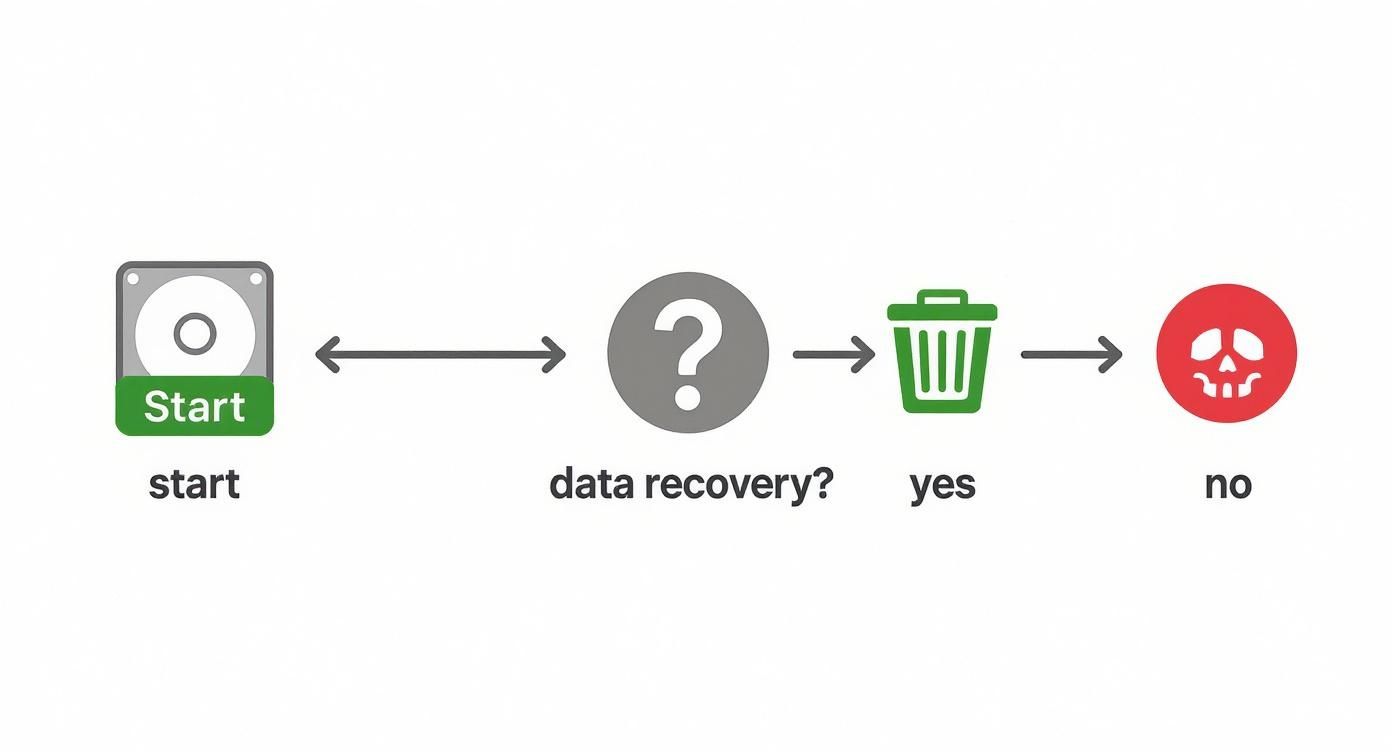
As the chart illustrates, every IT asset reaches a critical decision point: does it retain value, or is the data risk so significant that complete destruction is the only acceptable solution?
For IT managers, the key takeaway is that data destruction is not a one-size-fits-all process. The value of the asset must be weighed against the sensitivity of the data it contains. When in doubt, physical destruction is the safest and most defensible option.
Ultimately, your business needs a clear, documented process aligned with corporate security policies. By evaluating your options—software wiping for reuse, degaussing for magnetic drives, or shredding for absolute peace of mind—you can manage your end-of-life IT assets with confidence, minimize risk, and ensure compliance.
How To Navigate Data Disposal Compliance
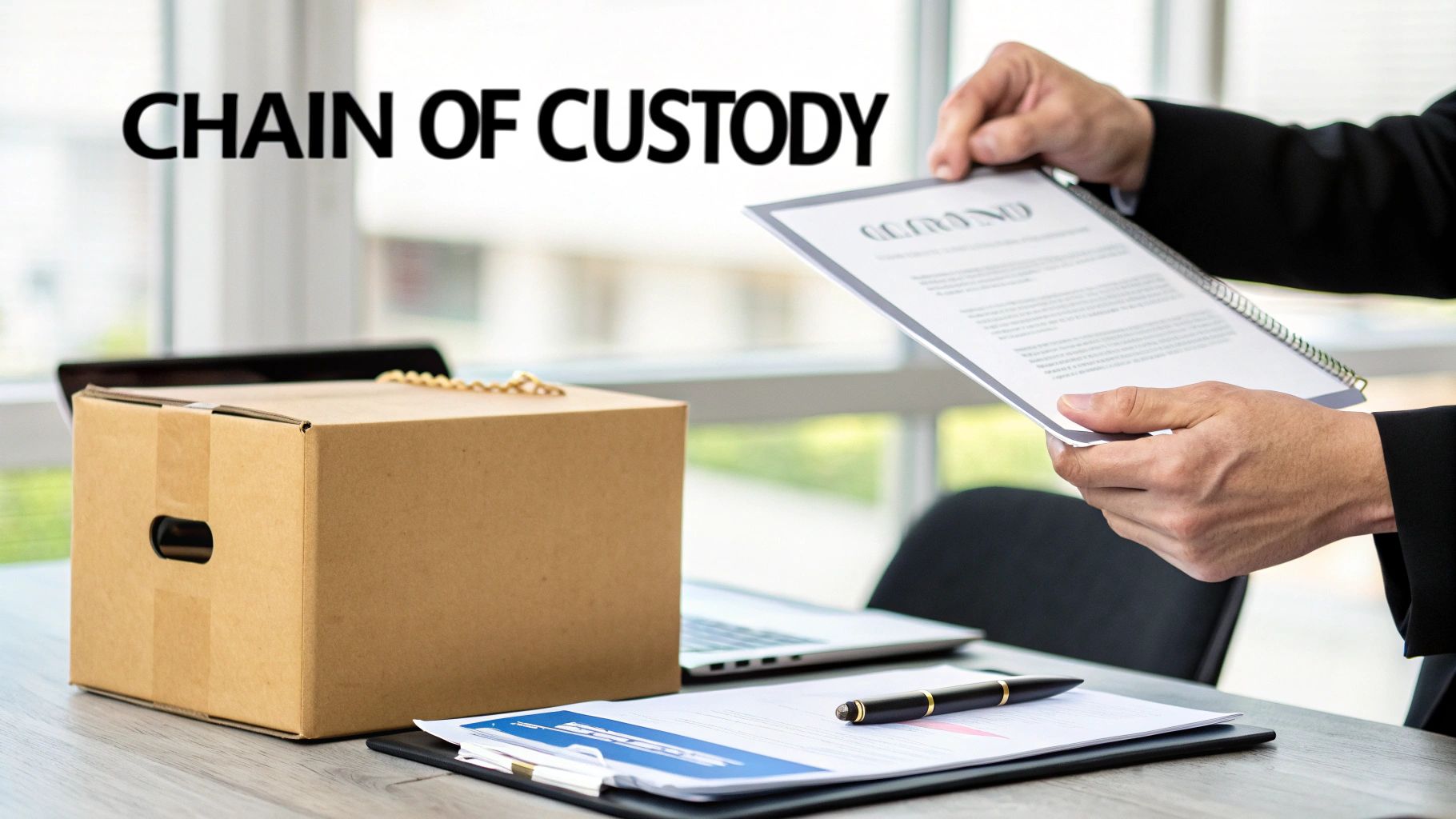
Securely disposing of data is not just an IT best practice—it is a legal requirement. When determining what to do with old hard drives, businesses must navigate a complex web of data protection laws. Failure to comply can lead to severe fines, operational disruptions, and irreparable damage to your corporate reputation.
Regulations such as HIPAA, FACTA, and GDPR establish strict rules for protecting sensitive information. These obligations do not end when a device is decommissioned; responsibility for the data follows the hard drive to its final disposition.
The Role Of Chain Of Custody
A critical component of any compliant data destruction program is a robust chain of custody. This is the evidentiary trail for your hard drives—a formal, auditable document that tracks every movement of your old drives, from the moment they leave your facility to the second they are destroyed.
A proper chain of custody meticulously tracks key details:
- Asset Identification: Serial numbers for every individual hard drive.
- Personnel Handling: Records of who handled the assets and when.
- Transportation Security: Documentation of how the drives were securely transported.
- Destruction Verification: The precise date, time, and method of destruction.
This unbroken record serves as proof that no assets were lost, stolen, or mishandled. It is your defense in an audit or legal proceeding, demonstrating due diligence.
The Certificate Of Destruction Explained
The chain of custody process culminates in one final, crucial document: the Certificate of Destruction. This is more than a simple receipt; it is a legally binding affidavit that serves as your official proof of compliant disposal. It formally transfers liability for the data from your organization to your certified destruction partner.
A Certificate of Destruction is your shield. If you are ever questioned during an audit, legal dispute, or data breach investigation, this document proves your company met its legal obligations to protect sensitive information by destroying it for good.
This certificate confirms the permanent and secure elimination of your data. The details are critical, including the specific destruction method used, which helps satisfy various regulatory requirements. For example, many regulations reference the standards set by the National Institute of Standards and Technology. You can gain a deeper understanding of these guidelines by exploring the NIST SP 800-88 media sanitization standards.
Why Compliance Documentation Matters
Data privacy laws are constantly evolving. Here is a brief overview of major regulations and their requirements for data disposal.
Key Data Privacy Regulations And Disposal Requirements
| Regulation | Governs | Data Disposal Mandate | Consequence of Non-Compliance |
|---|---|---|---|
| HIPAA | Protected Health Information (PHI) | Requires covered entities to implement policies for the final disposition of ePHI and the hardware on which it is stored. | Fines up to $1.5 million per year, per violation, and potential criminal charges. |
| FACTA | Consumer credit information | Mandates the proper disposal of consumer information through shredding, burning, or pulverizing electronic media. | Federal and state penalties, class-action lawsuits, and damages. |
| GDPR | Personal data of EU citizens | Data must be erased when no longer needed ("right to be forgotten"). Disposal must be done securely to prevent unauthorized access. | Fines up to €20 million or 4% of annual global turnover, whichever is higher. |
| GLBA | Nonpublic Personal Information (NPI) in the financial sector | Financial institutions must have a written plan to protect customer information, including secure disposal procedures. | Fines up to $100,000 for each violation, and potential prison time for individuals. |
| FTC Disposal Rule | Information from consumer reports | Requires businesses to take reasonable measures to protect against unauthorized access to information during disposal. | Civil penalties, federal enforcement actions, and lawsuits. |
Navigating this regulatory landscape can be challenging, but proper documentation provides clarity and security. It shifts the burden of proof, demonstrating that your business took proactive, verifiable steps to prevent a data breach. In today's business environment, being able to prove compliance is as important as being compliant itself.
This is why partnering with a certified expert that provides a detailed chain of custody and a formal Certificate of Destruction is non-negotiable for any commercial entity. It transforms a potential liability into a structured, defensible business process.
The True Cost Of Improper Hard Drive Disposal
When an old company hard drive is improperly discarded, it is not merely an IT oversight—it is the catalyst for a potential corporate catastrophe. The true cost is not the residual value of the drive; it is the staggering damage that follows when the data on it falls into the wrong hands.
A single, unsecured drive can ignite a full-blown data breach. The financial repercussions are severe. In 2023, the average cost of a data breach reached $4.45 million. This figure encompasses regulatory fines, legal fees, customer credit monitoring, and extensive public relations efforts to mitigate brand damage.
Beyond The Financial Penalties
While the direct financial costs are significant, the indirect costs often inflict long-term damage on a business. These are the hidden consequences that impact operations for years.
- Reputational Damage: Trust is a cornerstone of business. A data breach shatters it instantly. Once customers learn that their information was not protected, they will take their business elsewhere.
- Loss of Intellectual Property: If an old drive contains your company’s trade secrets, product blueprints, or strategic plans, its loss to a competitor could erase your market advantage overnight.
- Operational Disruption: Managing a data breach is a resource-intensive crisis. It diverts key personnel, from the IT department to the C-suite, away from core business functions, grinding productivity and innovation to a halt.
Viewing professional IT asset disposal as just another expense is a critical error in judgment. It is a non-negotiable insurance policy for your business—a strategic investment to protect against operational, financial, and reputational ruin.
A Proactive Defense Strategy
The dangers of data exposure from retired assets are well-documented. As detailed in our guide on data breaches from improper equipment disposal, the threat is both real and entirely preventable. The key is to shift from a reactive to a proactive stance.
When you understand the consequences and the need for a modern data breach response plan, the importance of proper hard drive disposal becomes clear. A certified destruction process is not just about disposing of old hardware; it is a core component of your company's cybersecurity and risk management strategy.
By implementing a secure, documented, and compliant disposal plan, you neutralize the threat before it can materialize. This means partnering with a certified ITAD provider who delivers a clear chain of custody and a final Certificate of Destruction. This documentation is your proof of due diligence and the only way to ensure yesterday’s assets do not become tomorrow’s liabilities.
Turning E-Waste Into A Sustainable Opportunity
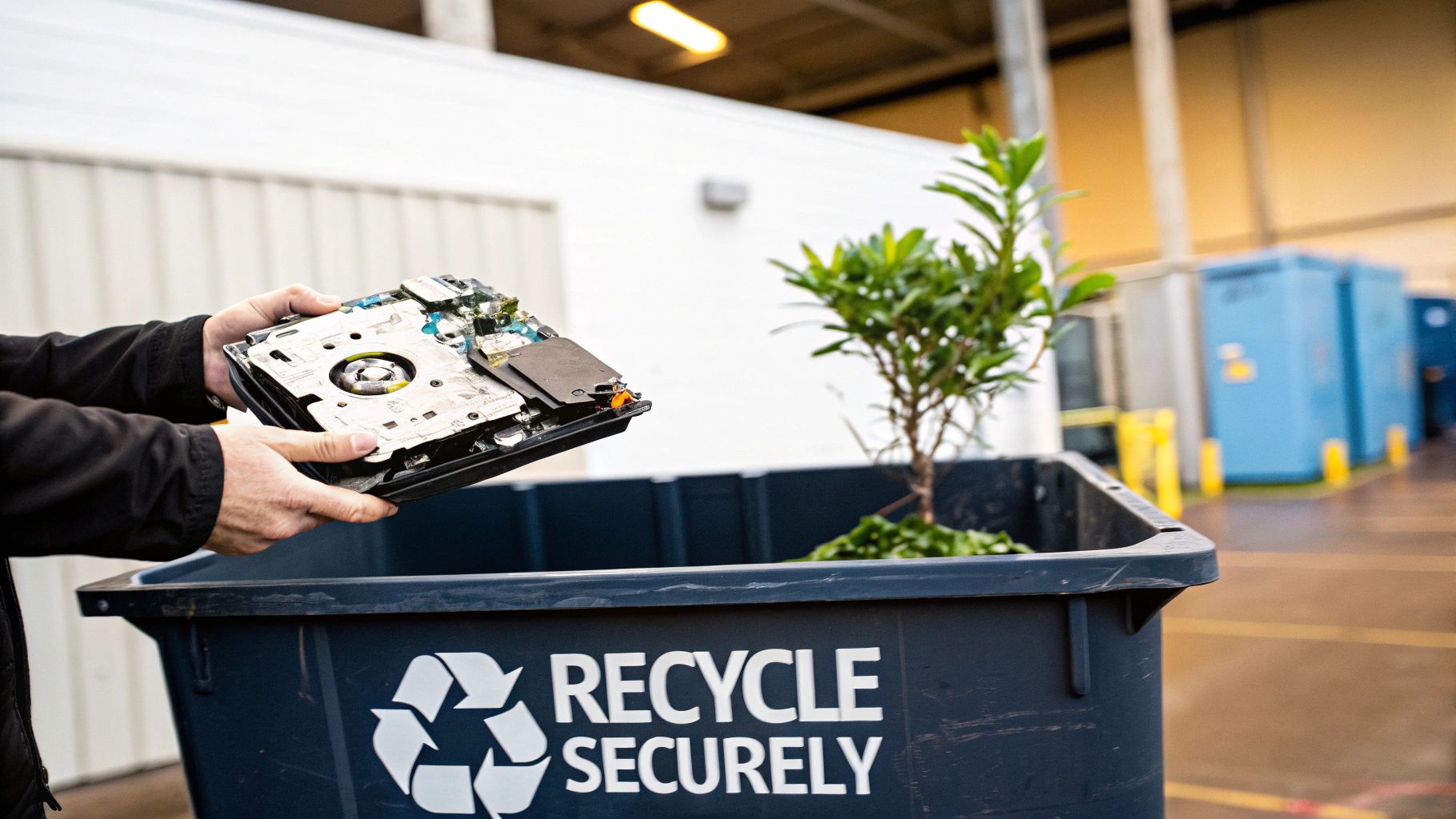
When determining what to do with old hard drives, businesses must balance two critical concerns: data security and environmental responsibility. These retired drives present a paradox: they contain hazardous materials like lead and mercury, but they are also rich in valuable, finite resources.
Choosing a certified disposal partner allows your business to address both concerns simultaneously, turning a potential liability into a clear demonstration of corporate stewardship.
The secure shredding process is not the end of the asset's life; it is the beginning of a sustainable recycling journey. Once data is irreversibly destroyed, the work of resource recovery begins. Certified electronics recyclers ensure that all shredded material enters a controlled and environmentally sound downstream process.
This approach elevates a simple disposal task into a strategic initiative. It directly supports your Corporate Social Responsibility (CSR) goals and contributes to a circular economy, where materials are recovered and reused rather than wasted.
The Scale of the E-Waste Challenge
The challenge of managing retired hard drives is immense, particularly for the data center industry. These facilities refresh hardware every three to five years, generating tens of millions of drives annually that require secure and responsible handling.
To put this in perspective, an estimated two million hard disk drives were shredded globally in a single recent year. This constant stream of e-waste places a significant strain on the environment, as hard drives contain valuable metals like neodymium that require specialized recycling for recovery. You can read more about Microsoft's innovative efforts to tackle this hard drive recycling challenge.
From Shredded Metal To Raw Materials
After a hard drive is shredded, the resulting mix of metals and plastics is processed using advanced separation technologies. This prepares the material to re-enter the manufacturing supply chain.
- Aluminum: Drive casings and platters are primarily aluminum, which is highly recyclable and can be melted down to create new products.
- Precious Metals: Circuit boards contain small but valuable amounts of gold, silver, and palladium, which are recovered through specialized smelting.
- Rare Earth Elements: Drive magnets contain neodymium and other rare earth metals, which are critical for manufacturing new electronics and green energy technologies.
By partnering with a certified e-waste recycler, your business ensures that these valuable resources are not lost to a landfill. This responsible choice reduces the environmental impact of mining for new materials and conserves natural resources.
The Value of R2 and E-Stewards Certifications
To ensure your old hard drives are handled responsibly from end-to-end, always work with a vendor holding key industry certifications like R2 (Responsible Recycling) or e-Stewards. These certifications are the gold standard in the electronics recycling industry.
They provide third-party verification that your partner adheres to the highest standards for:
- Environmental protection and pollution prevention.
- Worker health and safety.
- Secure data destruction practices.
- A transparent and accountable chain of custody for all materials.
Selecting a certified partner guarantees that your e-waste will not be illegally exported or improperly dumped. For a broader perspective on responsible disposal, check out a guide on how to reduce electronic waste. This knowledge helps your business make informed decisions that align with both security requirements and sustainability goals, ensuring your retired IT assets contribute positively to the environment.
Choosing A Certified IT Asset Disposal Partner
Selecting the right IT Asset Disposition (ITAD) partner is as critical as the data destruction method itself. This partner acts as the custodian of your data from the moment an old hard drive leaves your facility until it is verifiably destroyed. A poor choice can undermine your entire security posture, exposing your business to the very risks you are trying to mitigate.
Your evaluation should begin with non-negotiable certifications. Look for a partner holding credentials such as NAID AAA for data destruction and R2 or e-Stewards for environmental responsibility. These certifications represent rigorous, third-party audits confirming the vendor meets the highest industry standards for both security and sustainable practices.
Key Questions To Ask A Potential Vendor
Before engaging a vendor, it is essential to ask pointed questions. A transparent, professional partner will provide clear and confident answers.
- Can you walk me through your chain of custody process? They must demonstrate a detailed, auditable trail that tracks your assets from pickup through final disposition.
- Do you offer on-site shredding? For organizations requiring maximum assurance, witnessing the destruction firsthand at your own facility provides incontrovertible proof.
- What kind of documentation will I receive? A trustworthy partner will provide a serialized Certificate of Destruction for every job. This is not a receipt; it is your legal proof of compliance.
This level of scrutiny is vital. The demand for secure data disposal is growing, with the hard disk destruction equipment market valued at USD 2.69 billion and projected to reach USD 4.23 billion by 2032. This significant investment reflects a global consensus that professional, mechanical destruction is the gold standard for data security. You can learn more about hard disk destruction equipment trends from 360iResearch.
Choosing a certified partner isn't just about outsourcing a task; it's about extending your company's security perimeter. Your vendor's processes become your processes, and their compliance documentation becomes your legal defense.
The Importance Of A Formalized Partnership
Engaging an unvetted recycler for a one-off transaction is a serious gamble. A formal partnership with a certified ITAD provider establishes a consistent, repeatable, and defensible process for all retired assets. It guarantees that every device is handled according to a strict, pre-agreed protocol that aligns with your security policies and regulatory obligations.
To better understand the full scope of these services, explore our detailed guide on what is IT asset disposition.
Ultimately, the right partner does more than just shred your old hard drives. They deliver genuine peace of mind by safeguarding your business from every conceivable angle.
Your Top Questions About Hard Drive Disposal Answered
Even with a comprehensive ITAD strategy, specific questions often arise when dealing with old hard drives. Here are answers to common queries from businesses to help finalize your asset disposal process with confidence.
Can't I Just Smash a Hard Drive With a Hammer?
While it may seem like a quick solution, using a hammer to destroy a hard drive is not a secure data destruction method for any business. Physical damage may mangle the casing and crack the platters, but it often leaves large, data-bearing fragments intact.
A determined individual with forensic tools could still recover sensitive information from these pieces. Professional shredding, in contrast, grinds the entire drive into tiny, confetti-like fragments, making data reconstruction physically impossible. It is the only method that guarantees complete, verifiable destruction that meets compliance audit standards.
Is It Really Safe to Donate or Resell Old Corporate Hard Drives?
It can be safe, but only after one critical step: certified data sanitization. This is not a simple "delete." It requires professional software that follows strict standards like NIST 800-88 to overwrite every sector of the drive, often multiple times. This forensically wipes the drive clean, making it safe for reuse.
However, if this process is skipped, you are essentially handing over corporate, employee, or customer data to an unknown third party. The risk of a data breach is exceptionally high. For this reason, most businesses seeking maximum security and peace of mind opt for physical destruction over reuse.
How Do I Know for Sure My Data Is Actually Destroyed?
Official documentation is your definitive proof of proper disposal. A reputable ITAD partner will provide two essential documents:
- Chain of Custody: This document provides a complete timeline for your assets, tracking your hard drives from the moment they leave your facility and logging every individual who handles them through to their final destruction.
- Certificate of Destruction: This is the official, legal document confirming the exact date, time, method, and location of destruction. It serves as your proof of compliance and formally transfers liability.
Without these documents, a business has no verifiable proof that it met its legal and ethical obligations. With them, you have definitive assurance that your sensitive data has been permanently destroyed.
Contact Beyond Surplus for certified electronics recycling and secure IT asset disposal. We provide certified data destruction, detailed chain-of-custody reporting, and environmentally responsible recycling for businesses across the United States. Contact us today to schedule a secure pickup and protect your company’s sensitive information.