If you're running IT for a growing company in Atlanta, you probably know the pattern. New hires need laptops fast. A dev team outgrows its current environment. A product group swaps networking gear, test devices, or aging servers. Then the retired hardware starts piling up in a closet, cage, or back office because no one wants to create risk by moving too quickly.
That’s why tech village atlanta matters to more than founders and investors. For IT managers, facilities teams, procurement leaders, and operators, Atlanta Tech Village is a practical signal of how fast technology moves in this market, and why secure lifecycle planning has to keep up.
What Is Atlanta Tech Village and Why Does It Matter
Atlanta businesses often hear about Atlanta Tech Village as a startup destination. That description is incomplete. It’s also a concentration point for talent, infrastructure, vendors, and business relationships that affect how companies buy, deploy, retire, and replace technology.

Founded in 2012, Atlanta Tech Village is a 103,000 square foot facility that quickly became a key tech hub. In its first five years, startups at ATV raised over $600 million in capital, nurturing over 300 startups and creating thousands of jobs across the Southeast, according to Growjo’s Atlanta Tech Village profile.
Why operators should pay attention
A place like this changes the local market in practical ways.
- Talent gets concentrated. Engineers, product teams, MSPs, recruiters, and founders move through the same environment.
- Technology turnover speeds up. Fast-moving companies replace endpoints, lab gear, networking hardware, and server equipment more often than slower organizations do.
- Vendor access improves. Companies can find implementation partners, service providers, and specialized support without long sourcing cycles.
For Atlanta companies outside the building, that matters. You don’t need to lease space there to benefit from the network around it. You need to understand how the ecosystem works and where your business fits.
Why it matters for lifecycle planning
The usual public story about ATV focuses on innovation. The less discussed reality is that innovation creates operational residue. Devices age out. Storage media has to be handled correctly. Demo equipment, failed prototypes, and replaced infrastructure need documented disposition.
Practical rule: If your business is tied to Atlanta’s tech economy, your asset retirement process needs to be as deliberate as your procurement process.
For companies looking at regional reuse and disposition options, this Atlanta technology reuse resource is useful context for thinking about value recovery alongside data security.
Exploring the Ecosystem Inside Atlanta Tech Village
The best way to understand tech village atlanta is to think of it as an engineered collision space. It isn’t just office square footage. It’s a system built to make useful conversations happen faster.

ATV supports over 1,100 workers and provides amenities like “crazy fast” multi-gigabit fiber internet, free cloud credits, and event spaces. That infrastructure helps resident startups reduce their funding timelines from a national average of 12-18 months to under 6 months, according to One America Works.
What the day-to-day environment looks like
A founder can walk from a product conversation to a mentor meeting to a pitch practice in the same day. That density matters because it cuts waiting time between problem and answer.
For IT teams, there’s a parallel lesson. Dense environments expose weak processes quickly. If onboarding is sloppy, hardware tracking is weak, or offboarding is informal, the pace of activity will surface those gaps.
Who benefits most from the setup
Different groups use the same environment for different reasons:
- Early-stage teams need workspace, credibility, and quick access to advice.
- Investors and advisors want proximity to companies before formal diligence deepens.
- Corporate partners use hubs like this to scout solutions, monitor trends, and build local relationships.
- Service providers gain access to decision-makers who need support now, not next quarter.
That last point gets overlooked. Not every meaningful partner inside a tech hub is a startup. Many are operators who solve recurring business problems.
A strong ecosystem doesn’t remove friction. It removes the wrong friction.
What works and what doesn’t
What works is physical and social proximity. People solve more problems when they can meet quickly, share context, and move to action without weeks of scheduling.
What doesn’t work is assuming community alone fixes execution. Startups can still become disorganized. Inventory can still sprawl. Test devices can still disappear into untracked drawers and unused storage shelves.
That’s also why support functions matter. As companies grow, they often need help beyond product and fundraising. They need branding, demand generation, and market visibility. For teams evaluating outside help, these digital marketing services are one example of the kind of specialized support businesses in fast-moving hubs often seek.
A related local view of the surrounding ecosystem is available through this Atlanta Tech Village Buckhead page, especially for companies evaluating how the district connects to broader business operations.
How to Engage with Atlanta Tech Village
If you want to work with Atlanta Tech Village, start with the practical details. ATV operates at 3423 Piedmont Rd NE Ste 500, Atlanta, Georgia, according to the verified company information from Growjo. That Buckhead location matters because it puts the hub near established business activity, talent pools, and other service providers.
Practical ways to participate
You don’t need a single path in. Companies usually engage in one of three ways.
First, some organizations join because they need workspace and daily community access. That makes sense for startups, satellite teams, and operators who benefit from being physically present.
Second, some businesses participate through events, workshops, and network-driven introductions. This is often the better move for firms that want access without relocating people.
Third, larger companies explore partnership opportunities. They may be looking for startups to pilot, founders to mentor, or a visible presence in Atlanta’s tech market.
What to check before you engage
Use a short screening list before committing time.
- Your objective: Are you hiring, scouting partnerships, building market visibility, or looking for operating support?
- Your team fit: Some teams need dedicated office space. Others only need event access and relationship-building.
- Your process maturity: If your internal procurement, security, or device management is loose, a fast ecosystem can magnify those weaknesses.
For hiring, especially in emerging technical categories, it can help to explore current job opportunities in adjacent startup and Web3 markets. Even if you’re not hiring for crypto-specific roles, the platform can reveal how technical talent is positioning itself.
The best engagement strategy is usually narrow at the start. Join for one reason, then expand once the relationship proves useful.
A Strategic Hub for IT Infrastructure and Data Centers
For IT leaders, the most important part of tech village atlanta isn’t the coffee bar, event calendar, or startup energy. It’s the infrastructure layer that supports serious workloads.
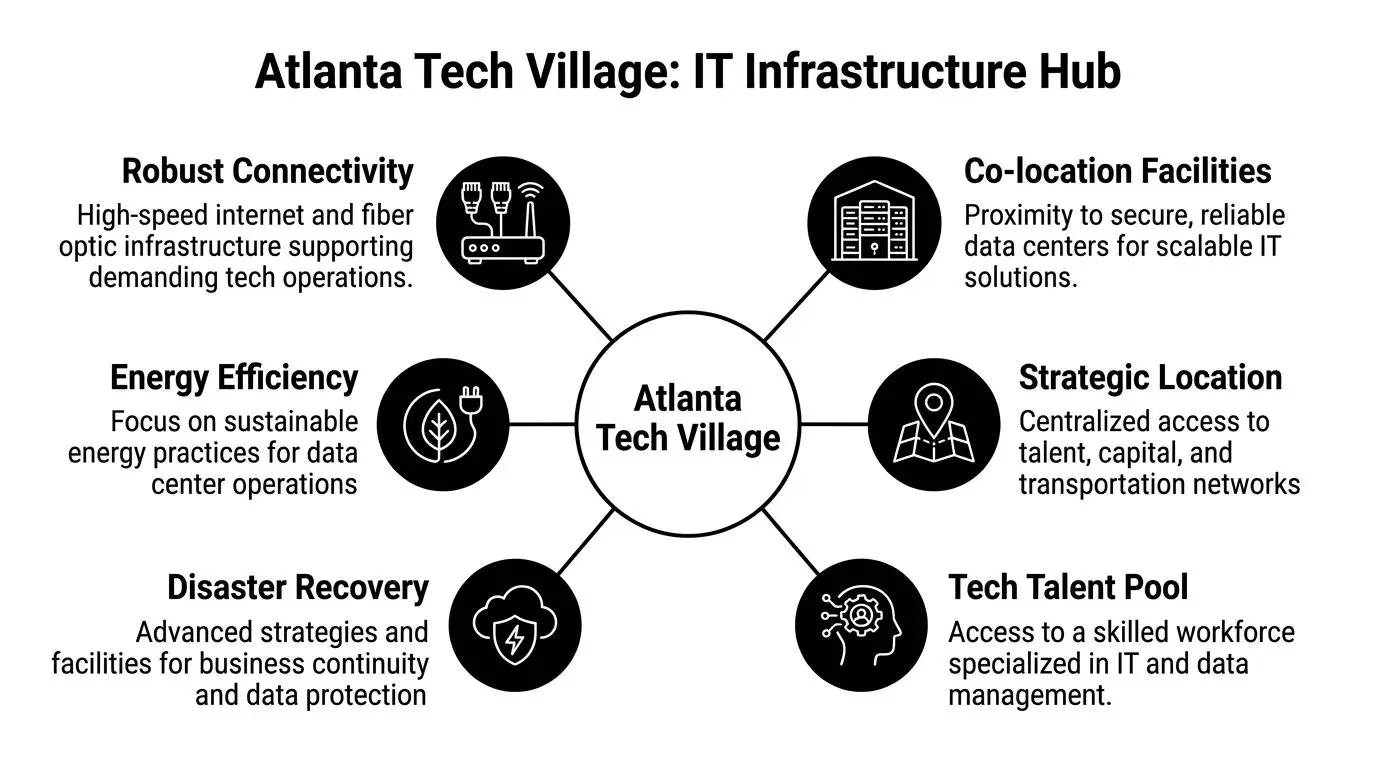
The on-site Performive data center offers Tier III+ uptime, N+1 redundant cooling, power densities up to 24kW per rack, and direct peering with over 20 networks. The same source states that this setup reduces data sovereignty risks for regulated industries and can cut cloud egress costs by 40-60% for tenants, based on the Performive at Atlanta Tech Village data center profile.
Why that matters in real operations
This isn’t just a startup convenience. It’s relevant to businesses running latency-sensitive applications, hybrid infrastructure, regulated workloads, or AI-heavy environments.
A few examples make the trade-offs clearer.
| Need | Why the hub matters |
|---|---|
| Low-latency connectivity | Closer interconnection can improve performance for local users and partner systems |
| Compliance-sensitive processing | Localized infrastructure can help reduce jurisdiction and handling concerns |
| High-density compute | Rack power capacity matters when workloads go beyond light virtualized environments |
| Hybrid cloud cost control | Egress-heavy architectures can become expensive without the right design |
What works for enterprise teams
The best use cases tend to share the same traits.
- Burst growth environments: Teams that can’t wait through long infrastructure buildouts benefit from established colocation options.
- Pilot-heavy programs: Companies testing new workloads can avoid overcommitting capital too early.
- Regulated business units: Healthcare, finance, and similar sectors often need tighter control over where systems sit and how data moves.
Where companies get it wrong
Some businesses see a hub like this and assume all infrastructure problems disappear. They don’t.
You still need asset inventories. You still need decommissioning plans. You still need documented custody when equipment leaves a cabinet, office, lab, or cage. The more capable the environment, the more important disciplined exit processes become.
Operational insight: Fast deployment without an equally clear retirement plan creates hidden risk. The hardware that enters cleanly has to leave cleanly too.
That’s especially relevant for infrastructure teams planning refresh cycles, site moves, or shutdown work. This overview of the data center decommissioning process is useful for framing what should happen before racks are touched, drives are pulled, or transport is scheduled.
Secure IT Asset Disposition for Tech Village Tenants
Growth gets attention. Retirement work gets postponed. That’s a mistake.
In a dense environment like Atlanta Tech Village, companies acquire and replace technology quickly. Laptops move between employees. Network gear gets upgraded. Storage media leaves active use but still holds sensitive information. If no one owns disposition, risk accumulates in closets, cabinets, and staging rooms.

Having supported over 300 startups that have raised more than $1 billion in capital, the sheer volume of IT hardware cycling through Atlanta Tech Village represents a significant and continuous need for secure, compliant asset management and disposal, based on ZoomInfo’s Atlanta Tech Village company profile.
Why informal disposal fails
A lot of companies still treat retired hardware as a facilities issue. It isn’t. It’s a security, compliance, and governance issue.
Common failure points include:
- Untracked storage media: Drives and backup devices sit in bins with no clear chain of custody.
- Ad hoc handoffs: Equipment gets passed to staff, movers, or general recyclers without documented accountability.
- Mixed asset streams: Valuable redeployable equipment gets lumped together with damaged or obsolete gear.
- Missing paperwork: When auditors or legal teams ask what happened to retired devices, nobody has a complete record.
What a sound ITAD approach looks like
Strong ITAD programs aren’t complicated, but they are disciplined.
They start with asset identification. Teams need to know what they have, which devices store data, and what can be reused, remarketed, or physically destroyed.
They continue with controlled handling. Equipment should move through a documented process, not an improvised cleanup.
They end with proof. If your business can’t show what happened to storage devices and retired electronics, your process isn’t finished.
The risky part of disposition usually isn’t recycling. It’s the handoff before recycling.
The startup-specific risk
Startups and innovation teams often have a blind spot here. They buy fast, scale fast, and replace fast. But they don’t always mature their lifecycle controls at the same speed.
That creates awkward scenarios. A company can have excellent cloud security and weak endpoint retirement. It can enforce modern identity controls while leaving old SSDs in a shelf bin. It can pitch enterprise buyers while lacking disposition records those buyers expect.
For businesses near ATV that are evaluating local handling considerations, this Atlanta Tech Village Sylvan page offers another useful local reference point.
Scheduling E-Waste Recycling and Certified Data Destruction
Once assets are ready to leave service, the process should be simple and documented. That’s where many businesses benefit from using a standard operating rhythm instead of one-off cleanup days.
A practical scheduling workflow
Inventory the material
Separate laptops, desktops, servers, networking gear, mobile devices, and loose drives. Flag anything that may contain regulated or sensitive data.Define the handling requirement
Some assets are candidates for reuse or buyback. Others need physical destruction because the media, condition, or policy requires it.Choose on-site or off-site destruction
On-site destruction makes sense when your internal policy, client obligations, or chain-of-custody preference requires witnessing the process. Off-site handling can work well when the provider’s transport, intake, and destruction controls align with your compliance needs.Schedule pickup and site logistics
Confirm building access, loading dock rules, elevator limitations, packaging expectations, and who will sign release paperwork.
What documentation should look like
Two records matter most after the work is complete.
- Certificate of Data Destruction documents that data-bearing media was destroyed or sanitized according to the agreed process.
- Certificate of Recycling documents downstream handling of material and supports environmental accountability.
Those records matter because they create an audit trail. They also help transfer liability away from the generator once the assets move through a documented process.
Best practices for event organizers and shared spaces
If you manage a demo day, office move, lab refresh, or tenant transition, don’t wait until the final week to ask what happens to retired gear.
Coordinate early around these items:
- Access control: Who can release equipment
- Media segregation: Which devices require special handling
- Pickup windows: When carts, pallets, or sealed containers can move
- Final signoff: Which manager approves completion
For businesses arranging local service logistics, this Atlanta e-waste pickup page provides a practical reference for pickup planning.
Partnering for a Sustainable Tech Lifecycle in Atlanta
Atlanta Tech Village represents what many companies want from a regional tech hub. Dense relationships. Faster problem-solving. Better access to talent, capital, and infrastructure.
But mature technology leadership includes more than acquisition and growth. It also includes disciplined retirement. Devices, drives, racks, and surplus hardware don’t stop being your responsibility just because they’ve stopped being useful.
The strongest operators in Atlanta treat lifecycle management as part of business continuity. They plan how equipment enters service, how it’s tracked while in use, and how it leaves without exposing data, creating compliance gaps, or wasting recoverable value.
That’s the practical lesson behind tech village atlanta. Innovation works better when operations are controlled from procurement through final disposition.
If your organization needs secure pickup, certified data destruction, IT asset recovery, or data center equipment removal, contact Beyond Surplus for certified electronics recycling and secure IT asset disposal.