A founder steps out of a meeting in South Downtown, signs for a shipment of replacement laptops, and asks the office manager where the retired ones should go. That question sounds minor until customer data, compliance, and chain of custody are attached to it.
The Dawn of a New Tech Hub in South Downtown
South Downtown has needed a business anchor that does more than fill space. It needed a reason for founders, operators, and investors to show up repeatedly and build habits around the district.
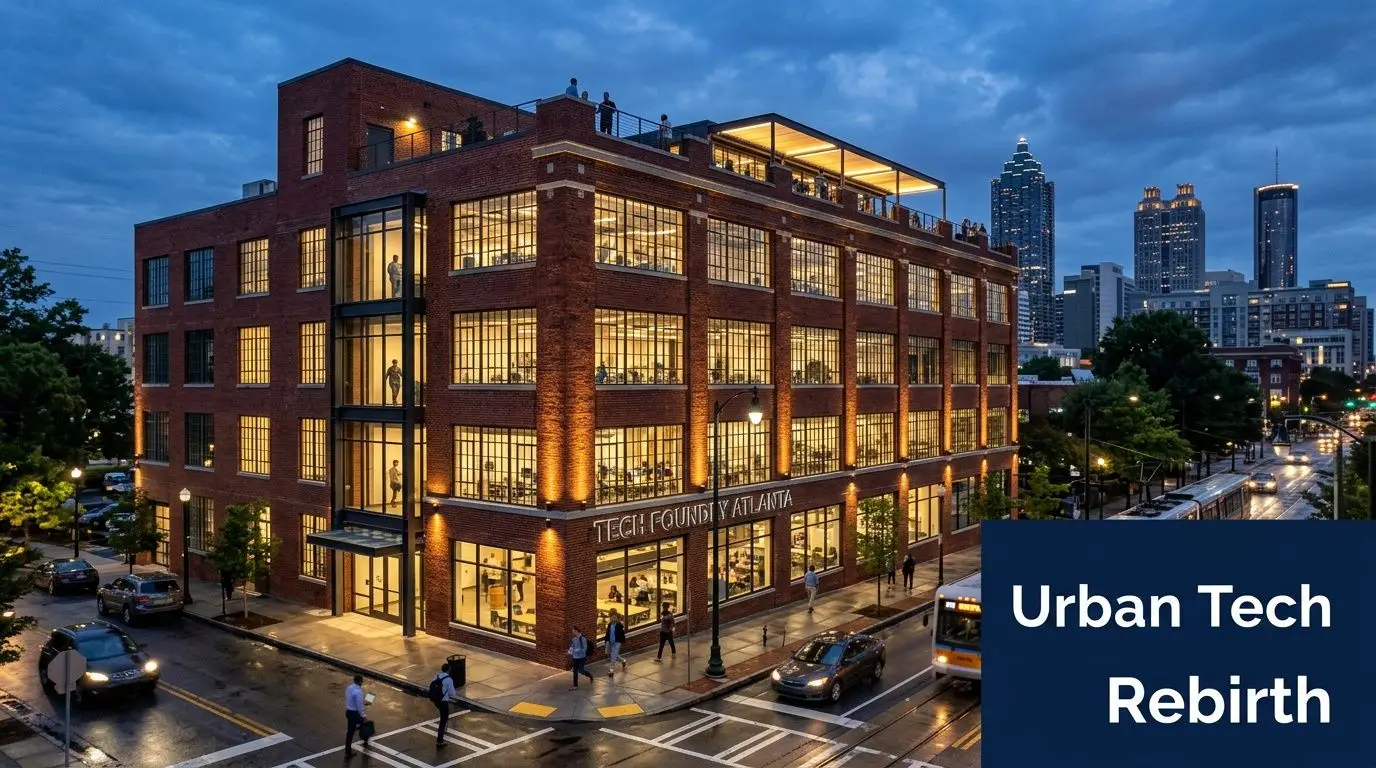
That’s why atlanta tech village downtown matters. ATV Sylvan opened on January 8, 2025, in a 30,000 square foot facility on Mitchell Street’s historic Hotel Row, with capacity for roughly 225 people, according to Axios’ coverage of the opening. This isn’t a symbolic ribbon cutting. It puts working companies inside a part of Atlanta that has long had strong location fundamentals but needed daily business activity.
Why this opening feels different
The strongest downtown projects give companies a practical reason to relocate or expand. ATV Sylvan does that by combining startup density with a neighborhood revival story.
A lot of people outside Atlanta still think of the city’s startup scene through Buckhead, Midtown, or scattered office pockets. South Downtown changes the conversation. It puts entrepreneurship in historic buildings, in a walkable street grid, in the city’s front door.
For teams evaluating where to place founders, product staff, or revenue leaders, this creates a more grounded version of a premier tech hub. Not a campus isolated from the city, but a working node inside it.
What operators should notice
The headline isn’t just coworking. It’s concentration.
- Historic setting, current use: The project places startup activity on Hotel Row instead of another generic office floor.
- Real occupancy pressure: Early demand matters because space with active tours behaves differently from space that sits empty.
- Ecosystem spillover: More founders in one corridor means more laptops, networking gear, monitors, test devices, and retired hardware moving through the same few blocks.
For Atlanta companies tracking the district, this local overview of https://technostolic.com/atlanta-tech-village/ gives added context on why the site is drawing so much business attention.
Downtown revitalization becomes real when operators start solving ordinary business problems there every day.
What Exactly Is Atlanta Tech Village Downtown
Atlanta Tech Village Downtown is best understood as an extension of a proven startup platform, not a separate experiment. It carries the Atlanta Tech Village model into a different part of the city with a different operating advantage.
The original Atlanta Tech Village opened in 2013, and CB Insights states it helped recruit more than 500 companies that created 55,000 jobs in metro Atlanta through its first decade. That track record is detailed in CB Insights’ company profile. For business owners, that history matters more than the branding. It shows the organization knows how to gather founders, advisors, and capital in one place.
How it differs from Buckhead
Buckhead established the brand. Downtown changes the use case.
The downtown site is better suited to companies that want proximity to transit, civic institutions, downtown venues, and the broader movement around South Downtown’s redevelopment. It’s still aimed at startups and growth-stage operators, but the context is more urban and more integrated with the city’s core.
That difference matters for hiring. Some teams recruit better in a polished business district. Others recruit better in a setting that feels closer to builders, creators, and city energy.
Who should pay attention
Three groups should be watching atlanta tech village downtown closely:
- Founders building in regulated sectors such as fintech, health, or public sector software.
- IT managers supporting hybrid teams with growing device inventories.
- Procurement and facilities leaders who inherit the hardware decisions startups postpone.
A practical local resource is https://technostolic.com/atlanta-tech-village-atlanta-ga/, especially if you’re evaluating the business services ecosystem around the downtown expansion.
A startup hub proves itself when it supports ordinary company building, not just launch events.
A Space Engineered for Innovation and Collaboration
Some coworking spaces are little more than desks and good photography. ATV Sylvan appears to have been built with a more specific operating theory.
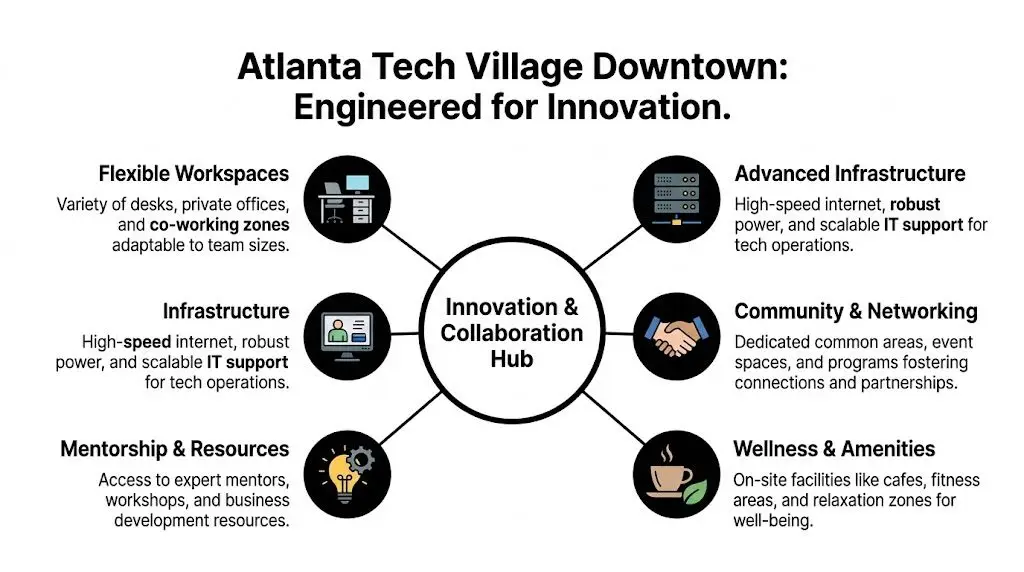
Gensler designed the 30,000 square foot space, with 50% dedicated to a community hub and shared zones intended to encourage serendipitous interaction, according to Gensler’s project page. That design choice matters because young companies rarely grow in a straight line. They need quiet space, fast conversations, private calls, and informal contact with other operators, sometimes in the same hour.
What the layout gets right
A strong startup workspace has to support conflicting needs. ATV Sylvan appears to address that tension directly.
- Focused work: Private areas matter because founders still need places to close deals, review contracts, or handle customer issues.
- Fast collaboration: Huddle rooms and open shared zones reduce the friction of grabbing people for a quick decision.
- Community density: When half the building is built around connection, chance meetings become part of the operating model rather than an afterthought.
That’s a meaningful contrast with older office layouts that separate teams too aggressively and drain energy from the day.
What doesn’t work in practice
Founders often overvalue aesthetics and undervalue operational flow. Good lighting and historic character help. They don’t fix a bad layout.
What usually fails in startup spaces is simple:
- too little private meeting capacity,
- poor phone-call acoustics,
- not enough room for teams to grow without relocating,
- and shared areas that look active but don’t support real work.
The better benchmark is whether a team can recruit, sell, onboard, and troubleshoot from the same location without constant workarounds. That’s the standard downtown has to meet.
For companies comparing the newer site to the original community, https://technostolic.com/atlanta-tech-village-buckhead/ is useful background.
The Strategic Advantage of a Downtown Location
Location affects more than commute times. It affects hiring, meetings, partnerships, and network performance.
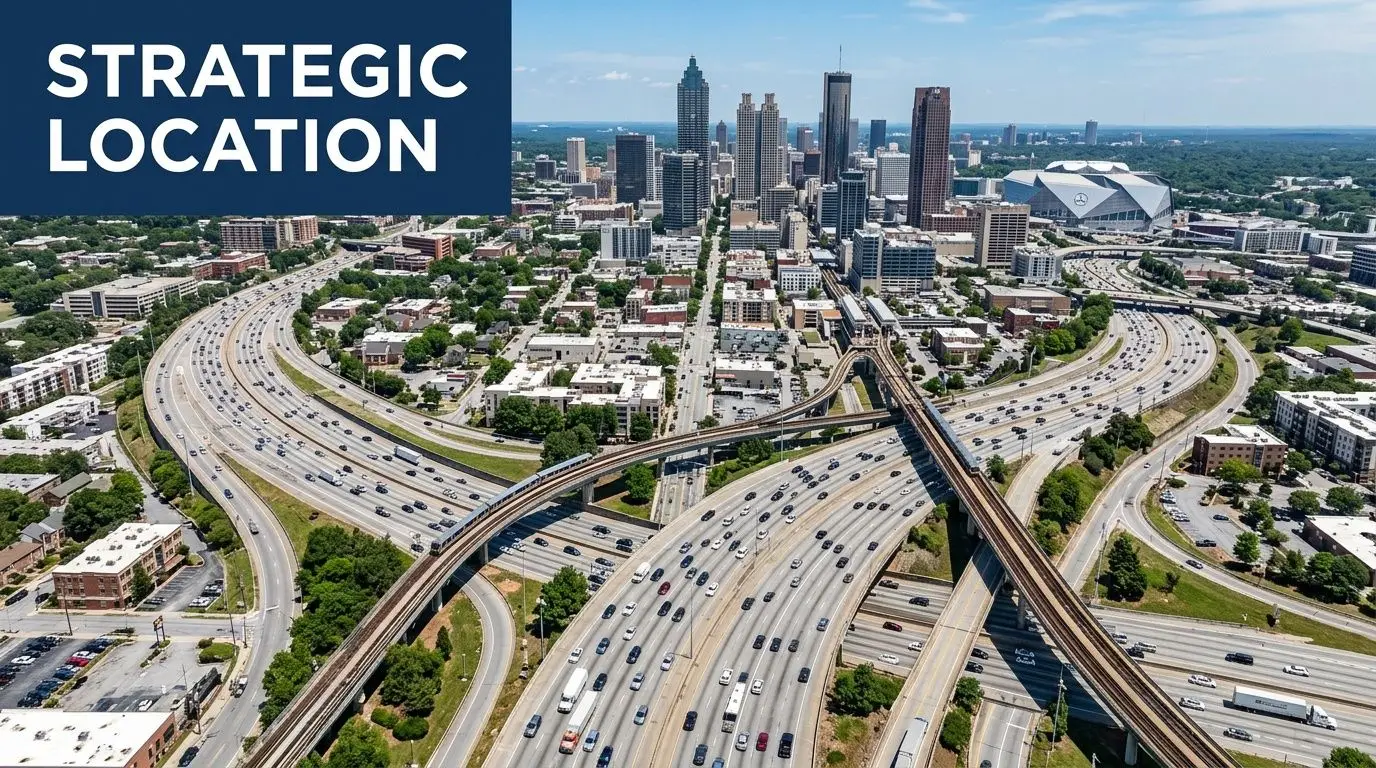
A downtown startup hub has one clear advantage over peripheral office space. More people can reach it without friction, and more business activity happens around it by default. ATV Downtown also benefits from Atlanta’s major connectivity assets. Newby Ventures describes it as a key interconnection facility positioned near extensive internet exchanges and fiber infrastructure, supporting the low-latency connectivity startups need for AI, cloud, and SaaS work in its Atlanta Tech Village facility research.
Why downtown helps operations
For a startup, convenience isn’t a luxury item. It’s part of execution.
A downtown address helps when:
- investors are already moving through the urban core,
- candidates rely on MARTA or prefer central access,
- customers want an easy meeting point,
- technical teams need dependable connectivity.
The trade-offs are real
Downtown isn’t automatically easier. Teams still have to think through parking, move-in logistics, building access, and after-hours procedures.
That said, many firms benefit when they stop treating location as a lifestyle choice and start treating it as infrastructure. In that view, atlanta tech village downtown gives companies a practical downtown foothold instead of a prestige address with little operational upside.
The best office location is the one your team, customers, and vendors can actually use without friction.
The Unseen Challenge of Startup Growth Secure IT Asset Disposal
Startup coverage usually celebrates hiring, fundraising, and product launches. It rarely spends time on what happens to the equipment left behind.
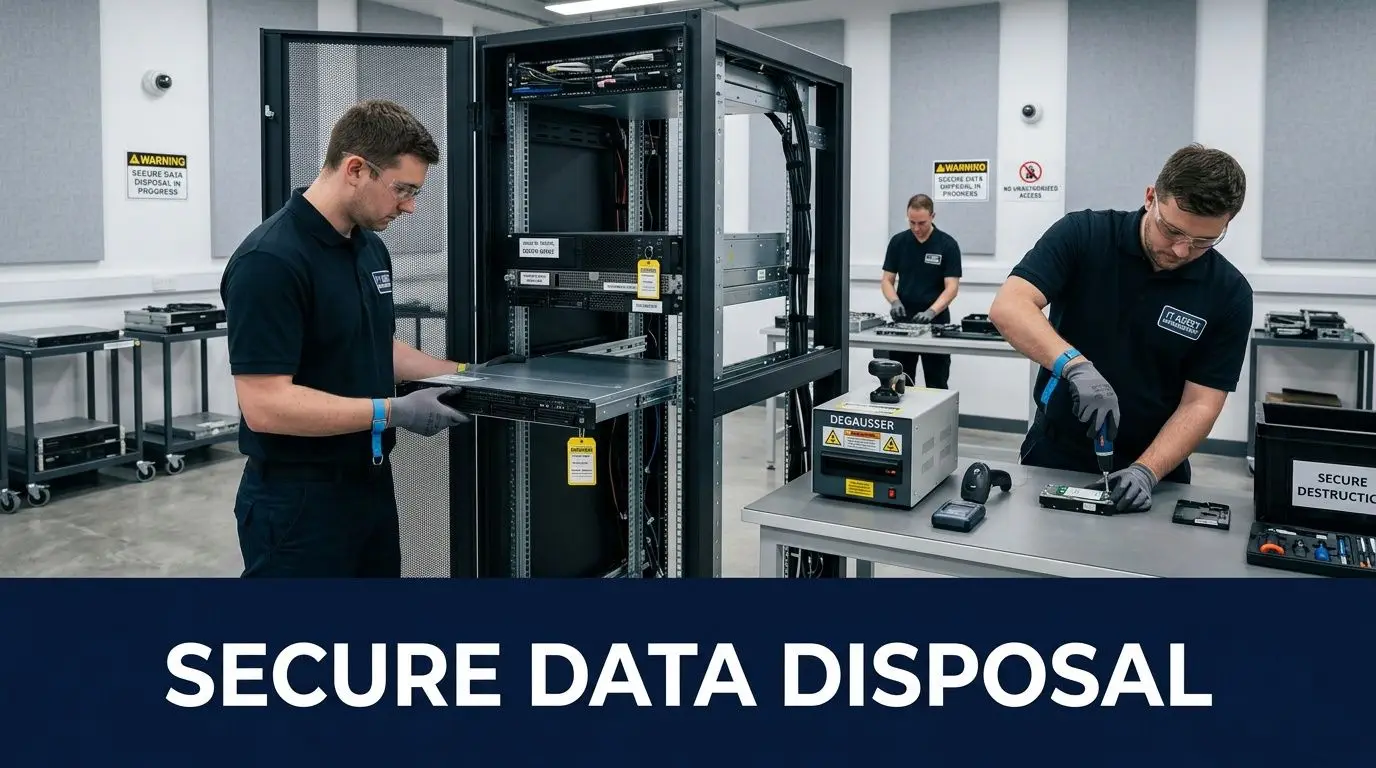
That’s a mistake. The official Atlanta Tech Village material leaves a notable information gap around sustainable IT practices, even though growing companies generate retired laptops, failed drives, networking gear, test devices, and obsolete peripherals. The issue is more serious because firms can face disposal-related compliance risk under rules such as the FTC Disposal Rule, as noted on Atlanta Tech Village’s site.
Growth creates hardware waste fast
The pattern is familiar. A startup hires fast, upgrades devices unevenly, replaces lab or dev hardware on short notice, and stores old equipment in a closet because nobody owns the process.
That works until one of these happens:
- a customer asks how drives are destroyed,
- finance asks whether retired assets have residual value,
- an office move exposes years of unmanaged hardware,
- or security realizes devices left service without proper documentation.
Teams obsessed with product and pipeline often overlook this while refining user acquisition strategies for startups. But growth creates operational residue. Hardware is part of it.
What fails most often
The weakest approach is informal disposal. That includes ad hoc recycling, untracked pickups, donation without wiping standards, and storing old assets indefinitely.
For Atlanta companies building in and around the Village, https://technostolic.com/atlanta/ is relevant because the local hardware lifecycle problem is no longer hypothetical. More startups in one district means more end-of-life IT decisions that need adult supervision.
Retired hardware isn’t an office cleanup issue. It’s a data governance issue with a loading dock attached.
An IT Director's Plan for Secure E-Waste Management at ATV
If I were advising an IT director inside atlanta tech village downtown, I wouldn’t start with recycling. I’d start with control.
A workable plan has to match startup speed without sacrificing documentation. That means creating a repeatable path from asset retirement to final disposition, especially for devices that held customer, employee, financial, or product data.
A practical operating model
First, assign ownership. Someone has to approve retirement, verify inventory, and release equipment. In small firms that may be the head of IT. In growing teams, it may sit with IT operations plus finance.
Second, separate asset categories. Laptops, phones, drives, servers, prototypes, and networking gear don’t all move through the same process.
Third, require documentation at each handoff. If a company can’t show what left, when it left, and how data was destroyed, it’s depending on memory instead of process.
The checklist that actually helps
- Inventory before pickup: Match serials or internal asset tags to the retirement list.
- Choose the destruction path: Some assets need certified wiping. Others need physical destruction.
- Preserve chain of custody: Every transfer should be documented from office or cage to final processor.
- Review value recovery: Some retired equipment still has resale or buyback potential.
- Keep policy current: Fast-growing firms outgrow their original disposal habits quickly.
For vendor evaluation, https://technostolic.com/vendor-due-diligence-checklist/ is a practical starting point because it pushes teams to look at process, accountability, and documentation instead of marketing language.
The larger point is simple. A maturing startup district doesn’t just need founders and capital. It needs the unglamorous systems that let companies grow without creating avoidable security or compliance risk.
Companies growing at Atlanta Tech Village Downtown need more than office space. They need secure, documented end-of-life processes for laptops, drives, servers, lab gear, and surplus IT assets. Contact Beyond Surplus for certified electronics recycling and secure IT asset disposal.