If you're evaluating atlanta tech village atlanta ga, you're probably not just asking where startups rent desks. You're asking where founders meet investors, where early teams hire fast, and where growing companies get the support structure they need without losing momentum.
That makes Atlanta Tech Village worth understanding at an operational level, not just as a startup brand. In Atlanta, space, community, and execution tend to overlap. A founder may come for networking, stay for mentorship, and then discover a less glamorous issue that suddenly matters a lot: what happens to retired laptops, failed drives, demo hardware, and old networking gear once the company starts moving quickly.
Welcome to the Heart of Atlanta's Tech Scene
A founder signs a new hire on Monday, hands over a laptop on Tuesday, swaps out a failing monitor on Wednesday, and by Friday the team has already outgrown its first setup. That is the practical rhythm inside a fast-moving startup hub. At Atlanta Tech Village, the value is not only that companies work near other ambitious teams. It is that growth happens in close quarters, which speeds up decisions and also exposes operational weak spots much earlier.
That second point often gets missed.
Startup communities are usually described through funding wins, networking, and energy. Those things matter, but business operators also need to ask a different set of questions. How are devices tracked as headcount rises? Who is responsible when old laptops pile up in a storage room? What happens to failed drives, demo hardware, and retired networking gear when a company moves offices or upgrades equipment?
Atlanta Tech Village is useful partly because it concentrates these needs in one place. The environment helps companies meet potential hires, partners, and advisers faster. It also creates a real-world test of whether a growing business can manage the full lifecycle of its technology assets without creating security gaps.
A good way to understand ATV is to view it as shared business infrastructure, not just shared office space. Founders may arrive looking for community. Operations leaders, IT managers, and security teams quickly notice another advantage. They are surrounded by companies dealing with many of the same procurement, deployment, compliance, and disposal questions at roughly the same stage of growth.
For business readers, that makes Atlanta Tech Village Atlanta GA relevant in three practical ways:
- Growth happens faster in context. Hiring, vendor selection, and team expansion often move more quickly when companies operate near peers and service providers.
- Operational problems show up earlier. Asset tracking, access control, equipment refresh cycles, and office hardware sprawl become visible before they turn into larger security issues.
- End-of-life planning matters sooner than expected. A scaling startup does not just buy more tech. It also has to retire, store, wipe, recycle, or dispose of old tech correctly.
That last point deserves more attention than it usually gets. In a startup hub, hardware moves through a business much like inventory moves through a warehouse. Devices come in, get assigned, get repaired or replaced, and eventually leave service. If that last step is handled casually, the company can create data exposure, compliance problems, and unnecessary e-waste.
So the main draw of Atlanta Tech Village is not only access to Atlanta's startup activity. It is the combination of community, speed, and operational pressure that pushes member companies to build better systems as they grow.
The History and Vision Behind Atlanta Tech Village
A founder can join a startup hub for community and still end up solving something more concrete: how to build a company without letting operations fall behind growth. That practical tension helps explain why Atlanta Tech Village took hold. David Cummings launched ATV in 2013 with a clear goal. Put founders, operators, mentors, and investors close enough together that decisions move faster and young companies can mature with fewer avoidable delays.
That origin matters because startup growth rarely stalls on ideas alone. It often stalls on execution. A sales team grows before devices are tracked well. New hires arrive before access rules are documented. Older laptops stack up in a closet because no one has set a policy for storage, wiping, resale, or recycling. In that sense, a startup hub works a lot like a shared proving ground. Companies test not only products, but also the internal systems that keep a business secure and scalable.
Early proof of concept
ATV gained attention early because companies inside its orbit raised capital, added jobs, and built recognizable brands. The point is not the ranking or the headline number by itself. The stronger signal is that the model produced repeat business outcomes over time.
For B2B readers, that is the useful lens. ATV was built to shorten the distance between a business problem and the people, tools, or advice needed to address it. Hiring becomes easier when talent is nearby. Vendor selection gets faster when other founders can share what worked. Operational discipline improves for the same reason. Teams see sooner which processes need structure.
That last point gets overlooked.
A startup community often gets described through funding rounds and founder stories. The less visible side is the operating load that arrives as companies add people and equipment. Every stage of growth creates more devices to buy, assign, repair, replace, store, and retire. Teams that do not plan for that full lifecycle usually create risk before they notice the pattern.
What the vision looks like in practice
The Village's vision is broad enough to support founders and specific enough to help operating teams. Companies come for access to talent, ideas, and capital, but they stay because proximity reduces friction across daily work. A conversation with a peer founder can improve a hiring plan. An introduction to a service provider can clean up onboarding. Advice from an experienced operator can help a company set up a centralized storage solution for retired and redeployed IT assets before spare equipment turns into a security blind spot.
That is a useful way to read ATV's history. Its ecosystem has been associated with well-known Atlanta tech companies, but the deeper value is structural. The community gives growing businesses a place to learn the habits of a mature company while they are still small enough to fix problems cheaply.
Why the origin story still matters
The original vision still shapes how member companies grow inside ATV. A team may start by looking for workspace and introductions. Soon it needs clearer procurement rules, better access control, a refresh schedule for aging hardware, and a documented process for equipment leaving service.
That progression is normal. It is also where the Village becomes more than a place to work. It becomes an environment that pressures companies to build better operating habits early, including the often-ignored parts of the IT lifecycle that affect security, compliance, and e-waste.
Inside the Village A Tour of the Infrastructure
The building itself tells you a lot about how Atlanta Tech Village works. Gensler designed the 103,000-square-foot facility as a "vertical village" with "crazy fast" internet and flexible office partitioning to encourage interaction and help startups scale, according to Gensler's Atlanta Tech Village project page.

How the layout supports work
"Vertical village" isn't a branding flourish. It's a design choice. Instead of separating everyone into isolated suites, the building uses open coworking areas, private offices, and shared common spaces to keep movement and interaction natural.
That lowers a barrier many startups don't notice until they leave a dense environment. In a traditional office, useful conversations often require a scheduled meeting. In a village model, they can happen between tasks.
The setup typically supports several kinds of work at once:
- Solo focus work in open desk areas
- Small-team coordination in flexible offices
- Mentor and investor meetings in common or event spaces
- High-output technical work that depends on reliable connectivity
The operational side of infrastructure
Founders usually notice the atmosphere first. IT teams notice different details.
High-bandwidth connectivity matters for cloud platforms, development pipelines, product demos, and customer support systems. Flexible partitioning matters because team size can change quickly. Shared facilities matter because they reduce the burden of building every process from scratch.
For companies thinking beyond desks, storage discipline also starts becoming important. Teams often accumulate retired laptops, test devices, and backup hardware faster than they expect. A structured approach to centralized storage solutions can help keep growth from turning old equipment into a security blind spot.
What visitors often miss
The visible features are easy to understand. Fast internet. Modern work areas. Shared amenities. The less visible value is how the building reduces friction.
Good infrastructure doesn't just look polished. It removes small delays that slow hiring, collaboration, and technical execution.
That's why the space matters so much in atlanta tech village atlanta ga. The building isn't separate from the ecosystem. It's one of the tools that makes the ecosystem work.
Joining the Community Membership Models Explained
Most companies don't enter a hub like Atlanta Tech Village with the same needs. A solo founder testing an idea doesn't shop the same way a funded team does. That's why membership usually makes the most sense when you match workspace to operating stage.
A simple way to think about fit
Start with the question, "How many people need a dependable place to work together every week?"
If the answer is one, flexibility matters most. If it's a small team, consistency starts to matter more. If the answer is a growing company, privacy, room to hire, and operational control become bigger priorities.
Common membership paths
While specific packages can change over time, the practical models most readers should expect are easy to understand:
- Hot desk style access: best for individual founders, consultants, or very early teams that need a professional base without committing to a dedicated footprint.
- Reserved desks: better for small teams that need predictability. People know where they'll sit, where they'll meet, and where equipment will live during the workweek.
- Private offices: the right fit for startups that are scaling, hiring, handling more sensitive conversations, or coordinating structured workflows.
A reader often gets stuck on the wrong question here. They ask which option is cheaper. The better question is which setup creates the least drag for your team.
What changes as companies grow
A solo founder can tolerate some improvisation. A product team usually can't. Once multiple employees share devices, monitors, peripherals, and onboarding materials, the workspace decision affects operations.
Use this quick comparison:
| Team stage | Best-fit environment | Main reason |
|---|---|---|
| Early founder | Flexible shared workspace | Low commitment, high exposure to community |
| Small startup team | Dedicated desks | Better routine and coordination |
| Scaling company | Private office | More privacy, structure, and room for process |
Membership isn't just about access to a building. It's a decision about how much structure your company needs right now, and how much change you're likely to face in the near term.
Fostering Innovation Through Events and Networking
A founder finishes a product demo, closes the laptop, and starts talking with a hiring lead, a potential customer, and another operator who has already solved the same scaling problem. That is how a tech community creates value. The event is only the setting. The actual output is faster learning, warmer introductions, and fewer expensive mistakes.
Atlanta Tech Village builds that kind of repeated contact into daily life. People meet in planned sessions, hallway conversations, workshops, and follow-up coffees. Over time, those touchpoints work like a shared operating rhythm for the community. They help companies find answers sooner than they would in isolation.

Why events matter more than they seem
It helps to view the event calendar as infrastructure, not entertainment.
A workshop can tighten a sales story before a founder presents to prospects. A meetup can surface a contract engineer at the moment a product team is falling behind. A mentor session can save weeks of trial and error. One strong conversation after a panel can change a vendor decision, a hiring plan, or a go-to-market approach.
Startup communities only keep producing those outcomes when participation becomes a habit. For useful context on how that kind of engagement is built and sustained, this ultimate guide to building engaged startup communities is a helpful reference.
The operational side most people miss
Networking gets the attention. Operations keep it working.
As companies grow inside a busy community, events create a steady flow of equipment and support tasks. Teams bring in demo devices, loaner laptops, monitors, badge printers, accessories, and test hardware. Some items move from office to event space and back again. Others break, age out, or become too risky to keep in circulation.
That creates a practical IT lifecycle challenge for member companies:
- Before an event: prepare laptops, tablets, displays, and peripherals for demos or meetings
- During an event: track who is using what, where equipment is located, and which devices hold business data
- After an event: recover gear, identify damaged or obsolete items, and separate reusable assets from those that need secure retirement
For an early startup, that may sound minor. For a scaling company with multiple team members and customer-facing hardware, it becomes a process issue. If no one owns asset tracking, storage, wipe verification, and disposal decisions, community activity can lead to increased security risk.
Organizations that host frequent programs or refresh shared equipment benefit from a clear plan for electronic recycling events. It keeps end-of-life devices from piling up in closets, conference rooms, or office corners where they are easy to forget and hard to audit.
The human engine of the Village
Atlanta Tech Village in Atlanta, GA stands out because the same people keep showing up, helping, and reconnecting. That repetition matters. A one-time event can produce interest. Repeated interaction produces trust, and trust is what turns introductions into partnerships, hires, customer conversations, and referrals.
For B2B companies, that trust has an operational effect too. Teams share more information, coordinate faster, and expose process gaps sooner. A founder may arrive looking for investors and leave with something just as useful: better hiring advice, a stronger vendor relationship, or a clearer policy for handling company devices after a showcase or office move.
Community value is easiest to see in the visible moments. The fuller picture includes everything behind them, including how companies manage the tools and hardware that support growth.
Quantifiable Benefits for Startups and Enterprises
At some point, every business reader asks the same question. Does this environment produce measurable business value, or does it just create startup energy?
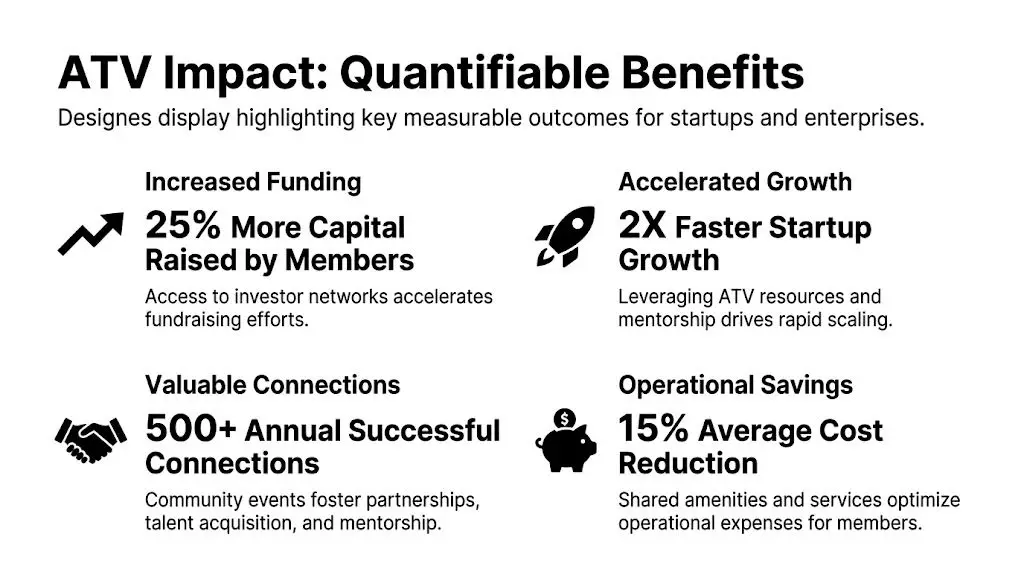
ATV's ecosystem has helped over 300 alumni startups secure $826 million in funding and create over 6,000 jobs, with infrastructure that enables 20-30% faster customer acquisition through networking, according to Atlanta Tech Hub's organizational profile of Atlanta Tech Village.
What those results actually mean
Funding and job creation are the visible outcomes. Customer acquisition speed may be even more revealing.
When a company acquires customers faster through network effects, that usually means the ecosystem is helping with trust, introductions, market feedback, or referrals. In other words, the community isn't just supportive. It's commercially useful.
For larger enterprises, the value can look different:
- access to emerging companies
- visibility into local innovation
- partnership opportunities with specialized vendors
- easier engagement with startup talent
How to read the business case
These numbers don't mean every company inside ATV succeeds. They do show that the environment improves the odds of useful business outcomes for many firms.
A practical consideration is this:
| Business need | How ATV can help |
|---|---|
| Raise capital | Proximity to investors and pitch ecosystems |
| Find customers | Warm introductions and community referrals |
| Recruit talent | Access to Atlanta's startup and tech network |
| Build partnerships | Shared location with complementary companies |
Teams exploring investor mapping can also use outside resources like Top Information Technology investors in the United States to understand the broader funding environment beyond local introductions.
For businesses managing the full hardware lifecycle, reuse also matters. Equipment that still has value shouldn't automatically become scrap. A strategy around Atlanta technology reuse can support both value recovery and cleaner asset tracking.
The strongest proof of a tech hub is not foot traffic. It's whether companies inside it close deals, raise capital, hire talent, and keep moving.
Secure IT Asset Disposition for ATV Members
A founder at Atlanta Tech Village replaces 25 employee laptops after a hiring sprint. The old machines still hold customer emails, product roadmaps, saved credentials, and browser sessions. If those devices end up in a closet with no inventory record, the company has not finished the upgrade. It has created a security and compliance problem.
That is why IT asset disposition deserves a place in the operating playbook for ATV members. Growth changes hardware fast. Teams add staff, swap devices, retire phones, replace networking gear, and clear out test equipment. Each item may look like scrap. In practice, it is more like a file cabinet that can still contain sensitive business records.
Why this issue shows up earlier than many founders expect
Early-stage companies often assign clear owners for product, finance, and recruiting. Retired hardware falls into a gap between IT, operations, and office management. A broken laptop gets shelved. Old drives stay in a drawer. Demo units from a trade show sit in storage after the next office move.
Small oversights add up.
The business risks are straightforward:
- Data exposure: laptops, SSDs, phones, and backup media can still hold customer, employee, financial, or source-code data
- Compliance gaps: regulated information needs documented handling and destruction procedures
- Inventory confusion: untracked devices make audits, moves, and refresh cycles harder to manage
- E-waste problems: electronics need proper downstream recycling, reuse, or remarketing
What good ITAD looks like for a scaling company
A sound process starts with ownership. Someone needs authority to decide when equipment leaves service, how it is recorded, who approves pickup, and what proof the company receives afterward.
From there, the workflow should cover five parts: asset inventory, secure collection, data destruction, chain-of-custody documentation, and final disposition through recycling or reuse. That sequence works like a custody log for physical evidence. If one step is missing, confidence in the whole process drops.
For teams comparing local options, Atlanta IT asset disposition services offer a practical example of how companies structure pickups, serialized tracking, data destruction, and recycling records.
Retired hardware remains a business responsibility until the company can show where it went, how data was destroyed, and who handled it.
Why this belongs in the ATV conversation
Atlanta Tech Village is built to help companies grow. Growth also increases device turnover, offboarding activity, and the volume of equipment that reaches end of life. That operational reality rarely appears in startup headlines, but it affects security posture, office efficiency, and compliance readiness.
For ATV members, disciplined disposal is not just an IT housekeeping task. It supports due diligence during fundraising, cleaner employee offboarding, better audit trails, and more responsible e-waste handling. Founders who treat IT lifecycle management as part of scaling usually face fewer surprises later.
Conclusion Building the Future Responsibly
Atlanta Tech Village has earned its place in Atlanta's business environment by combining founder density, thoughtful infrastructure, and a community designed to connect people with talent, ideas, and capital. Its history shows real economic impact. Its building design supports daily execution. Its event culture helps companies build momentum.
But fast growth creates practical obligations. Teams still need to manage retired laptops, storage devices, networking gear, and other electronics with care. Innovation works best when operations stay disciplined.
Companies in Georgia that want a more sustainable approach to technology end-of-life planning can also explore broader circular thinking through circular economy electronics in Georgia.
If your organization needs certified electronics recycling, secure data destruction, IT asset disposition, product destruction, or data center decommissioning, contact Beyond Surplus. They help businesses manage end-of-life technology securely, document the chain of custody, and keep growth aligned with compliance and sustainability.